

2025-108 California Community Colleges Reserve Funds
August 6, 2026
2025‑108
The Governor of California
President pro Tempore of the Senate
Speaker of the Assembly
State Capitol
Sacramento, California 95814
Dear Governor and Legislative Leaders:
As directed by the Joint Legislative Audit Committee, my office conducted an audit of the California Community Colleges (CCC) Chancellor’s Office (Chancellor’s Office) and a selection of six of the CCC’s 73 districts. Our assessment focused on the Chancellor’s Office’s oversight of districts’ unrestricted general fund reserves, and the following report details the audit’s findings and conclusions. In general, we determined that several districts did not have adequate reserve policies and had reserves that had grown to be in excess of their own reserve policies or the statewide median for all college districts. Further, the Chancellor’s Office did not sufficiently oversee the financial condition of the districts we reviewed.
My office determined that reserve levels for five of the six districts increased during the past seven years. As of the end of fiscal year 2024–25, four districts maintained reserves in excess of their reserve goals, or the statewide median in the absence of such goals. Only three of the six districts established maximum reserve policies or procedures, and two of them exceeded even those maximum levels. None of the districts with high reserve balances have formal plans to spend the funding to support student outcomes.
Although maintaining sufficient funding in reserve is important for districts’ fiscal health, when districts accumulate reserves beyond their needs, they miss opportunities to spend on programs to better support students. We found that opportunities exist for these districts to use the excess reserves to improve student and system outcomes. Further, none of the districts have conducted risk analyses consistent with recommended best practices to determine their reserve needs. My office also determined that the Chancellor’s Office did not provide sufficient oversight for districts’ reserves, nor did it monitor the appropriateness of districts’ policies or their plans to reduce excess reserves.
Respectfully submitted,
GRANT PARKS
California State Auditor
Selected Acronyms Used in This Report
| BAM | Budget and Accounting Manual |
| CCC | California Community Colleges |
| GASB | Governmental Accounting Standards Board |
| GFOA | Government Finance Officers Association |
| SCFF | Student-Centered Funding Formula |
Summary
Key Findings and Recommendations
Districts in the California Community Colleges (CCC) system routinely save excess revenue they have earned or received—referred to as reserves in this report. They may do this for various purposes, such as to maintain cash flow, respond to significant unplanned costs or future revenue losses like those incurred from a natural disaster or a recession, or make large, nonrecurring planned purchases of land and buildings. Government accounting standards direct districts to develop adequate reserve policies and maintain sufficient reserves. The six districts we reviewed—Antelope Valley Community College District (Antelope Valley), Butte‑Glenn Community College District (Butte), Calbright Online Community College (Calbright), Kern Community College District (Kern), Mt. San Jacinto Community College District (Mt. San Jacinto), and San Francisco Community College District (San Francisco)—have set minimum reserve policies, but not all had maximum reserve policies. Further, four districts maintained higher reserves than their own maximum reserve policy or statewide median reserve level, with three having significantly high reserves. Districts with high reserves did not take steps to spend them, despite opportunities to use those funds to improve student success and support services. Further, none of the districts have conducted risk analyses when determining the reserve levels they need. The CCC Chancellor’s Office (Chancellor’s Office) has not taken any action to ensure that districts develop such risk‑based policies and that they spend excess reserves.
Reserve levels have increased from fiscal years 2018–19 through 2024–25 for Antelope Valley, Butte, Kern, Mt. San Jacinto, and San Francisco. As of the end of fiscal year 2024–25, Antelope Valley, Kern, and Mt. San Jacinto maintained reserves that were at least double the maximum level described in their reserve policy or the statewide median of three months. Although these districts have expressed some ideas on how they expect to reduce excess amounts, such as spending on new IT infrastructure or new construction projects, none of them have established formal spending plans. We have identified key areas, including those related to student outcomes, student support, and number of full‑time faculty, where districts could improve through additional spending.
The Government Finance Officers Association (GFOA) recommends that districts develop adequate reserve policies and ensure that they maintain sufficient reserves. All six districts we reviewed had set minimum reserve policies ranging from 5 percent to 20 percent of their respective total general fund expenditures, while only three districts—Butte, Kern, and San Francisco—have established policies or procedures for a maximum level of reserves they should maintain. However, none of the six districts could demonstrate that they conducted risk analyses when determining the reserves they need, which may result in inadequate or excessive accumulated reserves at the cost of districts’ ability to respond to unexpected costs or support students and ensure their success. Further, although all six districts projected an increase in their reserves at the end of fiscal year 2025–26, we projected higher reserves. We also found that four districts did not budget all available funds that exceeded their reserve goals. By not budgeting all available funds that exceed their reserve needs, districts may be missing opportunities to improve student outcomes.
State law requires the Chancellor’s Office to monitor districts’ financial reporting and to evaluate the risks of a district needing follow‑up intervention if it is not in compliance with the principles of sound fiscal management, including maintaining adequate reserves. However, the Chancellor’s Office did not accurately calculate districts’ reserves in accordance with its fiscal policy. It also did not monitor districts’ reserve policies for appropriateness, nor did it review their plans to spend any excess reserves. Further, the Chancellor’s Office lacked accurate information to assess whether districts maintained adequate reserves, because it did not verify the data that districts submitted to it. The Chancellor’s Office did not communicate its expectation that districts should update previously submitted data for corrections, resulting in multiple inaccuracies and inconsistencies.
As part of our audit, we also reviewed districts’ other governmental funds and found that most districts obtained appropriate board authorization for larger projects before moving financial resources from the general fund to other governmental funds. Further, we reviewed districts’ credit ratings and determined that although the reserves, among many other factors, can affect districts’ credit ratings, we did not see any evidence for the districts we reviewed that high reserves significantly affected their credit rating.
To address these findings, we recommend that the Legislature direct districts to disclose reserve amounts in their budgets and the reasons for falling short of or exceeding the recommended levels. We further recommend that the Chancellor’s Office develop policies and procedures for monitoring districts’ financial reporting. The Chancellor’s Office should also improve its process for calculating districts’ reserves, enhance its monitoring of districts’ reserve levels, and require districts to establish risk‑based reserve policies and plans to spend excess reserves to improve student support and outcomes.
Agency Comments
The Chancellor’s Office agreed with our findings and stated that it will implement our recommendations. Although we did not make any recommendations to the districts we reviewed, Antelope Valley provided a response stating that it disagreed with our conclusions in a few areas.
Introduction
Background
The CCC system—comprising 116 colleges across 73 districts—is the largest system of higher education in the nation. The system is open to all Californians with a high school diploma or equivalent and currently serves 2.2 million students. California’s community colleges play a key role in helping students increase their employability and achieve their individual potential. According to the Chancellor’s Office, for every dollar the State invests in the CCC system, students gain about $13 in lifetime earnings and society gains $14 in added income and social savings.
An 18‑member Board of Governors (CCC Board of Governors) oversees the CCC. It appoints the Chancellor, who acts as the systemwide chief executive officer. State law requires the CCC Board of Governors to develop and implement a comprehensive community college educational and fiscal accountability system that is designed to promote student success in community colleges and measures, among other things, the fiscal conditions of districts. Under state law, each district is responsible for its ongoing fiscal stability through the responsible stewardship of available resources, including maintenance of adequate reserves. State law also requires the Chancellor’s Office to monitor districts’ budget reporting and other fiscal practices.
California Community College Districts’ Funding Models
The State adopted the Student‑Centered Funding Formula (SCFF) in fiscal year 2018–19 to change the funding structure of districts. According to the fiscal year 2018–19 state budget summary, the previous funding model was primarily based on the number of students enrolled at a particular point in time, which was not the most effective way for community colleges to reach their student success goals and close the achievement gap. SCFF provides funding to districts according to additional factors, including the number of low‑income students enrolled and the number of students who meet specified student success metrics, including completion of a degree or certificate. Since the adoption of SCFF and as of fiscal year 2021–22, the overall funding across all districts statewide increased by $650 million, or 9 percent, compared to the old funding model. Unlike other districts, Calbright currently receives funding through an annual appropriation of $15 million from the State’s budget instead of SCFF.
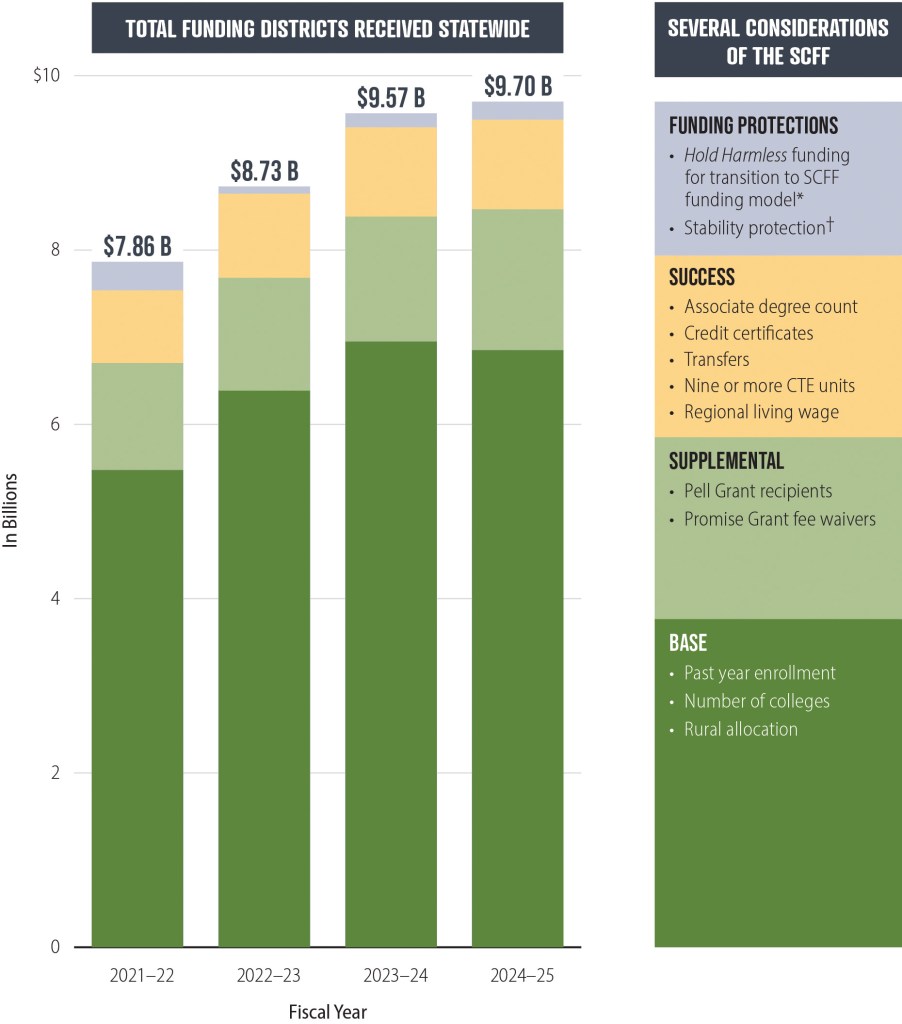
Beyond base, supplemental, and success funding, as Figure 1 shows, some districts receive additional funding through funding protections. These began as hold harmless provisions, which set a minimum funding level for districts based on fiscal year 2017–18 funding. As of fiscal year 2025–26, the minimum funding protection has been updated and currently uses fiscal year 2024–25 enrollment as a baseline for calculating the funding amount. Some districts receive a different funding protection, referred to as stability protection, that allows the district to receive its SCFF calculated amount in the previous year adjusted for cost of living. These protections are meant to establish predictability, so community college districts may more readily plan and implement instruction and programs by providing them with baseline funding.
Figure 1
Districts Receive Funding According to the Student-Centered Funding Formula
Source: Chancellor’s Office Student-Centered Funding Formula Dashboard.
Note: The table as presented shows a simplified selection of some of the larger considerations.
* Hold Harmless refers to a funding protection for districts as they adapt to the new SCFF funding model. These were based on fiscal year 2017–18 funding levels plus a cost-of-living adjustment (COLA) until fiscal year 2025–26, when the formula switched to base year 2024–25 with no COLA.
† The stability protection allows a district to receive its SCFF‑calculated amount in the previous year adjusted for COLA. Districts are funded according to stability if the associated funding exceeds both their SCFF‑calculated amount for that year and their hold harmless amount.
Figure 1 presents the total funding amount districts received statewide through the student-centered funding formula from fiscal year 2021-22 through 2024-25. Districts received $7.86 billion in fiscal year 2021-22, $8.73 billion in fiscal year 2022-23, $9.57 billion in fiscal year 2023-24, and $9.70 billion in fiscal year 2024-25. The graphic also provides a selection of larger considerations of the student-centered funding formula and examples of these larger considerations. Specifically, the districts’ allocation through student-centered funding formula is comprised of base, success, and supplemental funding, as well as funding protections. Example of the base funding considerations include past year enrollment, number of colleges, and rural allocation; supplemental funding includes Pell Grant recipients and Promise Grant fee waivers; success funding includes associate degree count, credit certificates, transfers, nine or more CTE units, and regional living wage; funding protections include Hold Harmless funding for transition to SCFF funding model and stability protection.
Guidance for Managing Reserves
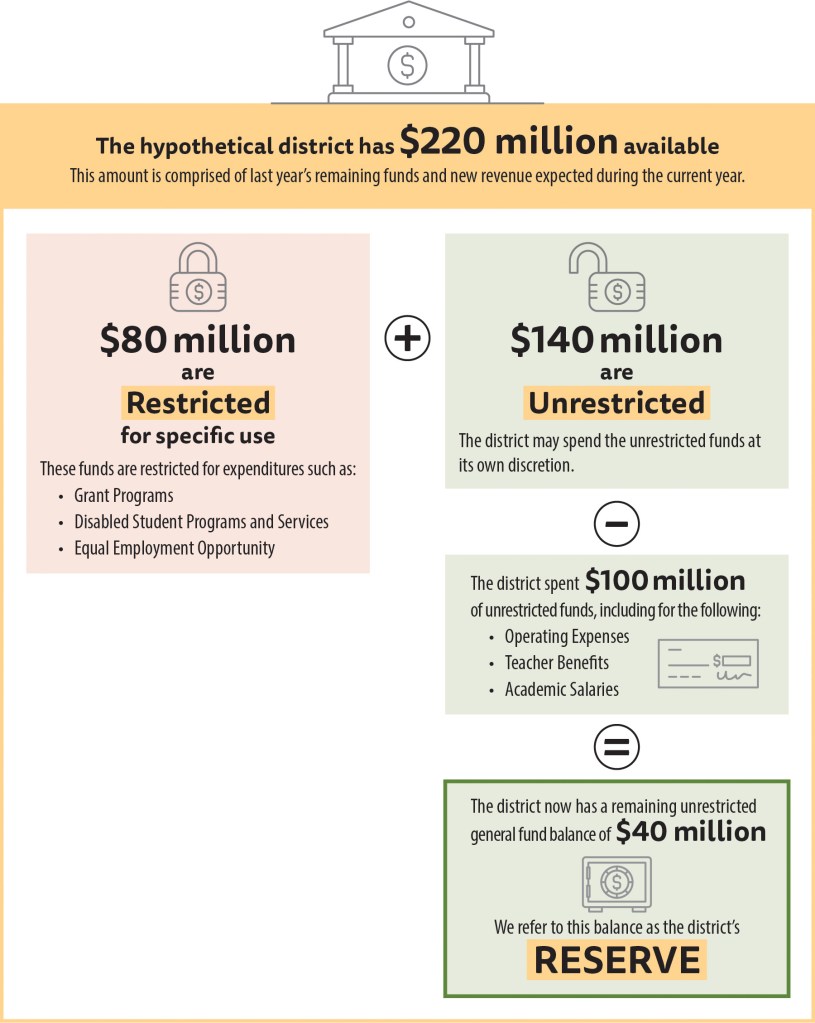
Each district may set aside a portion of its financial resources that it does not include in its annual spending plan. As Figure 2 shows, a district’s total financial resources are generally comprised of restricted and unrestricted funds. Restricted funds are amounts that a district has available and that it is required to spend for a specific use, such as grant programs, programs for disabled students, or equal employment opportunity programs. In contrast, a district can use unrestricted funds for other purposes, including to pay for teacher benefits, academic salaries, or other operating expenses. In this report, we use the term reserve to refer to a district’s unspent balance of available unrestricted funding that it can use for various purposes, including to maintain cash flow, respond to significant unplanned costs or revenue losses such as a natural disaster or a recession, or to make large, nonrecurring planned purchases, such as land or buildings. The Chancellor’s Office provides districts with general guidance for managing reserves in its Budget and Accounting Manual (BAM) and other fiscal policies. In addition, districts must follow the criteria from the Governmental Accounting Standards Board (GASB), which issues accounting and financial reporting standards, and may follow guidance from the GFOA, which provides budgeting best practices for state and local governments.
Figure 2
We Refer to a District’s Unspent Balance of Available Unrestricted Funding as Its Reserve
Source: Districts’ budget documentation and the Chancellor’s Office’s guidance.
Figure 2 presents a hypothetical district that has $220 million funding available, which is comprised of last year’s remaining funds and new revenue expected during the current year. Of this $220 million, $80 million are restricted for specific use, such as grant programs and disabled student programs and services, and the remaining $140 million are unrestricted which the district may spend at its own distraction. The district spent $100 million of the $140 million unrestricted funds on expenditures like operating expenses, teacher benefits, and academic salaries. At the end of the fiscal year the district has a remaining unrestricted general fund balance of $40 million. We refer to this balance as the district’s reserve.
Governmental Accounting Standards Board
According to the GASB, governmental entities should organize and operate their accounting systems by using separate funds, such as governmental, proprietary, and fiduciary funds. The GASB advises governmental entities to segregate these funds for the purpose of carrying on specific activities or attaining certain objectives in accordance with special regulations, restrictions, or limitations. Governmental funds include the general fund, special revenue fund, capital projects fund, debt services fund, and other permanent funds.
The GASB’s standards are intended to promote financial reporting that provides useful information to taxpayers, public officials, investors, and others who rely on financial reports. The GASB requires entities to classify governmental fund balances as restricted—constrained by external legal requirements, such as legislation or grants—or unrestricted, which the entity can use at its discretion. For governmental funds, the GASB requires government entities to report fund balances in five classifications, which the text box lists. The GASB designates committed, assigned, and unassigned classifications as unrestricted. In this report, we define each district’s unrestricted resources in its general fund as reserves.
Fund Balance Classifications
Nonspendable: Funds that are not in spendable form, such as inventories, or legally or contractually required to be retained in perpetuity.
Restricted: Funds with constraints externally imposed by creditors, grantors, contributors, or legislation.
Committed: Funds the district’s board formally designates for a specific purpose.
Assigned: Funds a district’s board, committee, or authorized official has designated for an intended purpose.
Unassigned: Residual classification of general fund balance that has not been assigned to other funds and is not restricted, committed, or assigned to a specific purpose within the general fund.
Source: GASB.
Government Finance Officers Association
The GFOA distinguishes between two related but different financial concepts: fund balance is an accounting term that describes the difference between a government’s assets and liabilities, while reserve is a budget and policy term that describes the resources a government holds outside the budget for use when designated resources are insufficient. The GFOA recommends that government entities, including community colleges, establish comprehensive reserve policies that identify minimum and maximum reserve amounts and specify when and for what purposes reserves may be spent. At a minimum, the GFOA recommends that agencies maintain a reserve of no less than two months, which equals about 17 percent of regular annual general fund operating revenue or expenditures. The GFOA further recommends that districts conduct a risk analysis to assess their risk exposures and determine a reserve level that is sufficient to accommodate those risks. Risks could include events that disrupt cash flow or cause revenue instability, natural disasters and other hazardous events, or public health and safety risks.
The Chancellor’s Office
The Chancellor’s Office defines reserves as an amount set aside to provide for estimated future expenditures or losses, for working capital, or for other specific purposes. In February 2022, the Chancellor’s Office recommended that districts adopt policies and practices consistent with the GFOA’s budgeting best practices and that districts maintain sufficient unrestricted reserves with a suggested minimum of two months of total general fund operating expenditures. However, the Chancellor’s Office does not require districts to separately disclose in their budgets the amount of the unrestricted general fund balance that districts’ own reserve policies require them to maintain. The districts we reviewed have commingled the reserves they needed to maintain as part of their total unrestricted resources, and districts’ budget documents do not identify specific reserve amounts. Therefore, aligning with the GFOA’s and the Chancellor’s Office’s guidance, we calculated each district’s reserve level as its unrestricted general fund balance divided by its total general fund operating expenditures. The text box shows how we calculated the reserve level expressed as a percentage and as a number of months of reserves.
Calculating Reserve Level as Months of Reserves
(Unrestricted general fund balance / Total general fund operating expenditures) X 100
=
Reserves as a percentage of annual operating expenditures X 12 months
=
Months of reserves
Example:
($1,000,000 unrestricted fund balance / $5,000,000 annual operating expenditures) X 100
=
20 percent unrestricted reserves X 12 months
=
2.4 months of reserves
Source: Auditor’s analysis of the GFOA’s and the Chancellor’s Office’s guidance.
The Chancellor’s Office’s Role in Overseeing Districts’ Reserves
Following state law, the Chancellor’s Office requires the districts to report financial information to it quarterly and annually. The Fiscal Portal Annual Financial and Budget Report (annual fiscal report) includes a statement of the actual revenue and expenditures for the most recently completed fiscal year and the estimated revenue and proposed expenditures for the following fiscal year. State law requires the Chancellor’s Office to evaluate, through review and analysis of districts’ financial reports, whether a follow‑up or an intervention is needed. Intervention may be necessary if a district needs an emergency apportionment—financing provided to a community college district as authorized by the Legislature—within three years or if a district is not in compliance with the principles of sound fiscal management, including maintaining adequate reserves and implementing and maintaining effective fiscal policies and processes.
Further, state law provides that the follow‑up or intervention conducted by the Chancellor’s Office may include requiring the submission of additional or more frequent reports, requiring the district to respond to specific concerns, or directing the district to prepare and adopt a detailed fiscal plan and to demonstrate the impact of the fiscal plan on the district’s educational program. According to state law, when the Chancellor’s Office determines that a district’s plans are inadequate to implement the principles of sound fiscal management, the Chancellor’s Office may require changes to the district’s fiscal and educational plans. In more serious cases, it may appoint a special trustee or fiscal monitor to support the district’s management team or assume management responsibilities over the district.
Audited Financial Statements
State law requires that independent certified public accountants perform annual audits of districts’ financial records (audited financial statements). The GASB identifies governmental activities as those that are generally financed through taxes, and business‑type activities as those financed in whole or in part by fees charged to external parties for goods or services, such as tuition, bookstore sales, or cafeteria sales. According to the GASB, public colleges that have both governmental and business‑type activities, such as the districts we reviewed, should provide fund financial statements for both types of activities, as well as government‑wide financial statements. Fund financial statements present revenue, expenditures, and changes in fund balances, including reserved and unreserved categories, for each of the districts’ major funds. Although government‑wide financial statements provide an aggregate statement of all governmental assets, liabilities, revenue, expenses, and gains and losses, presenting that information alone makes it difficult for users to assess accountability of individual funds. However, the Chancellor’s Office adopted and recommended that districts adopt a business‑type activities only reporting model, with fund financial statements for governmental activities being optional. The six districts we reviewed mostly elected to report only business‑type activities in their audited financial statements throughout our audit period. Thus, the majority of the audited financial statements of the districts we reviewed do not separately present each governmental fund balance, classifications of those fund balances as restricted or unrestricted, or the expenditures for each governmental fund, including the general fund.
Selection of Districts
The Joint Legislative Audit Committee (Audit Committee) requested that we select up to five districts for this audit, in addition to Calbright. Calbright was established in 2018 as an online community college district. It first began enrolling students in Fall 2019 and, rather than providing duplicate services to local community colleges, such as associate degrees or certificates, Calbright focuses on providing industry‑valued credentials and certifications such as project management, human resources talent acquisition, and medical coding. We selected the other five districts based on their reserve levels, geographic location, and size. Our selection includes Antelope Valley, Butte, Kern, Mt. San Jacinto, and San Francisco.
Audit Results
Increases in Districts’ Reserves Present Opportunities for Improving Student and System Outcomes
Key Points
- Reserves for five of the six California Community Colleges (CCC) districts we reviewed increased from fiscal years 2018–19 through 2024–25, driven primarily by increased revenue rather than reduced expenditures. Four of these districts—Antelope Valley Community College District (Antelope Valley), Kern Community College District (Kern), Mt. San Jacinto Community College District (Mt. San Jacinto), and San Francisco Community College District (San Francisco)—maintained reserves that were at least double their own policy maximum or the statewide median reserves as of the end of fiscal year 2024–25, with three having significantly high reserves.
- Although districts have some ideas about how they expect to spend excess reserves, none of the districts with high reserves have established formal plans to spend them. These districts gave various reasons for not developing spending plans. Districts shared some broad ideas of where they intend to spend the excess reserves, but they have not clearly disclosed these ideas to the public. These districts maintained high reserves without a formalized plan for the past seven years.
- Although districts have internal processes to identify districtwide student needs and allocate additional funding, districts still retained significant amounts of unused reserves. We identified areas related to student success and support that districts could improve by spending their excess reserves.
Reserve Levels for Five of the Six Districts We Reviewed Increased During the Past Seven Years
Although both the CCC Chancellor’s Office (Chancellor’s Office) and the Government Finance Officers Association (GFOA) recommend that governmental entities maintain a minimum reserve in their general fund in an amount equal to two months, or 17 percent, of their general fund expenditures, each entity’s specific financial condition should guide its reserve needs. Therefore, the GFOA recommends that governmental entities establish reserve policies to specify the minimum and maximum reserve amounts to meet their needs. Each of the six districts we reviewed has developed a reserve policy that requires minimum general fund reserves of 5 percent to 20 percent. However, only three districts—Butte‑Glenn Community College District (Butte), Kern, and San Francisco—have established maximum reserve policies or procedures, with Butte and Kern each targeting reserves of up to 25 percent and San Francisco requiring up to 9 percent.
To assess districts’ reserves, we used fiscal data that districts reported to the Chancellor’s Office each year. Districts’ audited financial reports generally do not present reserves or expenditures separately by fund type, which our analysis required. Although the Chancellor’s Office does not verify the districts’ self‑reported fiscal data and they therefore may contain some inaccuracies, we determined that they remain the best source available for calculating and assessing districts’ reserves. Using these data, we calculated each district’s reserve as a percentage of total general fund expenditures.
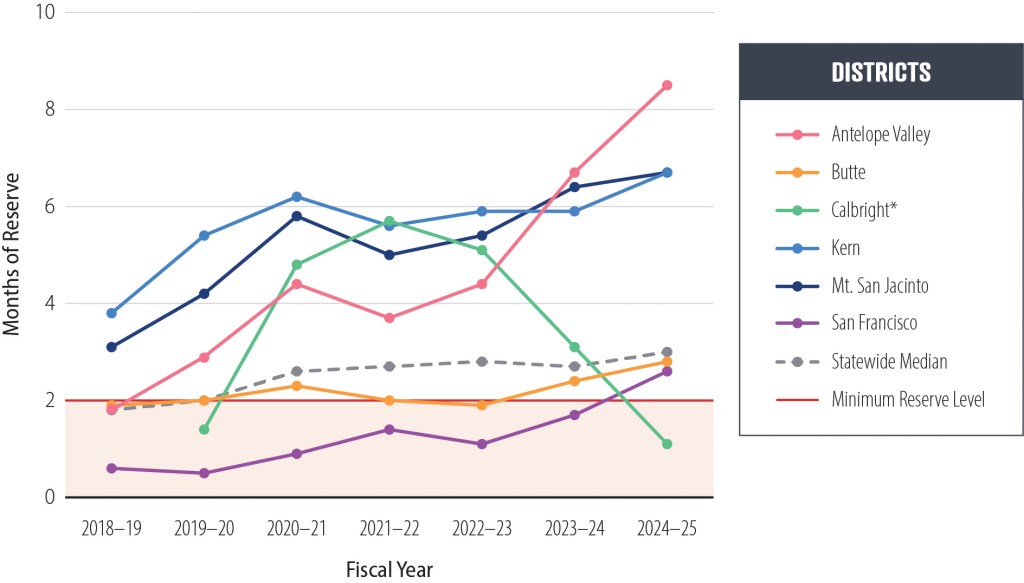
The reserves for five of the six districts we reviewed increased from fiscal years 2018–19 through 2024–25, as Figure 3 shows. Although these districts have accumulated additional funds, they have not yet used them for student and system needs. Antelope Valley experienced the biggest change with its reserves increasing from 15 percent (about two months) of annual general fund expenditures at the end of fiscal year 2018–19 to 71 percent (more than eight months) by the end of fiscal year 2024–25. Kern’s reserves increased from 32 percent (about four months) of annual operating expenditures during the same period, and Mt. San Jacinto’s went from 26 percent (about three months) to 56 percent (nearly seven months). In contrast, Calbright Online Community College (Calbright), which became operational in fiscal year 2018–19, experienced a decrease in its reserve, ending fiscal year 2024–25 with 9 percent or about one month of expenditures. However, Calbright’s financial activity was different from the other districts in that Calbright explained that it spent amounts from its balance during its start‑up phase to support initial operations, which contributed to the overall decrease in its reserves.
Figure 3
Most Districts Increased Their Reserve Levels From Fiscal Years 2018–19 Through 2024–25
Source: Auditor’s analysis of data from the Chancellor’s Office’s Fiscal Portal.
Note: The GFOA recommended that districts maintain a minimum of two months, or about 17 percent, of annual general fund operating expenditures as reserves throughout our audit period, and the Chancellor’s Office aligned its recommendation to this standard in 2022.
* Calbright’s fiscal year 2018–19 unrestricted general fund balance is an outlier because of its formation the same year, when it received a start‑up allocation, most of which it did not use. We did not include that year in our analysis.
Figure 3 shows the months of reserves for the six selected districts from fiscal year 2018-19 through fiscal year 2024-25. It further compares them to the statewide median and the minimum recommended reserve of two months for the same period. The line graph shows that five of the six districts—Antelope Valley, Butte, Kern, Mt. San Jacinto, and San Francisco—increased their reserve levels over time. Four of those districts— Antelope Valley, Butte, Kern, and Mt. San Jacinto—maintained the reserves above the recommended two months. Antelope Valley, Kern and Mt. San Jacinto significantly exceeded the statewide median reserve level for most of the audit period. San Francisco’s reserve remained below the recommended two months and the statewide median for most of the audit period and only in fiscal year 2024-25 it was above the recommended two months. Calbright initially increased its reserve from less than two months in fiscal year 2019-20 to about six months in fiscal year 2021-22 but decreased it to around one month by fiscal year 2024-25 which is below the recommended minimum reserve of two months.
Of the three districts that have established maximum reserve policies or procedures, two—Kern and San Francisco—exceeded those maximum levels by more than double at the end of fiscal year 2024–25. Kern ended the year with a reserve that was 56 percent, or more than six months, of its annual general fund expenditure, more than twice the 25 percent stipulated in its maximum reserve policy. Similarly, San Francisco’s reserve was equivalent to 22 percent of its general fund expenditures, which was more than twice the 9 percent set in its maximum reserve policy. Although San Francisco’s reserve was below the statewide median, it nonetheless exceeded the maximum that its own board established by a substantial amount. Butte was the only district with a reserve that remained below its 25 percent maximum throughout our audit period, reaching a peak of 23 percent in fiscal year 2024–25. We discuss the adequacy of districts’ reserve policies in a later section.
Because Antelope Valley, Calbright, and Mt. San Jacinto have not defined a maximum limit of reserves in their policies, we compared their reserves at the end of fiscal year 2024–25 to the statewide median as a proxy to assess their reasonableness. The statewide median reserve as a percentage of annual general fund operating expenditures at the end of fiscal year 2024–25 was about 25 percent, or three months for all 73 community college districts, as Appendix A shows. However, reserves for Antelope Valley and Mt. San Jacinto at the end of fiscal year 2024–25 exceeded the statewide median by at least three months. Antelope Valley maintained a reserve equal to 71 percent, or more than eight months, and Mt. San Jacinto maintained 56 percent, or nearly seven months, of their respective general fund expenditures. When districts accumulate higher reserves than what they need to maintain fiscal stability, they are not using additional funding to further support student success.
The five districts—Antelope Valley, Butte, Kern, Mt. San Jacinto, and San Francisco—whose reserves increased from fiscal years 2018–19 through 2024–25, attributed those increases to additional revenue they received during those years. The districts told us that the additional revenue primarily came from a change in the State’s funding formula, as well as COVID‑19 pandemic relief funding and other temporary state and federal revenue. Mt. San Jacinto identified the revisions to the Student‑Centered Funding Formula (SCFF) as a significant factor in its revenue growth. Antelope Valley stated that it received a COVID‑19 emergency conditions allowance, which held its funded enrollment at a prior‑year level in SCFF so that it would not lose apportionment as enrollment declined. It continued receiving funding based on its fiscal year 2018–19 enrollment of approximately 11,000 full‑time equivalent students, even after its enrollment declined to approximately 8,000 in subsequent years. Although fiscal year 2022–23 was the last year for districts to receive the emergency conditions allowance, districts are still eligible for other statutory protections for their SCFF funding, such as the hold harmless provisions or stability protections, which the Introduction describes. In fact, Antelope Valley’s SCFF apportionment increased by about $18 million, or about 17 percent between fiscal years 2021–22 and 2024–25. Similarly, Kern’s SCFF funding increased by about $75 million, or 30 percent, and Mt. San Jacinto’s SCFF funding increased by about $31 million, or 26 percent. The increases in districts’ ongoing state funding opens opportunities for them to increase their spending on additional programs to better support students.
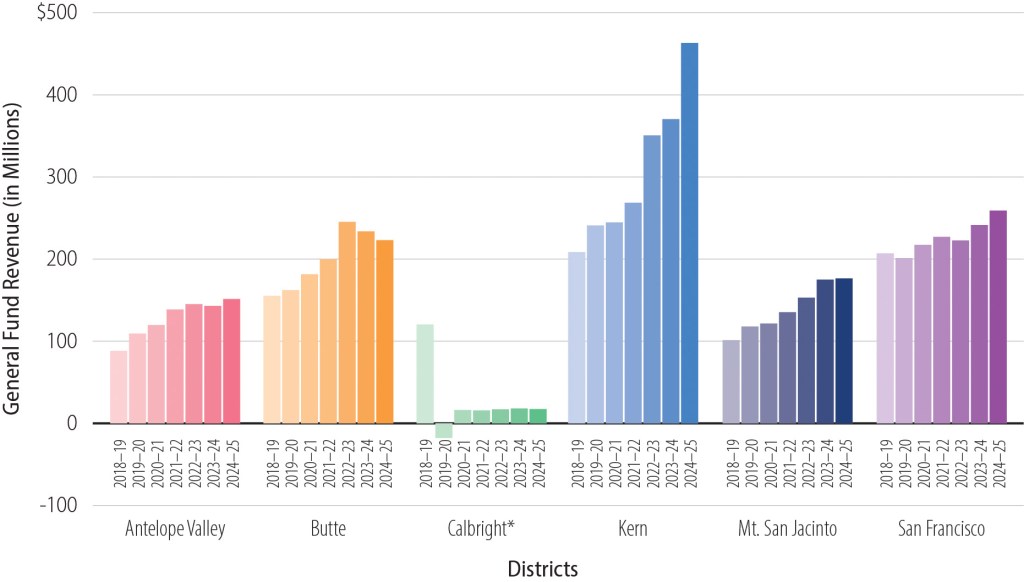
Our review of these five districts’ financial records found that their general fund revenue also increased from fiscal years 2018–19 through 2024–25, ranging from 25 percent to nearly 125 percent. Kern experienced the largest revenue increase, from about $208 million in fiscal year 2018–19 to about $463 million in fiscal year 2024–25, as Figure 4 shows. Only Calbright had a reduction in revenue, decreasing from $120 million in fiscal year 2018–19 to about $17 million in 2024–25. Calbright’s founding legislation provided one‑time start‑up funding, and the higher fiscal year 2018–19 revenue reflected the receipt of this start‑up funding. Calbright does not receive funding through SCFF but instead receives annual appropriation from the State’s budget. Calbright was also the only district that had a lower reserve at the end of fiscal year 2024–25 than it did at the end of fiscal year 2018–19.
Figure 4
General Fund Revenue Increased for Five of Six Districts From Fiscal Years 2018–19 Through 2024–25
Source: Auditor’s analysis of data from the Chancellor’s Office’s Fiscal Portal.
* Unlike the other districts, Calbright currently does not receive funding through SCFF and instead receives an annual appropriation.
Figure 4 shows that between fiscal years 2018-19 and 2024-25 the general fund revenue increased for five of the six districts we reviewed, including Antelope Valley, Butte, Kern, Mt. San Jacinto, and San Francisco. Kern had the largest increase with its revenue going from around $200 million in fiscal year 2018-19 to more than $450 million in fiscal year 2024-25. Antelope Valley’s revenue went from less than $100 million to around $150 million; Butte’s went from around $150 million to more than $200 million; Mt. San Jacinto’s went from around $100 million to around $190 million; and San Francisco’s went from around $200 million to around $250 million. Unlike the other districts, Calbright currently does not receive funding through student-centered funding formula and instead receives an annual appropriation of $15 million.
The districts did not reduce their overall spending to achieve higher reserves during the years we reviewed. As Figure 5 shows, these districts’ expenditures generally increased during the years we reviewed. For example, Kern’s expenditures grew from about $202 million in fiscal year 2018–19 to about $375 million in fiscal year 2024–25, an increase of 86 percent. Mt. San Jacinto’s expenditures grew from about $97 million in fiscal year 2018–19 to about $144 million in fiscal year 2024–25, an increase of almost 49 percent. San Francisco’s expenditures, on the other hand, were virtually the same in fiscal year 2024–25 as they were in fiscal year 2018–19. Several districts explained that although overall their expenditures increased, they experienced challenges that limited their ability to fully spend the budgeted amounts. For example, Antelope Valley, Kern, and Mt. San Jacinto identified hiring challenges, including limited applicant pools for academic and classified positions, that prevented them from filling vacant positions. Although these districts’ expenditures did not grow at the same rate as their revenue, the increases in expenditures indicate that it was not by reducing spending on educational programs or student services that districts allowed reserves to grow.
Figure 5
Five of Six Districts’ Expenditures Increased From Fiscal Years 2018–19 Through 2024–25
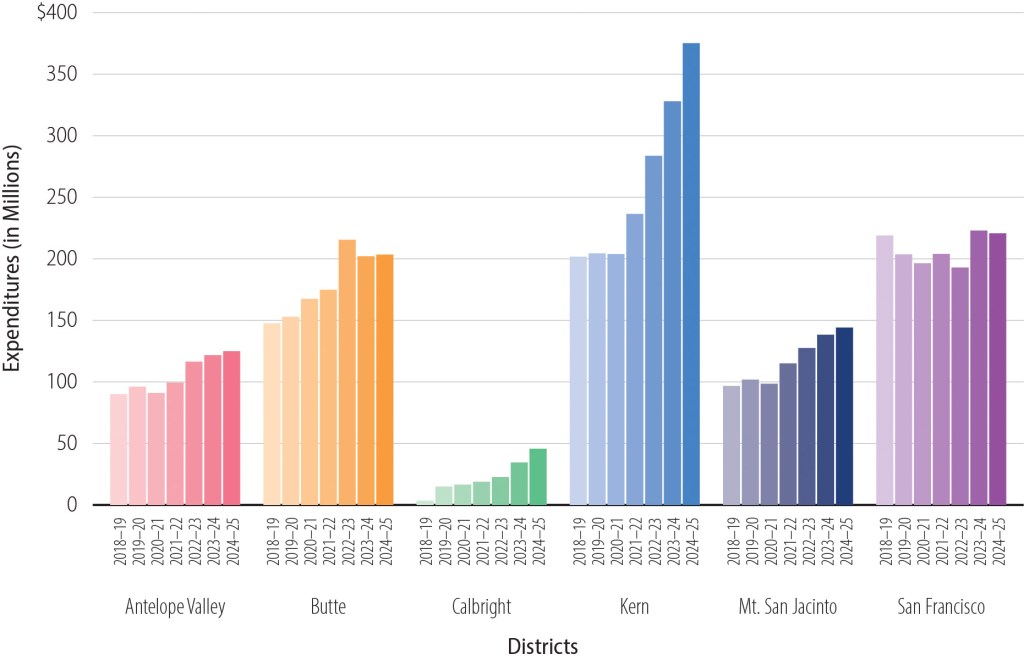
Source: Auditor’s analysis of data from the Chancellor’s Office’s Fiscal Portal.
Figure 5 shows that between fiscal years 2018-19 and 2024-25 the general fund revenue increased for five of the six districts we reviewed, including Antelope Valley, Butte, Calbright, Kern, and Mt. San Jacinto. Antelope Valley’s expenditures went from less than $100 million to around $130 million; Butte’s went from around $150 million to around $200 million; Calbright’s went from around $3 million to around $45 million; Kern’s went from around $200 million to around $380 million; and Mt. San Jacinto’s went from around $100 million to around $150 million. San Francisco’s expenditures remained relatively consistent at around $220 million over the same period.
Some Districts With Excess Reserves Do Not Have Formal Plans to Spend Them
Because some districts had higher reserves than the state median or than their own reserve policies allow, we expected them to have formalized plans that outline how those excess reserves would be spent to improve student outcomes. We considered a plan to be formalized if a district demonstrated that it developed its plan in coordination with its board and consistently provided the board with timely updates on the plan. According to the GFOA, districts’ planning and budgeting processes should include identifying instructional priorities and analyzing resources and expenditures to determine how to pay for top priorities. In alignment with these best practices, we expected the districts to adopt plans that clearly identify their instructional priorities, assess their current unrestricted reserve levels, and identify how they would spend any excess funds to address their priorities.
Three districts—Antelope Valley, Kern, and Mt. San Jacinto—that have significantly higher reserve levels than the state median or what is allowed in their maximum reserve policy could not demonstrate that they took steps to reduce their balances. Antelope Valley stated that, as of fiscal year 2022–23, it did not consider itself to be in a structural surplus because it was planning to increase expenditures for staffing and, therefore, the district did not believe there was an urgent need to reduce its reserve. Similarly, Mt. San Jacinto stated that because of economic uncertainties, the district’s board believed that having a larger reserve was beneficial. Kern explained that changes in leadership and staff turnover, an influx of one‑time funds, and the district’s financial practices and accounts not aligning with the Budget and Accounting Manual (BAM) for years led to its reserve growth. Consequently, the three districts’ reserves have continued to increase.
Mt. San Jacinto, Antelope Valley, and Kern also do not have formalized plans in place to reduce their reserves in the future. These districts stated that in the future, they anticipate using their excess reserves in a wide variety of areas, such as investing in infrastructure, covering increased operating expenditures, and modernizing IT systems. For instance, Mt. San Jacinto explained that it plans to use funds for a construction project arising from a building’s structural failure at one of its colleges and for funding post‑employment benefits. Kern similarly stated that it plans to use excess reserves to finance three different construction projects and to upgrade its outdated software and IT systems. However, even though these districts agreed that they need to spend their excess reserves, at the time of this audit their plans are conceptual and not formally documented. Additionally, these three districts’ reserves have steadily increased throughout the seven‑year period of our review, and none of them could demonstrate that they have identified the specific amount of reserves that they plan to spend on various projects.
Although San Francisco and Calbright also had reserves that exceed the amount their reserve policies allow, San Francisco plans to revise its reserve policy and Calbright has been taking steps to spend its reserve balance to align closely with its minimum reserve policy. As we discuss earlier, at the end of fiscal year 2024–25, San Francisco’s reserve level was 22 percent of its expenditures, which was slightly below the statewide median of 25 percent, but considerably higher than the district’s own policy’s maximum of 9 percent of the unrestricted general fund expenditures. However, because San Francisco’s current reserve policy sets a low reserve level as its maximum threshold, San Francisco acknowledged that its reserve policy maximum may not be sufficient to support operations during fiscal emergencies. It further stated that it is currently working with its board to update its reserve policy to clarify policy language and to determine an appropriate reserve level. Similarly, Calbright has significantly spent down its reserve from nearly 50 percent at the end of fiscal year 2021–22 to 9 percent at the end of fiscal year 2024–25, which was below both the 25 percent statewide median for the year and the recommended minimum reserve level of about 17 percent, but it was slightly above its own reserve policy’s minimum of 5 percent. The district explained that it monitors the adequacy of its reserve level during its budgeting process.
Butte is the only district with a reserve level below its own reserve policy’s maximum. To attain this level, Butte has developed a detailed approach to using reserve funds. The district has a fiscal policy that requires it to develop a plan to spend excess funds if its reserve exceeds its maximum of 25 percent. Butte explained that with its fiscal policies, it was able to develop a manageable and practical process to regularly monitor reserves, evaluate available resources, and identify appropriate uses of one‑time funds. In addition, Butte has a multiyear strategy to identify the areas and services on which it intends to spend any excess reserves. The district’s strategy to spend reserves is based on one‑time investments, such as capital and infrastructure improvement. According to Butte, maintaining such a strategy alongside its current budgeting practices has allowed the district to make informed decisions and enables the regular monitoring of its reserves.
Four of the six districts mentioned that state law makes it difficult to spend amounts from unrestricted general funds in some areas. Specifically, Antelope Valley, Butte, Kern, and Mt. San Jacinto cited a state law, commonly referred to as the 50 Percent Law, as a barrier for spending in certain areas, such as on noninstructional staff or counselors. According to the 50 Percent Law, each district is required to spend at least half of its current educational expense each fiscal year on the salaries and benefits of classroom instructors. This restriction prevents districts from spending the excess funds in some areas. For example, Mt. San Jacinto stated that it has had to use grant funds to support core functions of district operations because the 50 Percent Law did not allow it to use its reserves.
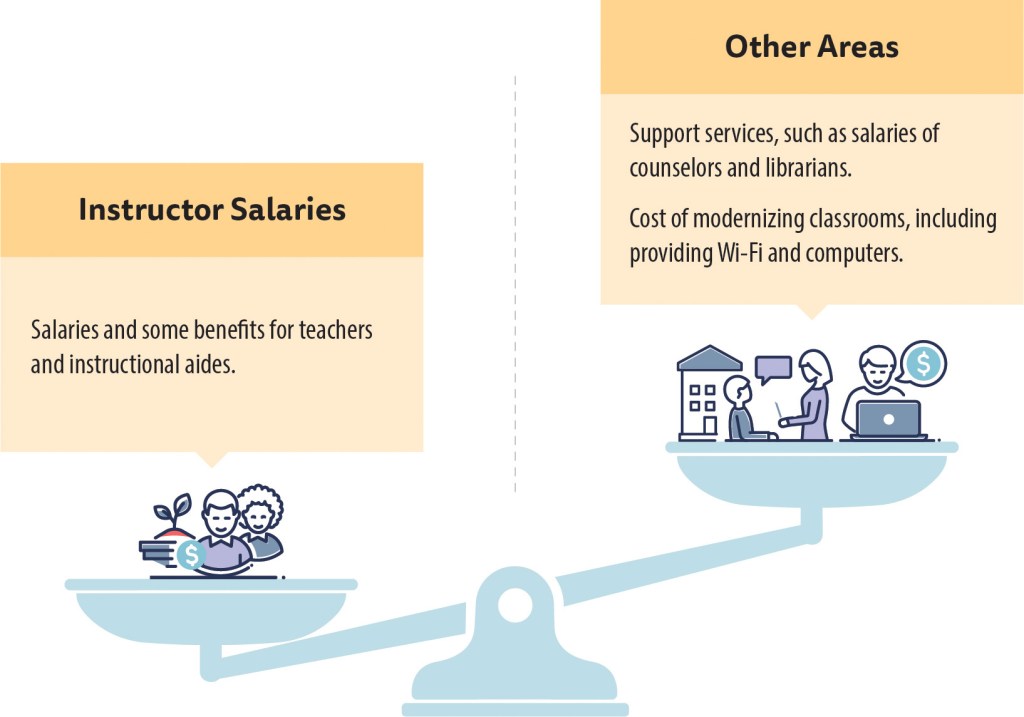
We acknowledge that the 50 Percent Law can be a barrier to spending from a district’s reserves on specific areas; however, except for Butte, none of the districts have attempted to resolve the limitations on spending from their excess reserves. In our 2025 audit, we noted that the 50 Percent Law limits districts’ ability to fund services outside the classroom and does not account for technological improvements, such as online instruction and the modernization of classrooms.1 Figure 6 describes how districts must carefully weigh complying with the 50 Percent Law and spending on other services that support student success. In that report, we suggested that to help districts provide support services for students while complying with the 50 Percent Law, the Legislature should consider amending the law to include the salaries and benefits of librarians and counselors, as well as to account for technological improvements. Although the Legislature has not yet taken action to implement this recommendation, the current law does make exceptions for certain types of expenses, such as equipment, library books, and capital projects. Notwithstanding the challenges districts face, unless districts develop ways to reduce the balances of their excess reserves, those reserves will continue to grow.
Figure 6
Districts Must Weigh Complying With the 50 Percent Law Against Spending on Services That Support Student Success
Source: California State Auditor’s Report 2023-126, California Community Colleges: Oversight of the 50 Percent Law Is Ineffective, and the Law Could Be Amended to Better Support Students, April 2025.
Figure 6 shows a two-pan balance scale demonstrating how districts should balance instructional expenditures against services that support student services to comply with the 50 Percent law. The left side of the balance scale wights districts’ expenditures for instructor salaries and benefits, and other instructional aids. The right side of the balance scale weights support services, such as salaries of counselors and librarians, and the cost of modernizing classrooms, including providing Wi-Fi and computers. The left side pan weighing the instructor salaries is the heavier side on the scale.
Districts Have Opportunities to Spend Excess Reserves to Improve Student Outcomes
The four districts with reserves that exceed either their maximum reserve policy or the statewide median—Antelope Valley, Kern, Mt. San Jacinto, and San Francisco—all have processes to identify student and departmental needs and to allocate additional funding for improvements. In California, community colleges must engage in accreditation review every six years. One of the accreditation organization’s criteria includes whether districts conduct systematic reviews and assessments to ensure the quality of their academic learning support and student services programs and implement improvements and innovations in support of achievement for all students. Our review of the four districts’ program review documentation for fiscal year 2024–25 found that all of them had a process in which individual departments used data points such as enrollment, retention, and success rates to identify program strengths and weaknesses and to request additional funding for improvements. For example, during its program review process, San Francisco identified increased student interest in its Linux Administration Certificate and allocated more funding to begin offering students the ability to complete the certificate in one semester through accelerated classes. In another example, Mt. San Jacinto’s biology department requested, and the district approved, $53,000 to buy lab equipment to better align some of its lab techniques with a local company with which the district partnered to secure entry‑level positions for district students.
Despite having established program review processes, the districts still retain significant funds above their established policy maximum reserves or the statewide median. For example, although Antelope Valley granted $876,000 in additional funding to its departments in fiscal year 2024–25, it still had an excess year‑end reserve of about $59 million. In another example, although Mt. San Jacinto provided $166,000 in additional funding in fiscal year 2024–25 for projects proposed by its departments, the district still had an excess reserve of about $53 million at the end of the fiscal year. When districts do not maximize the use of available financial resources, they overlook opportunities to improve student success.
Our review of available data that districts reported to the Chancellor’s Office found that the four districts with reserves that were in excess of either their maximum reserve policy or the statewide median—Antelope Valley, Kern, Mt. San Jacinto, and San Francisco—had opportunities to use additional financial resources to improve student outcomes, add additional full‑time faculty, or offer more student support services. We reviewed trends for selected metrics about student outcomes and the support services for these four districts. We also determined how the districts’ efforts compare to statewide metrics. The data suggests that districts can potentially do more with excess funds to help improve student outcomes and student support services and increase the percentage of full‑time faculty.
Student Outcomes
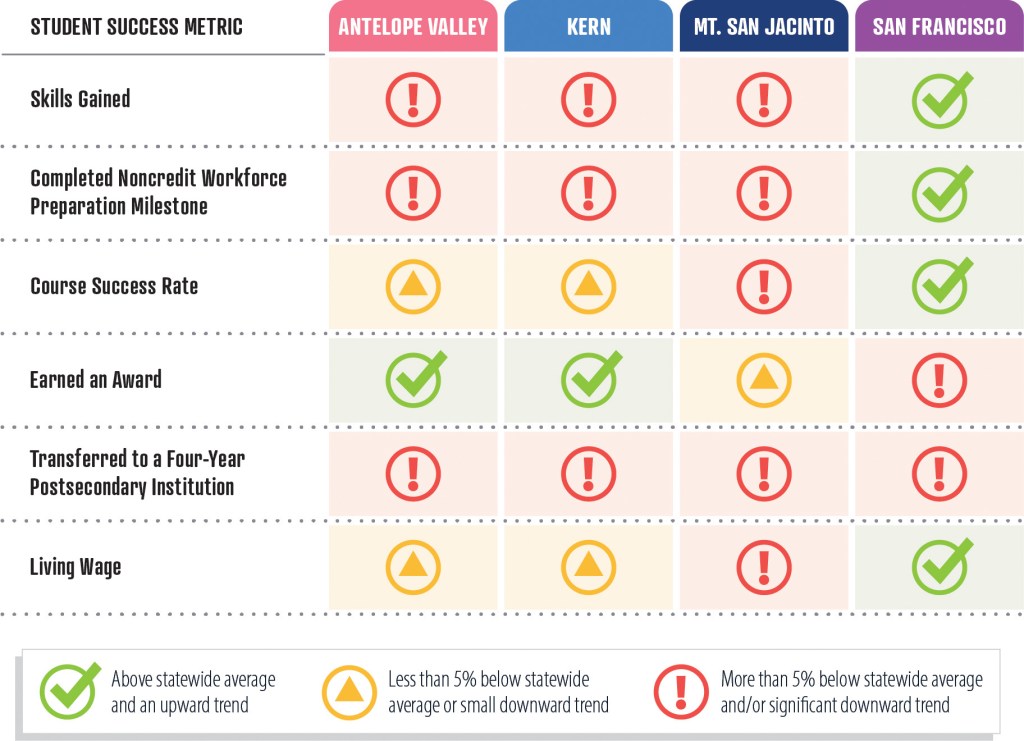
To measure student success, we selected six metrics that capture outcome data for the various types of students at community colleges, such as degree‑seeking students and transfer‑seeking students. We reviewed data from fiscal year 2018–19 through the last available fiscal year for which data were available for each district. As Figure 7 shows, all four districts with excess reserves had student success metrics that were below statewide averages. For example, Kern’s course completion rate of 69 percent in 2023–24, the latest year for which data were available, was 4 percent below the statewide average, and Antelope Valley’s four‑year transfer rate of 5 percent in fiscal year 2022–23, the latest year for which such data were available, was 2 percent below the statewide average. Mt. San Jacinto, meanwhile, saw the share of its students earning a living wage post‑graduation increase from 26 percent, or 12 percent below the statewide average in 2018–19, to 38 percent in 2020–21, before falling back down to 35 percent in 2022–23, ending at 6 percent below the statewide average for that year. We also reviewed these student success metrics by different equity groups, including race, gender, economic disadvantages, and sexual orientation. We found that all four districts had opportunities to invest in improving the outcomes for one or more subgroups. For example, in all four districts, course completion rates for Black or African American students were below the average of the overall student population. Past academic research suggests that funding comprehensive approaches can help with student success. Such approaches can include proactive advising, providing additional financial aid, and other forms of support, especially to those from low‑income or underserved backgrounds. According to academic research, students face multiple hurdles that make it difficult for them to complete college. Combining frequent advising with additional support, such as financial aid, can help students overcome barriers, accumulate more credits, remain enrolled, and graduate.
Figure 7
Four Districts Have Opportunities to Improve Some Student Success Metrics
Source: Auditor’s analysis of Chancellor’s Office data.
Figure 7 presents a table matrix that lists six student success metrics, including skills gained, completed noncredit workforce preparation milestone, course success rate, earned an award, transferred to a four-year postsecondary institution, and living wage. For each metric the graphic shows whether it is above or below the statewide median, or whether it had downward trend. If the metric is less than 5 percent below statewide average or has small downward trend, it shows a triangle warning sign; if the metric is more than 5 percent below statewide average and/or has significant downward trend, it shows a red exclamation warning sign. Four districts—San Francisco, Antelope Valley, Kern, and Mt. San Jacinto—each could improve in one or more student success metrics. Specifically, Antelope Valley and Kern could improve on skills gained, completed noncredit workforce preparation milestone, and transferred to a four-year postsecondary institution metrics; San Francisco could improve on earned an award, transferred to a four-year postsecondary institution metrics; and Mt. San Jacinto could improve on all six metrics.
Student Support Services
To increase students’ ability to reach their academic and career goals, state law directs state resources toward the provision of critical student support services such as orientation, assessment and placement, counseling, and other education planning services. We calculated the percentage of students who received student support services for each of the four districts with high reserves, and we found that three—Kern, Mt. San Jacinto, and San Francisco—had opportunities to improve student support services. For example, Kern consistently provided support services to fewer students than the statewide average throughout the audit period. Further, at Mt. San Jacinto, the number of students who received support services fell from 25 percent in 2018 to about 15 percent in 2024. Mt. San Jacinto explained that the decrease was a result of changes to service delivery formats, with many services now being accessed through self‑service or automated service formats, and the Chancellor’s Office’s data systems do not capture the number of these types of services used the same way as in the past. Nevertheless, the data show that these districts with substantial reserves have opportunities to use those funds to ensure that students have adequate access to support services, which are critical to the students’ ability to reach their educational goals.
Full‑Time Faculty
The Legislature has in the past determined that the quality, quantity, and composition of full‑time faculty have an immediate impact on the quality of instruction. Therefore, state law sets the goal that 75 percent of each district’s credit instruction hours should be taught by full‑time instructors. State law further requires the Chancellor’s Office to establish minimum thresholds for the annual number of full‑time faculty members for each district, referred to as the faculty obligation number. The Chancellor’s Office calculates the districts’ full‑time faculty percentage using a formula described in state law. Each district that does not satisfy the applicable faculty obligation number may have its funding reduced. Although all four districts maintained staffing that satisfied their minimum faculty obligation number, as of fiscal year 2024–25 only San Francisco reached the goal of 75 percent. As Table 1 shows, the other three districts—Antelope Valley, Kern, and Mt. San Jacinto—were below the 75 percent goal, which indicates that all three have an opportunity to increase their full‑time faculty numbers.
Hiring additional faculty would allow districts to use excess funds for other purposes. Some districts expressed reluctance to spend the excess reserves for ongoing costs, such as faculty salaries and benefits, because the excess reserves are short‑term resources. Although districts may prefer not to use excess reserves for expenditures related to hiring additional faculty, they could use other revenue to pay for those costs, which would allow them to use the excess reserves for other purposes. Specifically, Antelope Valley, Kern, and Mt. San Jacinto each had an increase in their state revenue allocations through SCFF, which on top of the base funding also provides supplementary and success funding. For example, Kern has seen its SCFF funding grow by $75 million from fiscal years 2021–22 through 2024–25. During the same period, Antelope Valley’s and Mt. San Jacinto’s SCFF funding grew by $17.6 million and $31.5 million respectively. Because districts have not been budgeting all available funds, they have ongoing revenue that they could use to hire additional full‑time faculty. Using these funds to hire more faculty would allow districts to use excess reserves for other noninstructional programs and still comply with the 50 Percent Law requirements.
The Districts We Reviewed Have Not Adequately Identified and Projected Their Reserves
Key Points
- None of the six districts we reviewed has established risk‑based policies that outline both minimum and maximum reserve levels and the steps they should take when reserves fall below or exceed those levels. Further, five of the six districts do not have requirements to reduce excess reserves, contributing to increasing reserves.
- The districts have under‑projected their reserves each year, including for fiscal year 2025–26. We also found that five of the six districts did not disclose the amount of reserves they need to maintain per their reserve policies and the remaining unrestricted funds that exceed their reserves and that are available to spend. Four of the six districts maintained significant unbudgeted funds that exceeded their reserve goals.
None of the Districts We Reviewed Have Reserve Policies That Account for Risks
Both the GFOA and the Chancellor’s Office recommend that districts establish policies to maintain no less than two months of general fund operating expenditures as a reserve, but also that each district should establish its own reserve policy. The GFOA strongly recommends that districts adopt a formal policy describing how much they will strive to maintain in their unrestricted general fund as a reserve. It also advises that districts define a risk‑based reserve target as a range, instead of as a single point. The GFOA lists different considerations that districts could use to analyze the risks they might face, including cash flow and revenue instability, natural disasters and other hazardous events, public health and safety risks, and the availability of resources in other funds. For example, Mt. San Jacinto is located in one of California’s major earthquake fault zones and may consider the possibility of a natural disaster as a significant risk. Similarly, Butte’s main campus is in an area that is considered a high fire‑hazard zone, so the district may consider that risk to be relevant in determining its reserve needs. The GFOA also recommends having a reserve policy that includes a plan to replenish the reserve should it fall below the policy‑defined level.
Although the six districts we reviewed all have established policies identifying minimum reserve levels, as Table 2 shows, none could demonstrate that they conducted risk analyses when determining the reserve levels they need. For example, Calbright and San Francisco both established 5 percent as their minimum reserve levels, which is well below the recommended 17 percent, or two months. When we asked why these levels were lower, neither district could provide a documented rationale to support these thresholds or explain its board’s decisions. Calbright’s current staff noted that its board may have established a low threshold because the Chancellor’s Office had recommended a minimum reserve of 5 percent at the time its policy was established in 2019. San Francisco established its reserve policy in November 2022, after the Chancellor’s Office had updated its recommendation for a minimum reserve of 17 percent. However, San Francisco staff told us that the district’s board is currently deliberating a revision to its minimum and target reserve levels, which it expects to approve as early as Fall 2026. In April 2026, San Francisco’s Interim Vice Chancellor of Finance and Administration recommended to the board that the district conduct a risk‑based reserve analysis as part of its considerations. The other four districts adopted minimum reserves that approximate the GFOA‑recommended minimum but similarly could not demonstrate how they determined that it was appropriate for their needs.
Districts also could not support their policies for maximum reserves. Only two districts, Kern and San Francisco, have established formal board‑approved policies for establishing maximum reserve levels. Their boards have adopted maximum reserve levels of 25 percent and 9 percent, respectively. However, these districts could not provide any analyses to support their decisions. Establishing reserve policies without performing detailed analyses of risks, obligations, and financial resources available in other funds may result in inadequate or excessive reserves that could significantly affect districts’ ability to support students and ensure their success. Further, neither of these districts’ boards has established policies that require district staff to act to reduce the reserves if they exceed the maximum reserve level.
Although Butte’s board has not implemented a maximum reserve policy, the district has administrative procedures establishing a maximum reserve of 25 percent. The district describes in its procedures the specific steps the district must take if it exceeds 25 percent. Specifically, its procedures require that the district’s superintendent present a plan to its board of trustees to manage or spend down reserves should the district exceed the established maximum reserve. According to Butte, its strategy to spend down reserves has been proactive, deliberate, and structured, prioritizing one‑time investments such as facility maintenance, IT infrastructure, and improvements to system efficiency and service delivery. Like Kern and San Francisco, Butte could not provide an analysis to support how it determined its threshold of 25 percent. However, its procedures and its stated planning strategy demonstrate a framework that specifically requires the district to contemplate its excess reserves and ensure that it uses these funds to benefit students and serve the intended educational purpose. In fact, Butte is also the only district we reviewed with an established maximum reserve whose reserve remained within its maximum reserve limit throughout our audit period.
Additionally, in comparing the districts’ policies and methodologies for calculating the reserve percentage, we found that they were somewhat inconsistent and did not always comply with the GFOA’s and the Chancellor’s Office’s guidance. For example, Calbright’s and San Francisco’s policies both established their minimum reserves at 5 percent; however, their policies do not specify whether to calculate the reserve as a percentage of the restricted or unrestricted general fund revenue or expenditures. Three other districts—Antelope Valley, Butte, and Kern—limit the calculation of reserve percentage to unrestricted general fund expenditures, while Mt. San Jacinto calculates its reserve based on all general fund expenditures. The differences in the districts’ policies likely originate in inconsistencies in the Chancellor’s Office’s guidance and practices for calculating reserves, which we discuss later.
Most Districts Underestimated and Underbudgeted Funds Available for Use
The districts’ budgets during our audit period under‑projected year‑end reserves. For example, Kern’s fiscal year 2024–25 budget included a projected reserve of about $177 million at the end of the fiscal year, but its actual year‑end reserve was more than $232 million, leaving the district with about $55 million more than it expected. Similarly, at the end of fiscal year 2024–25, Antelope Valley, Mt. San Jacinto, and San Francisco maintained reserves of about $27 million, $29 million, and $20 million, respectively, more than they anticipated in their budgets. The six districts under‑projected reserves in their budgets for at least four of the seven years we reviewed. Several districts explained that the timing differences in when they prepare their budgets and when they receive the actual state apportionment makes it challenging to accurately project their ending fund balance.
At the time of our review in April 2026, each of the six districts had projected an increase in its reserve by the end of fiscal year 2025–26. To assess the reasonableness of these projections, we conducted our own forecast and estimated that their reserve levels would be substantially higher. We projected each district’s fiscal year 2025–26 reserves using the trend in historical differences in its projected and actual reserves from fiscal years 2018–19 through 2024–25. As Table 3 shows, the districts’ projected reserve levels at the end of fiscal year 2025–26 were lower than the amounts we projected. For example, Antelope Valley projected that as of the end of fiscal year 2025–26, its reserve would be nearly seven months of its projected expenditures for the year. However, based on the historical differences in its projected and actual reserves and expenditures, we estimate that it would have a reserve representing about 11 months of its expenditures. Similarly, our projection shows that Kern and Mt. San Jacinto will have reserves of approximately four and three months more than their projected reserves, respectively. Our projected reserves for Butte, Calbright, and San Francisco for fiscal year 2025–26 were within about a half month of the districts’ projected reserves.
We also found that four districts did not budget all available funds that exceeded their reserve goals for specific projects or other purposes. To ensure that districts do not retain more funds than needed to meet their reserve needs, we expected them to allocate available funding that exceeds the needed reserves for specific purposes, including student services. However, according to the budget data that districts reported to the Chancellor’s Office, four of the six districts had projected fiscal year‑end reserves of tens of millions of dollars more than the maximum amounts that their reserve policies allow, as Table 4 shows. For example, according to the data that Kern reported to the Chancellor’s Office, it projected a reserve of nearly $233 million at the end of fiscal year 2025–26. However, according to its own reserve policy, the district should not have exceeded a maximum of $172 million in reserves. As a result, Kern amassed more than $60 million it did not budget that it could have used to improve student outcomes and support services. Similarly, Antelope Valley, Mt. San Jacinto, and San Francisco each had tens of millions of dollars they did not budget to spend. As we discuss earlier, each of these districts has opportunities to improve in one or more student success outcomes, including the rate at which students complete workforce preparation milestones, complete courses, earn a certificate or other award, transfer to a four‑year institution, or increase their living wage. Improving these success outcomes would allow each district to reach the strategic targets that the State defined in its statewide strategic goals. By not budgeting all available funds that exceed their reserve needs, districts are missing opportunities to improve student outcomes.
Districts may have underbudgeted their resources in part because their policies do not require them to include reserves as a separate item in their budgets. Mt. San Jacinto is the only district we reviewed that discloses in its budgets its reserves as a distinct line item. The other five districts do not disclose reserves as a separate item but include them as part of the total funds available at the end of the budget year. By not disclosing reserves as a separate item in their budgets, the districts do not clearly identify to their boards and stakeholders the excess unbudgeted reserves that are available to enhance education and student support.
The five districts stated that they have not separately accounted for reserves as a line item in their budgets because the Chancellor’s Office has not required them to do so. Nevertheless, three districts generally agreed that accounting for required reserves separately would provide greater transparency and accountability. In contrast, San Francisco believes that it is transparent and accountable because it reports all unrestricted fund balance as reserves. However, by not separately budgeting the portion of the unrestricted fund balance that it considers true reserves and that the district’s policy requires, San Francisco’s budget does not clearly indicate the amount that exceeds its reserve that it has available to spend. As a result, it has consistently not budgeted funds that exceed its reserve needs. For example, as Table 4 shows, San Francisco should have set aside a maximum reserve of about $25 million in its fiscal year 2025–26 budget in accordance with its maximum reserve policy. Instead, the district had budgeted to have nearly $58 million in reserves at the end of the budget year, which was about $33 million more than its policy required. Although San Francisco is currently working with its board to revise its policy to increase the reserve limit, as we discuss earlier, it nonetheless budgeted to have more in reserve than what its existing policy required.
Although we did not identify state law requiring college districts to specifically identify and report reserves in their budgets, best practices indicate that districts should specifically assign their reserves as a budgetary item and ensure that they strategically use all remaining funds. In fact, state law requires elementary and secondary school districts that propose budgets with total reserves exceeding the minimum state‑recommended level to identify the amount that exceeds the minimum and substantiate the need to maintain those reserves. The Legislative Analyst’s Office stated in its 2015 Analysis of School District Reserves that this disclosure requirement provided additional information that could help school districts with fiscal planning and might reduce some local concerns that school districts had not been sufficiently transparent about their reserves and the reasons for maintaining those reserves. Although this requirement does not apply to community college districts, we believe a similar practice would assist college districts with fiscal planning and managing their reserves.
The Chancellor’s Office Did Not Sufficiently Oversee the Financial Condition of the Districts We Reviewed
Key Points
- The Chancellor’s Office did not accurately calculate districts’ reserves. It also did not monitor the appropriateness of districts’ reserve policies or their plans to reduce excess reserves. By not verifying and monitoring these balances and policies, the Chancellor’s Office cannot appropriately assess districts’ financial risk or encourage districts to use excess reserves to support students.
- The Chancellor’s Office cannot reliably verify districts’ financial data because it does not require districts to include details of their governmental funds in their audited financial statements. Districts currently report only business‑type activities; however, reporting of governmental activities would improve accuracy and transparency. Furthermore, the Chancellor’s Office does not communicate its expectations to districts that if changes should occur, districts should update previously submitted data.
The Chancellor’s Office Did Not Accurately Calculate and Oversee Districts’ Reserves
The Chancellor’s Office did not follow its own policy when calculating districts’ reserves, which contributed to its inaccurate determination of districts’ reserve levels. In addition to its requirement to monitor districts’ budget reporting and provide districts with guidance through its BAM, the Chancellor’s Office’s fiscal policy states that it should calculate a district’s reserve as a percentage of its total general fund operating expenditures. However, the Chancellor’s Office used only the districts’ unrestricted general fund expenditures instead of total general fund expenditures when monitoring districts’ percentage of reserves. By doing so, the Chancellor’s Office overstated the percentage of all districts’ reserves statewide. As Table 5 shows, the Chancellor’s Office overstated the reserves of the six districts we reviewed by 6 percent to 41 percent. For example, based on the Chancellor’s Office’s calculation, in fiscal year 2024–25, Kern’s reserve as a percentage of its unrestricted general fund expenditures was about 98 percent, or nearly one year. However, using the district’s total general fund expenditures for that year in the calculation results in a much lower percentage of 57 percent, or under seven months. The Chancellor’s Office explained that it uses only the amount of unrestricted general fund expenditures in its calculation because that is what it has historically done. The Chancellor’s Office management staff explained that they are new to their current positions and that they cannot speak about previous decisions related to the calculation of reserves. However, they could not explain why they did not subsequently change the approach to align with the existing policy. Without accurate information about districts’ reserve levels, the Chancellor’s Office cannot appropriately determine whether a district is at risk of insolvency and intervene when needed.
Further, the Chancellor’s Office has not ensured that districts develop risk‑based reserve policies. State law encourages districts to practice sound fiscal management, some principles of which the text box lists. One of the Chancellor’s Office’s responsibilities is to evaluate whether districts follow these practices, including developing adequate fiscal policies and controls. However, the Chancellor’s Office did not establish a process to verify whether districts developed risk‑based reserve policies and processes to maintain adequate cash reserves. The Chancellor’s Office explained that it provides general guidance to districts in its BAM and relies on districts to comply with these principles. Although the Chancellor’s Office has recommended minimum reserve guidance, it does not have a suggested maximum reserve limit for districts to consider. Furthermore, the Chancellor’s Office does not have a process to monitor whether a district has conducted a risk assessment, whether the district is complying with its policies, and, if a district is not complying with its policies, to require it to provide the Chancellor’s Office with a plan to do so. We expect the Chancellor’s Office to exercise its oversight responsibility not only to provide written guidance but also to establish a process for ensuring that districts implement sound fiscal management practices by developing risk‑based reserve policies and plans to maintain adequate reserve levels.
Relevant Examples of the Principles of Sound Fiscal Management
- District management will maintain adequate cash reserves and implement and maintain effective internal controls.
- Each district will effectively develop and communicate fiscal policies, objectives, procedures, and constraints to the governing board, staff, and students.
- Each district will adhere to appropriate fiscal policies and procedures and have adequate controls to ensure that established fiscal objectives are met.
Source: State law.
Finally, the Chancellor’s Office has also not ensured that districts adopt plans to address their excess reserves. State law authorizes the Chancellor’s Office to intervene if it determines that a district’s financial data indicates a high probability that the district is not in compliance with the principles of sound fiscal management or is at risk of needing an emergency apportionment. However, that law does not specify whether the Chancellor’s Office can intervene in situations when districts have excess reserves. The Chancellor’s Office explained that it has historically prioritized assessing the risk of insolvency, which poses an immediate risk to operations, over monitoring districts with high reserve levels. It stated that high reserves often reflect local policy decisions and can represent prudent financial planning; therefore, the Chancellor’s Office has not historically viewed high reserves as a fiscal risk. Nevertheless, the Chancellor’s Office’s lack of oversight may have contributed to the fact that three of the six districts we reviewed have not taken any action to address their growing reserves, nor have they developed formalized plans to reduce them.
Further, the Chancellor’s Office’s guidance does not require districts to budget or assign all available funding, which may result in districts having large unbudgeted amounts of funding. This limited oversight and lack of guidance reduces the incentive for districts to use excess reserves to support essential student services and improve student success. To help mitigate these types of situations, we expect the Chancellor’s Office to exercise its oversight responsibility to ensure that districts appropriately spend amounts from their increasing reserves for the benefit of their students.
The Chancellor’s Office Does Not Verify the Financial Information That Districts Submit
The Chancellor’s Office cannot effectively verify the information districts report to it because it neither requires districts to include the details of governmental funds in their audited financial statements, nor does it require districts to provide it with supporting documentation, such as audit reconciliations. Districts have the option to report only business‑type activities in their audited financial statements, and the districts we reviewed all did so, thereby excluding any detailed presentation of governmental funds in their audited financial statements. Further, the Chancellor’s Office has not requested the districts to provide documentation—such as district auditors’ reconciliations of the information presented in districts’ financial statements and fund‑level detail—to verify the accuracy of the fund level data that districts report to the Chancellor’s Office. Without the audited financial statements or other documentation to show the financial data at the fund level that districts report to the Chancellor’s Office, the Chancellor’s Office cannot readily verify the accuracy of the districts’ financial data.
The Chancellor’s Office agreed that it would be challenging to verify the financial information for all governmental funds without having audited information for comparison. It agreed that if districts reported governmental activities, that would allow it to ensure consistency, accuracy, and transparency in the districts’ audited financial statements and self‑reported data. The Chancellor’s Office originally required districts to report only business‑type activities because the business‑type activity model aligned with higher education practices, offered comparable financial statements with those of private sector entities, and allowed for more readily available training for colleges and universities that follow the business‑type activities model. However, because community colleges are primarily government funded, the Chancellor’s Office’s director of fiscal standards and accountability (fiscal standards director) stated that the Chancellor’s Office is open to revisiting this decision. Nevertheless, she noted that the Chancellor’s Office is not the ultimate decision‑making body, and it must include other stakeholders—namely each district’s board of trustees or other designated committees—in making such decisions. Although the Chancellor’s Office may not have the final determination in this matter, it nevertheless plays a significant role as the oversight entity in shaping, guiding, and influencing the decision.
Furthermore, the Chancellor’s Office does not perform a sufficient review of districts’ total general fund balances because it cannot verify their actual reserve amounts. According to the fiscal standards director, the Chancellor’s Office focuses its monitoring primarily on the general fund, because it serves as the district’s main operating fund, and its condition is the most meaningful indicator of fiscal insolvency. To determine the entirety of a district’s reserves, the Chancellor’s Office must first identify the amount of its unrestricted general fund balance. However, it cannot substantiate the validity of that amount because districts generally do not report that information in their audited financial statements. The Chancellor’s Office’s inability to verify reserves means that it could make decisions based on inaccurately reported data.
The Chancellor’s Office also cannot verify districts’ reported data for other governmental funds to determine whether districts maintain unnecessarily large unrestricted financial resources in those funds. In their fiscal reports to the Chancellor’s Office, districts report their financial data by fund. Specifically, districts report amounts in each fund as nonspendable, restricted, committed, assigned, and unassigned. The fund classifications—committed, assigned, and unassigned, which together comprise the unrestricted balance in each governmental fund—are necessary for the Chancellor’s Office to ensure that the districts report their restricted and unrestricted fund balances accurately. However, the districts do not report this information in their audited financial statements because the Chancellor’s Office does not require them to do so, which limits the Chancellor’s Office’s ability to verify such information. Requiring districts to report governmental activities in their audited financial statements would also require them to appropriately classify and report their fund balances in alignment with the classifications they report to the Chancellor’s Office.
Despite acknowledging that districts may have unrestricted amounts in other governmental funds, the Chancellor’s Office explained that it does not routinely review the unrestricted amounts across all governmental funds when evaluating districts’ reserve levels. Consequently, the Chancellor’s Office cannot ensure that districts do not unnecessarily maintain unrestricted amounts outside their general fund. According to the Chancellor’s Office, its review procedures historically have not included verification of all data elements pertaining to governmental funds that are reported by districts and are also limited by the availability of independent sources for validation. The Chancellor’s Office stated that it will evaluate opportunities moving forward to expand its review and verification procedures. It further stated that such enhancements could require modifications to existing reporting processes, including the development of ad hoc reports and other tools to support data validation.
We performed a limited review of the districts’ reported unrestricted amounts outside their general fund and identified inaccuracies. As Table 6 shows, for fiscal year 2024–25, districts reported inaccurate information to the Chancellor’s Office related to unrestricted fund balance in governmental funds outside the general fund. For example, two districts reported to the Chancellor’s Office that they had an unrestricted fund balance available in their debt services fund when, in fact, those funds were legally restricted to address bond debts, resulting in the Chancellor’s Office having inaccurate information about those districts’ overall fiscal information. We also identified inaccuracies related to the unrestricted fund balances in the capital projects fund that districts reported to the Chancellor’s Office. The differences between the amounts that districts reported to the Chancellor’s Office and the amounts that were erroneous ranged from less than $1 million to nearly $271 million. When the Chancellor’s Office does not ensure the accuracy of the financial data that districts report to it, it cannot effectively evaluate districts’ financial condition.
The Chancellor’s Office also cannot verify the budget information that districts report to it. Similar to the actual financial data, districts report budget information to the Chancellor’s Office for each fiscal year. Specifically, districts report this information to the Chancellor’s Office for various funds by classification of nonspendable, restricted, committed, assigned, and unassigned. However, they do not include information in their budget documents using the same classifications as in their reports to the Chancellor’s Office. As a result, the Chancellor’s Office cannot fully verify the information that districts report to it using their budgets.
Further, even for the information—such as the budgeted general fund reserves—that the Chancellor’s Office could verify using the budget documents, it did not do so. In fact, we identified multiple inconsistencies and inaccuracies in the budget data that districts reported to the Chancellor’s Office, which the Chancellor’s Office was unaware of because it did not attempt to verify the reasonableness of the data. In our review, we compared districts’ general fund budgeted reserves and expenditures that the districts reported to the Chancellor’s Office with their adopted budgets. We found that districts did not always submit budget information to the Chancellor’s Office that was consistent with the data they included in their adopted budgets. For instance, in fiscal year 2021–22, Antelope Valley reported nearly $38 million in reserves. However, its budget for the year included only about $15 million in reserves, nearly $23 million less than the amount it reported to the Chancellor’s Office. In addition, Calbright reported to the Chancellor’s Office about $1 million more reserves for fiscal year 2021–22 than it included in its adopted budget. According to the Chancellor’s Office, the budgeted revenue, expenditures, and reserves that districts report to it should match those that the districts include in their final adopted budgets. Districts stated that they use estimates and projections when they begin budget development in January of each year because they do not have accurate revenue information from the State and their own year‑end financial information. They stated that the lack of accurate revenue information when they prepare their budgets results in the information in their budget possibly not matching the data they report to the Chancellor’s Office. However, they have more accurate information by September, when they report to the Chancellor’s Office.
Although the Chancellor’s Office expects districts to make corrections to the information they report to it, not all districts have been aware that they were supposed to do so. The Chancellor’s Office has not communicated to districts its expectation that the districts provide it with updated, accurate financial information. The Chancellor’s Office explained that if the districts had adjustments to their actual or budgeted financial information, they could ask to resubmit the information. A few districts, such as Butte and Antelope Valley, stated that they believed that they were reporting to the Chancellor’s Office at a point in time and that they were not expected to make modifications to previously reported data. The Chancellor’s Office stated that it expects districts to maintain and report accurate financial data and update previously reported data to reflect any corrections. Although the districts have a duty to report to the Chancellor’s Office their financial information, the Chancellor’s Office, as the oversight entity, should ensure that its expectations and the standards it develops for financial reporting are clear to the districts and then subsequently verify that districts comply with that guidance.
Other Areas We Reviewed
To address the audit objectives approved by the Joint Legislative Audit Committee (Audit Committee), we also reviewed districts’ other governmental funds with high balances to ensure that districts received appropriate authorizations from their boards for moving financial resources from their unrestricted general fund and that they had established reasonable plans to spend those amounts on assigned projects. Further, we reviewed districts’ credit rating documents to determine whether districts’ reserves had an impact on credit rating decisions.
The Districts’ Boards Appropriately Approved the Transfers for Capital Outlay Projects
To ensure that the districts we reviewed did not move financial resources from their general fund to other governmental funds as a means of lowering their unrestricted general fund reserves, we reviewed their other governmental funds with large fund balances. State law requires districts to place any income that exceeds amounts needed to cover their proposed budgeted expenditures into their reserve, and the governing board to pass a resolution before reclassifying any portion of those funds for any other purpose. The largest unrestricted amounts were primarily in capital projects funds. Thus, we reviewed a selection of capital projects at five districts to determine whether the district obtained the required board authorization and used the funding effectively and within reasonable time frames. Because Calbright does not maintain governmental funds outside its general fund, we did not review projects at Calbright.
Most districts were able to demonstrate that they had proper authorization to transfer funds from the general fund to the capital projects fund, but two districts could not demonstrate that they provided their boards certain key information that would allow for sufficient oversight of those funds. For projects we reviewed at Mt. San Jacinto and San Francisco, the districts demonstrated that their boards approved amounts in their adopted budget that comprised numerous smaller projects. However, neither district could substantiate that it provided its board with itemized project lists, formal cost estimates, or estimated completion dates. As a result, neither district could demonstrate that it made its board aware of the specific needs for which it allocated funds. For example, from fiscal years 2018–19 through 2024–25, Mt. San Jacinto allocated approximately $14 million to districtwide maintenance and more than $11 million to a project at one of its campuses but had spent only $5.9 million and $1.1 million, respectively, through fiscal year 2024–25. Without documented project lists, scopes, and timelines, neither the board nor the public can reliably assess whether the allocations were necessary, appropriate, and being spent within a reasonable time frame. In contrast, for the projects we reviewed at Antelope Valley, Butte, and Kern, each district demonstrated that it provided its board with project details, estimated costs, and projected timelines, and we found that the projects generally progressed at an acceptable pace.
High Reserves Did Not Significantly Affect Districts’ Credit Rating
Reserves are one of several factors that credit agencies consider when assessing the credit rating of a district. Although a healthy reserve can help support stronger credit ratings, we did not see any evidence for the districts we reviewed that high reserves significantly affected their credit rating. Specifically, five of the six districts received credit assessments during our review period. Our review of major credit rating agencies’ methodologies found that in their credit rating determinations, they generally included a discussion of reserves but also included several other factors such as governance, economic concerns, and local income trends. Although credit rating agencies considered strong reserves a positive factor, they also cited other factors, such as total debt, enrollment growth, and local economic profiles, as significant in their overall determination.
We also found that although five of the six districts we reviewed received an assessment from credit rating agencies, only San Francisco received a credit rating upgrade during the audit period. The credit rating agency’s explanation for its decision to increase San Francisco’s rating referenced the district’s strong demographic and economic factors. Additionally, the credit agency revised the district’s outlook from negative to stable in 2025 because of the district’s progress in implementing its fiscal stability plan, including that it made progress on balancing its budget in light of enrollment losses. Through this plan, which it began implementing in 2020, San Francisco sought to increase its reserves to about 8 percent of operating expenditures by fiscal year 2023–24. San Francisco stated that it did not increase its reserve to improve its credit rating. Instead, it stated that based on the district’s current economic situation, a higher reserve was needed to maintain fiscal stability.
Recommendations
Legislature
To ensure that community college districts transparently disclose and substantiate their reserves, the Legislature should consider requiring, similar to elementary and secondary school districts, each community college district to include the following in its annual budgets:
- The minimum and maximum recommended reserve amounts established by that district.
- The combined assigned, unassigned, and committed ending fund balances that fall short of the minimum or exceed the maximum reserve amounts established by that district.
- A statement of reasons that substantiates the need for a projected ending fund balance that falls short of the minimum or exceeds the maximum reserve amounts established by that district.
To ensure that districts develop and implement plans to spend funds that exceed their reserve goals, the Legislature should direct the Chancellor’s Office to do the following:
- Ensure that districts develop risk‑based reserve policies.
- Review a selection of districts’ reserve policies and supporting analyses every year to ensure that it agrees with the district’s minimum and maximum reserve levels.
- Annually review appropriate data to ensure that districts adhere to their own reserve policies.
- Develop a mechanism, such as requiring quarterly reporting, establishing spending timeframes, or appointing a special trustee, by which to require districts to develop plans to spend unrestricted funds that exceed their reserve goals.
To ensure that districts appropriately implement spending plans for excess reserves, the Legislature should direct the Board of Governors to establish a policy to require the Chancellor’s Office to adjust a district’s apportionment in subsequent years if the Chancellor’s Office determines that the district did not develop a maximum reserve policy, did not develop a spending plan for excess reserves, or did not implement its spending plan for a duration of three consecutive years.
Chancellor’s Office
To ensure that it can consistently and accurately monitor districts’ fiscal stability, the Chancellor’s Office should, effective immediately, revise its calculation of the districts’ reserve percentages to reflect their unrestricted general fund balances as a percentage of their total general fund expenditures, as stated in its guidance.
To ensure that districts maintain appropriate levels of reserves, the Chancellor’s Office should, by January 2027, develop a process to monitor districts’ reserve levels annually. If a district falls below its minimum or exceeds its maximum reserves, the Chancellor’s Office should require the district to provide a plan to bring its reserve levels within those required by the district’s policy.
To ensure that districts develop and implement comprehensive risk‑based reserve policies, the Chancellor’s Office should, by January 2027, develop a process to require all districts to do the following:
- Conduct a risk‑based assessment of their reserve needs and develop or revise their reserve policies and procedures to quantify the minimum and maximum reserves they should maintain.
- Specify the reason for the reserve limits they set, the circumstances under which they can use reserves, and the actions they will take when reserves fall short of or exceed the designated reserve range.
To ensure the sufficiency of districts’ reserve policies, the Chancellor’s Office should, by January 2027, develop a process for reviewing these policies to determine whether they are reasonable and whether the districts have performed risk analyses to support them.
To ensure that districts comply with its guidance and report accurate financial information, the Chancellor’s Office should, by January 2027, develop comprehensive policies, procedures, and practices for monitoring districts’ financial reporting, including ensuring that the districts maintain and report accurate and consistent financial records. Policies, procedures, and practices should include, but not be limited to, the following:
- Verifying that revenue, expenditures, fund balances, and classifications of fund balances that districts report in their adopted budgets are consistent with those they report in their fiscal reports to the Chancellor’s Office.
- Verifying that revenue, expenditures, fund balances, and classifications of fund balances for all fund types that districts report in their audited financial statements are consistent with those that they report in their annual fiscal report to the Chancellor’s Office.
- To the extent that the Chancellor’s Office identifies reporting inaccuracies or inconsistencies, it should notify the district and require it to correct the errors.
To ensure that the Chancellor’s Office maintains current and accurate financial information provided by the districts, the Chancellor’s Office should, by October 2026, include in its written guidance and remind districts of its expectations that districts provide it with updated, accurate budgeted information.
To ensure that the Chancellor’s Office has accurate financial data from the districts to conduct its monitoring, the Chancellor’s Office should, by January 2027, establish a policy to require districts to report all governmental and business‑type activities in their audited financial statements or, at minimum, obtain audit reconciliations that support the districts’ annual audits. If the Chancellor’s Office requires districts to include governmental reporting in their audited financial statements, it should also direct districts to follow government accounting standards in reporting their fund balances under the appropriate classifications.
To ensure efficient and effective use of state funds, the Chancellor’s Office should, by October 2026, require districts to disclose in their budgets the classification of all fund balances as nonspendable, restricted, committed, assigned, and unassigned, as appropriate.
We conducted this performance audit in accordance with generally accepted government auditing standards and under the authority vested in the California State Auditor by Government Code section 8543 et seq. Those standards require that we plan and perform the audit to obtain sufficient, appropriate evidence to provide a reasonable basis for our findings and conclusions based on the audit objectives. We believe that the evidence obtained provides a reasonable basis for our findings and conclusions based on our audit objectives.
Respectfully submitted,
GRANT PARKS
California State Auditor
August 6, 2026
Staff:
Kris Patel, Audit Principal
Ani Apyan, Senior Auditor
Dominik Baer
Salma Healy
Rohan Tandon
Karen Wells
Legal Counsel:
Natalie Moore
Appendices
Appendix A
Statewide Reserves for All Community College Districts
We obtained and reviewed data from the Chancellor’s Office’s fiscal portal pertaining to the reserves and total general fund expenditures at the end of fiscal year 2024–25 for all 73 community college districts throughout the State. As Table A shows, districts maintained varying reserve levels, which we present as percentages of their total general fund expenditures and the number of months of reserves available based on those expenditures. The median reserve level across all districts was 25 percent, or three months of total general fund expenditures.
Appendix B
Scope and Methodology
The Audit Committee directed the California State Auditor to conduct an audit of the oversight of the unrestricted general fund reserves in districts of the CCC. Table B.1 lists the objectives that the Audit Committee approved and the methods we used to address them. Unless otherwise stated in the table or elsewhere in the report, statements and conclusions about items selected for review should not be projected to the entire population of community college districts.
Assessment of Data Reliability
The U.S. Government Accountability Office, whose standards we are statutorily obligated to follow, requires us to assess the sufficiency and appropriateness of computer‑processed information we use to support our findings, conclusions, or recommendations. In performing this audit, we relied on electronic data files that we obtained from the Chancellor’s Office. Table B.2 describes the analyses we conducted using data from the information systems we used, our methods for testing them, and the results of our assessment. Although we recognize that these limitations may affect the precision of the numbers we present, there is sufficient evidence in total to support our audit findings, conclusions, and recommendations.
Responses
California Community Colleges
July 16, 2026
VIA EMAIL
Grant Parks, California State Auditor
621 Capitol Mall, Suite 1200
Sacramento, CA 95814
Re: California Community Colleges Office Written Response to 2025-108 Reserve Fund Oversight
Dear Mr. Parks:
The Chancellor’s Office has reviewed the draft audit report regarding district reserves and fiscal oversight. We appreciate the audit team’s work and collaboration throughout the audit process.
Consistent with the audit report, the Chancellor’s Office recognizes the importance of ensuring that districts maintain appropriate reserve levels while also supporting student success and institutional priorities. We look forward to continuing to work with districts and stakeholders to strengthen fiscal planning, transparency, and accountability across the system.
The Chancellor’s Office will work to implement the recommendations in the audit report. Our team is small, and we appreciate your highlighting areas that may improve reserve reporting, reserve calculations, and oversight of districts’ financial condition. As recommended, we will update our guidance and procedures to better assist districts in these areas.
We also fully understand the need for additional oversight, guidance, and training, and we will repurpose our limited resources to continue partnering with districts to promote sound fiscal management and compliance with applicable requirements.
On behalf of the Chancellor’s Office, I extend my appreciation to the audit team for their hard work and collaboration throughout the audit process.
Sincerely,
Chris Ferguson
Executive Vice Chancellor,
Finance & Strategic Initiatives
Antelope Valley Community College District
Office of the President
July 16, 2026
Mr. Grant Parks
California State Auditor
621 Capitol Mall, Ste. 1200
Sacramento, CA 95814
Dear Mr. Parks:
Antelope Valley Community College District Response
Antelope Valley Community College District appreciates the opportunity to respond to the California State Auditor’s report. The district supports transparency, responsible reserve management, and the use of public resources to advance student success. ① ② ③ However, the District respectfully disagrees with any implication that its fund balance increased at the expense of appropriately compensating employees, supporting students, planning for future needs, or responsibly budgeting available resources.
AVC Invested in Employees and Students
During the audit period, the district significantly increased employee compensation and expanded expenditures supporting instruction, student services, and college operations. Salary and benefit increases were negotiated to be more competitive in order to recruit and retain qualified faculty, classified professionals, administrators, counselors, and other employees who directly serve students.
AVC also increased overall expenditures during the period reviewed. Not only has the district hired aggressively each post-covid year, but also there have been significant increases in professional development for faculty, staff, and administrators in order to successfully execute the plans and initiatives give from the system office and locally. The report acknowledges that the districts with increased revenues generally did not reduce spending and that expenditures increased during the audit period. It further recognizes that AVC experienced hiring challenges, including limited applicant pools for academic and classified positions, which prevented the district from filling all budgeted positions as quickly as intended.
Unspent appropriations resulting from vacancies, recruitment challenges, procurement timelines, or delayed project implementation should not be interpreted as a lack of commitment to supporting students. These circumstances reflect implementation constraints, not an absence of commitment or planning.
AVC Planned and Budgeted the Use of its Resources
② The district also disagrees with the conclusion that it lacked plans for the use of available resources. AVC’s long-term planning is demonstrated through a transparent budget development process and formal assignment of fund balance for identified institutional priorities and obligations.
Assignments are not informal expressions of intent. They are an established governmental accounting mechanism used to identify resources intended for specific purposes. AVC has used assignments to support multiyear priorities such as employee compensation commitments, instructional and student-support initiatives, technology replacement, facilities and infrastructure needs, deferred maintenance, and protection against future funding volatility. These assignments are transparent throughout the budgeting process, discussed with constituent groups, and presented to the Board of Trustees in both the proposed and final budgets prior to approval. The planning and intent is clear and open for discussion and modification at all stages of the budget process.
These assignments demonstrate that the district has identified future uses for its resources even when expenditures could not reasonably or responsibly occur within a single fiscal year. Major projects, technology implementations, hiring initiatives, and program expansions frequently require planning, consultation, procurement, recruitment, and implementation across multiple budget cycles and multiple governmental bodies.
② The report’s focus on whether the district had a separate document described as a reserve-reduction or spending plan does not fully reflect the district’s existing budget development, fund-balance assignments, Board actions, facilities planning, program review, and multiyear financial forecasting. Taken together, these processes demonstrate intentional and continuing planning for the use of available funds. A historical look at the budget process exemplifies that the utilization of the fund-balance assignments is established past practice at this institution and constituents understand the meaning of this portion of the budget.
Conservative Budgeting Supports Fiscal Stability During Economic Downturns
AVC budgets conservatively to protect students, employees, and educational programs from sudden financial disruption. Community college funding is affected by enrollment, State budget conditions, apportionment recalculations, statutory funding protections, cost-of-living adjustments, and other factors that may not be known when the district adopts its initial budget.
The report recognizes that AVC received emergency-conditions and Student-Centered Funding Formula protections during a period of enrollment decline and that its State apportionment increased during the audit period.
③ Conservative revenue assumptions are not evidence that the district neglected to budget available resources. They are a safeguard against committing uncertain or temporary revenues to permanent ongoing expenses. Salaries, benefits, new positions, and continuing programs create obligations that extend well beyond the year in which they are approved. Using temporary or one-time funding (like fund balance) to support permanent costs could create structural deficits that bring negative consequences and ultimately could require reductions in services or employment.
AVC’s fiscal approach has been designed to preserve long-term solvency, maintain stable educational programs, meet employee obligations, address infrastructure and technology needs, sustain a healthy institutional credit rating and respond to future economic or State funding changes. As the institution has undergone this audit, there has been a simultaneous re-evaluation of its bond rating. Due to our strong fiscal position and healthy fund balance, the district’s bond rating increased. Having a stronger rating allows the district to access better financing opportunities when exploring various funding options, thereby demonstrating fiscal responsibility. ④ A statewide median or a single reserve percentage does not, by itself, establish the appropriate reserve level for an individual district. Reserve needs should reflect each district’s enrollment trends, revenue volatility, labor obligations, capital needs, operating risks, and local circumstances.
Moving forward
The district’s reserve policy is currently described in the budget report narrative, discussed during public budget presentations, and reflected in the budget documents through disclosure of reserves as a percentage of the fund balance. Building on these existing practices, the District accepts the opportunity to further improve the transparency and formal documentation of its reserve practices.
AVC will make reasonable efforts to:
- More clearly identify minimum, target, and maximum reserve levels;
- provide clearer public reporting of assigned resources and anticipated spending timelines; and
- continue monitoring whether one-time and ongoing revenues are matched appropriately with one-time and ongoing expenditures.
AVC remains committed to utilizing its resources for students while preserving its fiscal stability. The district requests that this report be considered in the context of emerging from pandemic times and the variety of atypical funding received. Additionally, the district respectfully maintains that its increased fund balance must be considered alongside its employee compensation increases, ongoing negotiations with bargaining units, expanded student and operational expenditures, formally assigned resources, hiring and implementation constraints, and responsibility to protect the institution from future funding uncertainties.
Sincerely,
Dr. Jennifer Zellet
Superintendent/President
Antelope Valley College
California State Auditor’s Comments on the Response From Antelope Valley Community College District
To provide clarity and perspective, we are commenting on the response to our audit report from Antelope Valley. The numbers below correspond with the numbers we have placed in the margin of Antelope Valley’s response.
① Antelope Valley mischaracterizes our report. We neither conclude nor imply that the district’s reserve increased at the expense of faculty compensation or supporting students. In fact, we acknowledge the district’s assertion that the increase in its revenue was the primary reason for the increase in its reserves. Additionally, we note that although Antelope Valley’s expenditures did not grow at the same rate as its revenue, the increase in its expenditures indicates that its reserves did not grow because it reduced spending on educational programs or student services. Nevertheless, as we state in the report, Antelope Valley had opportunities to use additional financial resources to improve student outcomes, offer more student support services, and add additional full-time faculty.
② Although Antelope Valley states that its long term planning is demonstrated through its budget development process, as we indicate in the report, Antelope Valley mentioned conceptual ideas of where it intends to spend the money but does not have a formalized plan to reduce its reserve. In fact, Antelope Valley’s reserve has continued to grow steadily since fiscal year 2018–19, as Figure 3 shows, raising concerns about the effectiveness of the district’s actions. As we state in the report, in alignment with best practices, we expected the district to adopt a plan that clearly identifies its instructional priorities, assesses its current unrestricted reserve levels, and identifies how it would spend any excess funds to address its priorities. As we state in the report, Butte has developed a detailed approach to using reserve funds, which, according to Butte, has allowed it to make informed decisions and enable the regular monitoring of its reserves. As such, we stand by our conclusion that unless Antelope Valley develops ways to reduce its excess reserve, the reserve will continue to grow.
③ Although the district states that the use of conservative revenue assumptions are not evidence that it neglected to budget available resources, our review of its fiscal year 2025–26 adopted budget shows that it significantly underbudgeted all revenue it projected to receive for that year. As Table 4 presents, Antelope Valley’s fiscal year 2025–26 budget projected the district to have about $96 million in its unrestricted general fund balance at the end of the fiscal year, which was about $53 million more than the amount it needed to save as a reserve based on the 25 percent statewide median. Further, we acknowledge that although districts may prefer not to use excess reserves for expenditures related to hiring additional faculty, they could use other revenue to pay for those costs, which would allow them to use the excess reserves for other purposes. We further state that Antelope Valley’s SCFF funding grew by $17.6 million from fiscal years 2021–22 through 2024–25. Additionally, we state that the district’s expenditures did not grow at the same rate as its revenues. Therefore, we stand by our conclusion that Antelope Valley did not budget all available funds for specific projects or other purposes.
④ Contrary to the district’s statement, our report does not conclude that a statewide median or a single reserve percentage solely establishes an appropriate reserve level. We describe that the GFOA advises that districts define a risk-based reserve target as a range, instead of as a single point, and that there are many considerations that districts could use to analyze the risks they might face. As we state in the report, such risks include cash flow and revenue instability, natural disasters and other hazardous events, public health and safety risks, and the availability of resources in other funds. A district’s reserve policy should also include a plan to replenish the reserve should it fall below the policy-defined level. However, as we state in the report, Antelope Valley’s current reserve policy does not define a maximum limit of reserves.
Footnote
- California State Auditor’s Report 2023-126, California Community Colleges: Oversight of the 50 Percent Law Is Ineffective, and the Law Could Be Amended to Better Support Students, April 2025. ↩︎
The post 2025-108 California Community Colleges Reserve Funds appeared first on California State Auditor.
Legal Disclaimer:
EIN Presswire provides this news content "as is" without warranty of any kind. We do not accept any responsibility or liability for the accuracy, content, images, videos, licenses, completeness, legality, or reliability of the information contained in this article. If you have any complaints or copyright issues related to this article, kindly contact the author above.
