

2025-128 Los Angeles County Department of Public Health
September 29, 2026
2025‑128
The Governor of California
President pro Tempore of the Senate
Speaker of the Assembly
State Capitol
Sacramento, California 95814
Dear Governor and Legislative Leaders:
As directed by the Joint Legislative Audit Committee, my office conducted an audit of the Los Angeles County Department of Public Health (LADPH), and our assessment focused on LADPH’s response to the conditions near the Chiquita Canyon Landfill. In general, we determined that LADPH’s actions in response to these conditions have been incomplete and that establishing internal safeguards could help LADPH improve future responses to health hazards.
LADPH could not demonstrate to us that it had consistently reviewed specific air quality data and did not communicate proactively with the communities surrounding the landfill about the data. LADPH also lacks an up-to-date understanding of community members’ health conditions because it has generally stopped collecting or receiving symptom reports from community members. We determined that LADPH took nearly two years to direct the landfill operator to provide funding for temporary relocation and that LADPH could not provide a sufficient reason for why it did not act sooner.
Because LADPH did not comprehensively or consistently communicate relevant information to residents, those residents may have lacked a clear understanding of the steps the department was taking to respond. LADPH’s community engagement activities had limitations that hindered their effectiveness, and LADPH did not respond effectively to certain community requests.
Our report includes recommendations to improve LADPH’s ongoing response to conditions at Chiquita Canyon Landfill and ways to incorporate safeguards to help ensure that future health hazard responses are consistent throughout Los Angeles County.
Respectfully submitted,
GRANT PARKS
California State Auditor
Selected Abbreviations and Acronyms Used in This Report
| air quality district | South Coast Air Quality Management District |
| Board of Supervisors | Los Angeles County Board of Supervisors |
| CAC | Chiquita Canyon Landfill Community Advisory Committee |
| CalRecycle | California Department of Resource Recycling and Recovery |
| Chiquita | Chiquita Canyon Landfill, LLC |
| enforcement program | Solid Waste Management Program |
| LADPH | Los Angeles County Department of Public Health |
| landfill | Chiquita Canyon Landfill |
| PHAB | Public Health Accreditation Board |
| REL | reference exposure level |
Summary
Key Findings and Recommendations
Since early 2022, the Chiquita Canyon Landfill (landfill) in northern Los Angeles County—which Chiquita Canyon Landfill, LLC (Chiquita) operates—has been the site of a high‑temperature, underground chemical reaction. The chemical reaction has produced an increase in landfill gas emissions and odors and nearby community members have experienced negative health symptoms, such as nasal irritation, headaches, and nausea. The Los Angeles County Department of Public Health (LADPH) has taken a variety of actions to respond to this health hazard in its capacity as the local public health agency. It has also used its authority as the local enforcement agency, which is a designation certified by the State that makes LADPH responsible for ensuring that the landfill complies with state law and regulations. LADPH has assigned this role to its Solid Waste Management Program (enforcement program). This audit reviewed LADPH’s actions in response to the chemical reaction and its effects on the communities near the landfill and concludes the following:
The enforcement program has directed Chiquita to take reasonable steps to address the chemical reaction and prevent future harm to the communities near the landfill. Specifically, the enforcement program has recommended or ordered Chiquita to take appropriate steps to mitigate the chemical reaction’s effects—such as by ordering Chiquita to cover the reaction area and install temperature monitoring probes to track the conditions at the landfill. It has acted with reasonable speed to do so and has escalated its use of its authority when necessary by issuing orders to Chiquita that the enforcement program can enforce through a variety of actions, including monetary penalties if Chiquita does not comply.
However, we identified shortcomings in LADPH’s efforts to monitor environmental conditions and residents’ health. LADPH told residents it was reviewing continuous monitoring data about the air quality near the landfill, and it had the opportunity to provide comments in public air quality reports that the landfill produced on a quarterly basis. We nonetheless could not verify that LADPH had always reviewed specific air quality information, and it did not communicate with the public about specific levels of chemicals in the air. In addition, LADPH’s information on residents’ health symptoms is not up‑to‑date. Its data on health conditions are mostly from the end of 2024, more than a year and a half ago. As a result, LADPH does not have a complete or current understanding of residents’ symptoms. Finally, LADPH did not advocate promptly for relocation assistance for residents. Specifically, it did not direct Chiquita to offer residents relocation assistance until May 2025, nearly two years into its response, and it does not have an adequate explanation for why it did not recommend this relief before that time.
LADPH communicated with residents near the landfill by attending community meetings and issuing written communications. However, at community meetings, LADPH did not communicate comprehensive updates about its response activities. For example, LADPH did not discuss in detail its efforts to collaborate with other agencies to respond to the chemical reaction. Also, in 2025 the department significantly reduced its participation in community meetings and issued few substantive written communications to the public when it could have been communicating about areas of concern, such as air quality or its coordination with medical providers.
LADPH also used community meetings to engage with residents, in addition to other engagement activities. However, we identified limitations with each of these activities that lessened the effectiveness of LADPH’s overall approach to community engagement. LADPH responded to community concerns in some instances, and at other times it did not substantively respond. For example, it did not provide mental health resources to residents despite repeated evidence that mental health was among the community’s top health concerns.
We identified inconsistencies in how LADPH responded to the conditions at the landfill when compared to its response to other health hazard events. For example, during a response to another such event, LADPH coordinated with another county department to provide mental health resources—which it has not done for the landfill event. It also more quickly and formally documented the health conditions of affected individuals during other events. We observed that the primary factor guiding LADPH’s response was the expertise of its leadership at the time of the events, rather than a set of policies and procedures. By designing and implementing policies and procedures related to event responses, along with conducting reviews of its past response activities to identify strengths and areas for improvement, LADPH could better ensure that it responds consistently to health hazards that occur in the county.
To address these findings, we have made recommendations to LADPH to adopt policies and procedures related to health hazard events and to document reviews of its health hazard responses. In addition, we recommend that the Los Angeles County Board of Supervisors (Board of Supervisors) direct LADPH to routinely provide the public with information about air quality and health risks, collect information about health symptoms from community members, and develop a community engagement plan for its continuing response to the conditions at the landfill.
Agency Comments
LADPH disagreed with many of our conclusions. However, it agreed to implement our recommendation for its enforcement program to take appropriate enforcement action and to create policies and procedures to guide its health hazard event responses. LADPH also agreed with our recommendation to review its responses to health hazard events, but did not indicate whether it would formalize this practice in a policy or document the outcomes of its reviews.
Although we provided the Board of Supervisors with the opportunity to review and respond to the draft report, LADPH stated that it was also responding on behalf of the county and indicated that the board would not implement the recommendations that we directed to it.
Introduction
Background
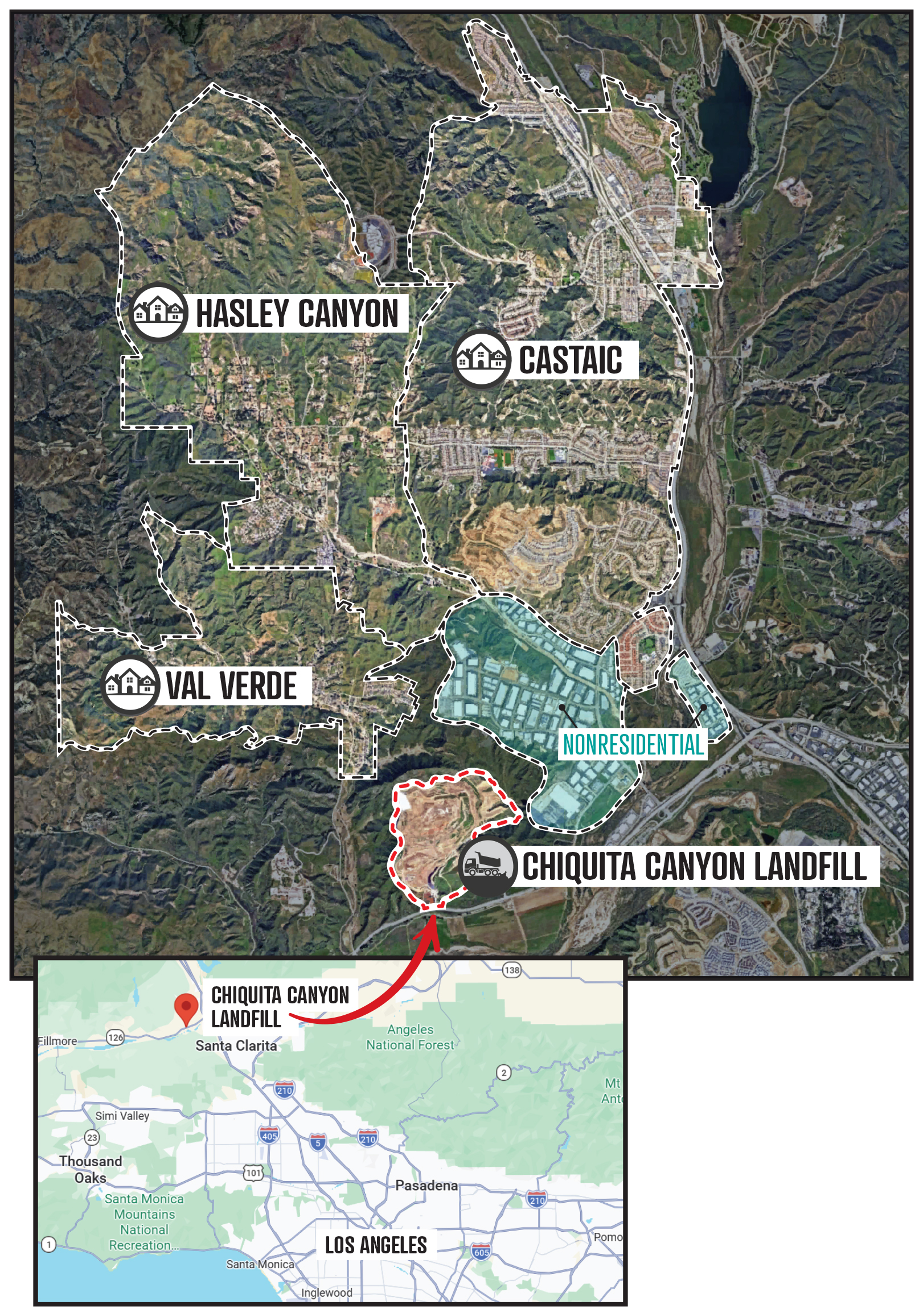
The landfill is in northern Los Angeles County, in the Santa Clarita Valley. Figure 1 shows the location of the landfill and some of the unincorporated communities near it. Several thousand people make their homes in these communities. In 2017, Los Angeles County issued a conditional use permit to Chiquita for the continued operation of the landfill. Among many conditions, the permit requires that Chiquita operate an air quality monitoring program and provide several regular reports to various county agencies so they can more effectively monitor landfill operations. When the county issued Chiquita its permit to operate the landfill, it also created the Chiquita Canyon Landfill Community Advisory Committee (CAC), which is a committee required to be composed of individuals who live in the Santa Clarita Valley. The CAC exists to serve as an advisory body to, among others, the Board of Supervisors on matters related to the landfill.
Figure 1
Chiquita Canyon Landfill Is Located Near Northern Los Angeles County Communities
Source: Publicly available map information.
Note: According to analysis by LADPH, the nearest households submitting complaints about heath symptoms were located approximately 0.3 miles from the landfill.
Figure 1. The figure shows a map of the greater Los Angeles County area with a pin marking the location of the Chiquita Canyon Landfill near the county’s northern boundary. A pop out map provides a closer view of the landfill and the nearby communities of Val Verde, Hasley Canyon, and Castaic, which lie north of and adjacent to the landfill. In the pop out map, the landfill’s boundaries are outlined in red. Val Verde is the closest community to the landfill, followed by Hasley Canyon, and then Castaic. There is also a nonresidential area near the landfill marked on the map.
In early 2022, the landfill became the site of a high‑temperature, underground chemical reaction.1 Concurrent with the chemical reaction has been an increase in both odorous landfill gas emissions and hazardous waste liquid (leachate). Both the California Department of Resources Recycling and Recovery (CalRecycle) and Chiquita anticipate that the reaction will continue for years, and the enforcement program believes the reaction is growing. In January 2025, Chiquita stopped accepting waste at the landfill.
Residents of the communities near the landfill have complained about increased odors coming from the landfill. Although the chemical reaction is understood to have begun in 2022, complaints about odors arising from the chemical reaction did not increase substantially until 2023. In connection with the odors, community members have reported experiencing negative health symptoms such as headaches; irritation of their eyes, nose, or throat (including nosebleeds); tremors; nausea; and fatigue.
LADPH’s General Responsibilities
LADPH—whose director is appointed by the Board of Supervisors—provides public health services for the benefit of Los Angeles County’s residents. It is accredited by the Public Health Accreditation Board (PHAB), which is a national organization that assesses the ability of local health departments to provide essential public health services. The text box lists some of these essential public health services. LADPH’s accreditation gives reasonable assurance that the department is prepared to offer the range of public health services that a public health department should provide.
LADPH Is Accredited to Provide Services in Key Categories
1. Investigate, diagnose, and address health problems and hazards.
2. Communicate effectively to inform people about health.
3. Support and mobilize communities and partnerships to improve health.
4. Use legal and regulatory actions to protect health.
Source: PHAB’s 10 Essential Public Health Services.
The Los Angeles County Code requires LADPH’s director or an authorized representative to perform the duties of a county health officer that are prescribed by law. State laws generally describing the powers and duties of county health officers require them to enforce and observe Board of Supervisors’ orders and ordinances pertaining to public health, quarantine orders and other regulations, and statutes pertaining to public health. County health officers are also authorized to take any preventive measures necessary to protect the public health from public health hazards when a state of emergency or local emergency is declared.
The Los Angeles County health officer (county health officer) explained that LADPH performs four key functions. First, it surveils health outcomes—monitoring to understand who is affected, what is happening, when a situation started, where it is occurring, and why it is occurring. Second, it strategizes about mitigation, including, as needed, identifying additional actions needed to reduce or prevent the risk of harm. Third, it communicates to the appropriate audiences about the risks and actions to reduce or prevent risks. These audiences can include the public, press, elected officials, and health care providers. Finally, it coordinates with others when it is necessary to complete the first three functions.
In addition, LADPH is certified as the local enforcement agency for the unincorporated areas of the county and for nearly all its incorporated cities. CalRecycle certifies local enforcement agencies and, subsequently, those agencies exercise the state function of enforcing provisions of state law governing solid waste facilities, including landfills. State law establishes that, when it is carrying out these functions, LADPH is independent from the Board of Supervisors and is not subject to its authority. As a matter of practice, LADPH assigns its local enforcement agency role to its enforcement program. The enforcement program inspects landfills and takes enforcement action. Because the actions LADPH took through its enforcement program were distinct from other actions it took, we describe them in this report as actions of the enforcement program, rather than LADPH.
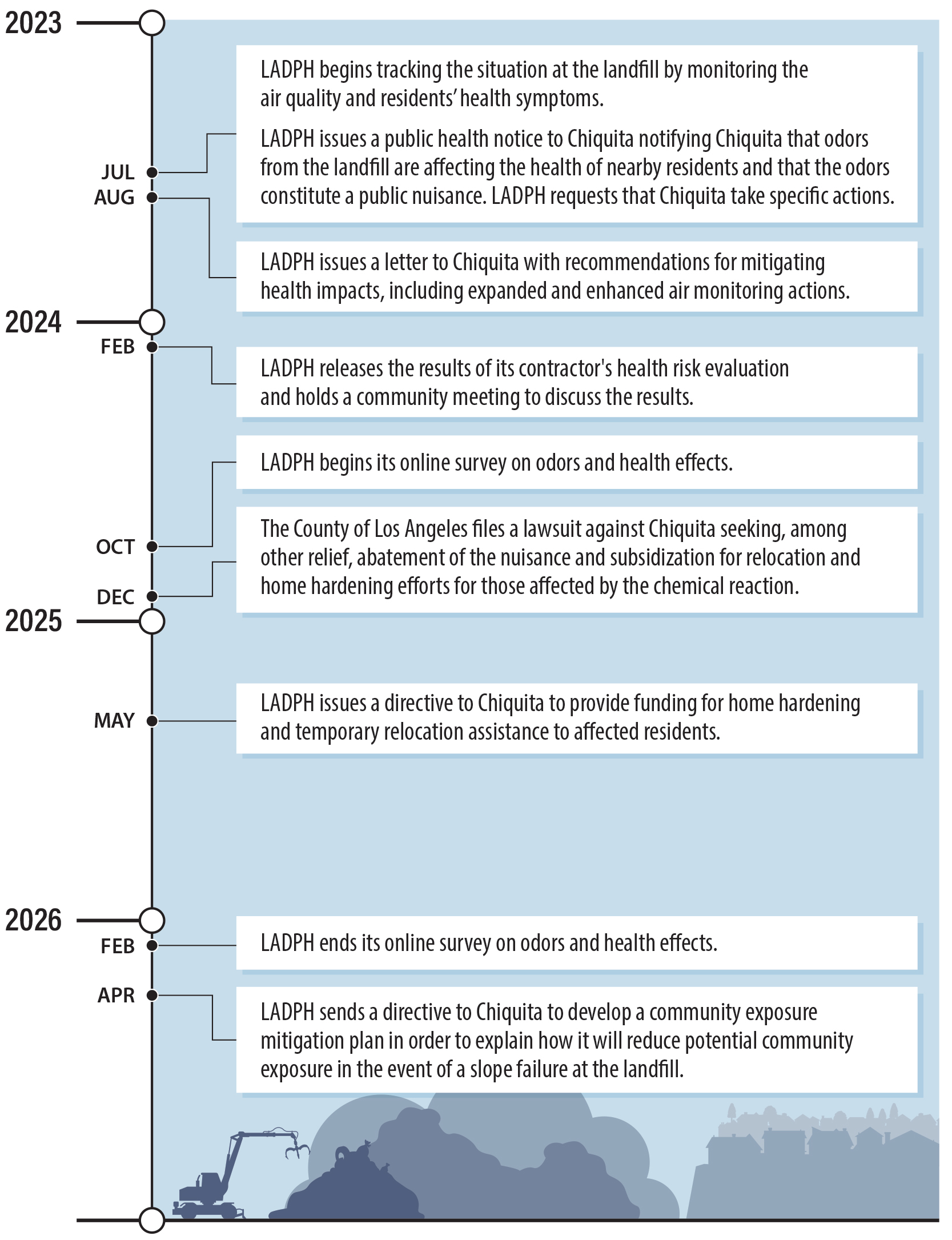
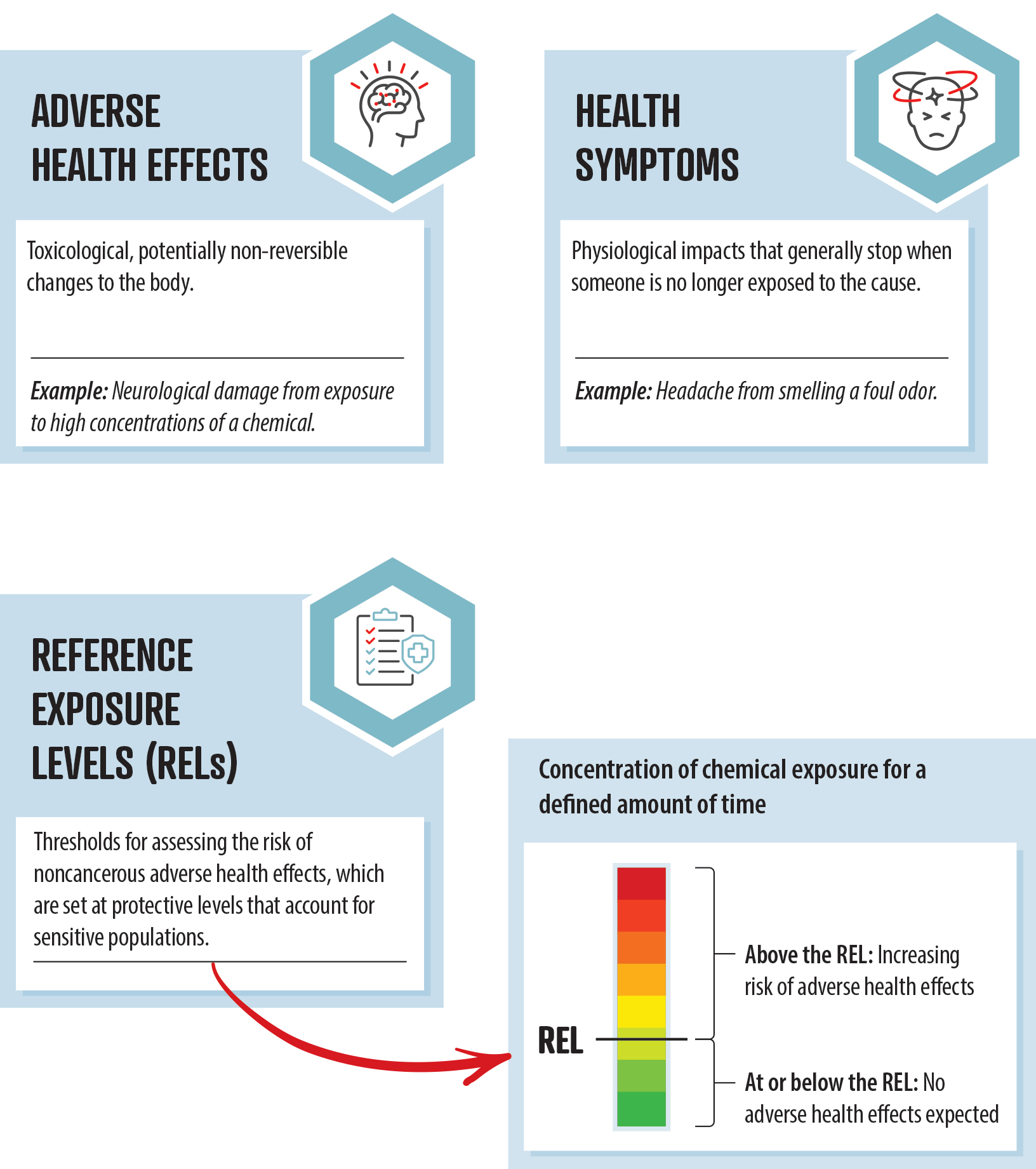
LADPH began responding in July 2023 to the health concerns of community members near the landfill. Figure 2 shows some of LADPH’s key response activities and Figure 3 explains some of the terms relevant to the discussion of effects on residents’ health. As Figure 3 shows, reference exposure levels (RELs) are an important public health concept because they point to the concentrations of a chemical that, under specified exposure conditions, could present a risk to human health. For example, the State’s Office of Environmental Health Hazard Assessment (OEHHA) has established RELs for different durations of exposure. Acute RELs are thresholds that apply to intermittent one‑hour periods of exposure, whereas chronic RELs are thresholds for continuous exposure over a lifetime, which are assessed by averaging the concentrations of chemicals in the air over a one‑year period.
Figure 2
Key Actions LADPH Took to Address Conditions at the Chiquita Canyon Landfill
Source: Court filing and LADPH’s notices, directives, letters, survey and health risk evaluation records.
Figure 2. The figure presents a timeline with events arranged from the top, representing the earliest actions, to the bottom, representing the most recent actions. It summarizes key actions taken by the Los Angeles County Department of Public Health in response to conditions at the Chiquita Canyon Landfill.
The first action occurs in July 2023. LADPH begins tracking the situation at the landfill by monitoring the air quality and residents’ health symptoms. LADPH also issues a Public Health Notice to Chiquita notifying Chiquita that odors from the landfill are affecting the health of nearby residents and that the odor constitutes a public nuisance. LADPH requests Chiquita take specific actions.
In August 2023 LADPH issues a letter to Chiquita with recommendations for mitigating health impacts including expanded and enhanced air monitoring actions.
In February 2024, LADPH releases the results of its contractor’s health risk evaluation and holds a community meeting to discuss the results.
In October 2024, LADPH begins its online survey on odors and health effects.
In December 2024, the County of Los Angeles files a lawsuit against Chiquita seeking, among other relief, abatement of the nuisance and subsidization for relocation and home hardening efforts for those affected by the chemical reaction.
In May 2025, LADPH issues a directive to Chiquita to provide funding for home hardening and temporary relocation assistance to affected residents.
In February 2026, LADPH ends its online survey on odors and health effects. The last event on the timeline is in April 2026, when LADPH issues a directive to Chiquita to develop a community exposure mitigation plan, in order to explain how Chiquita will reduce potential community exposure in the event of a slope failure at the landfill.
Figure 3
Key Terms for Understanding Health Risks and Effects
Source: Technical manual on RELs published by OEHHA, an interview with an OEHHA expert, and LADPH guidance on odors.
Figure 3. The figure is structured into three sections, showing three key terms used throughout the report, their definitions and examples.
The first term on the top left of the figure is “Adverse Health Effects.” This term refers to toxicological, potentially non‑reversible changes to the body. An example of Adverse Health Effects is neurological damage from exposure to high concentrations of a chemical.
The second term on the top right of the figure is “Health Symptoms.” Health symptoms are short‑term physiological responses that resolve once the exposure stops. An example of a health symptom is a headache from smelling a foul odor. The last term on the bottom half of the figure is “Reference Exposure Levels” or “RELs.” RELs are protective thresholds used to assess the risk of non‑cancerous adverse health effects, including consideration of sensitive populations. They specify chemical concentrations for a defined exposure period before the likelihood of experiencing adverse health effects increases. Chemical concentrations at or below RELs are not expected to cause adverse effects, while concentrations above RELs represent increasing risk.
This Audit’s Scope and Review of Other Health Hazard Events
The Legislature asked us to compare LADPH’s response to the chemical reaction to its response to other health hazard events, including the 2015–16 gas leak at Aliso Canyon and the January 2025 wildfires in Los Angeles County. In addition to the Aliso Canyon gas leak and the January 2025 wildfires, we reviewed two other health hazard events. To determine which additional events to include, we reviewed local health hazards to which LADPH had responded and selected two that had similarities to the conditions at the landfill. As Table 1 shows, we reviewed a total of five events.
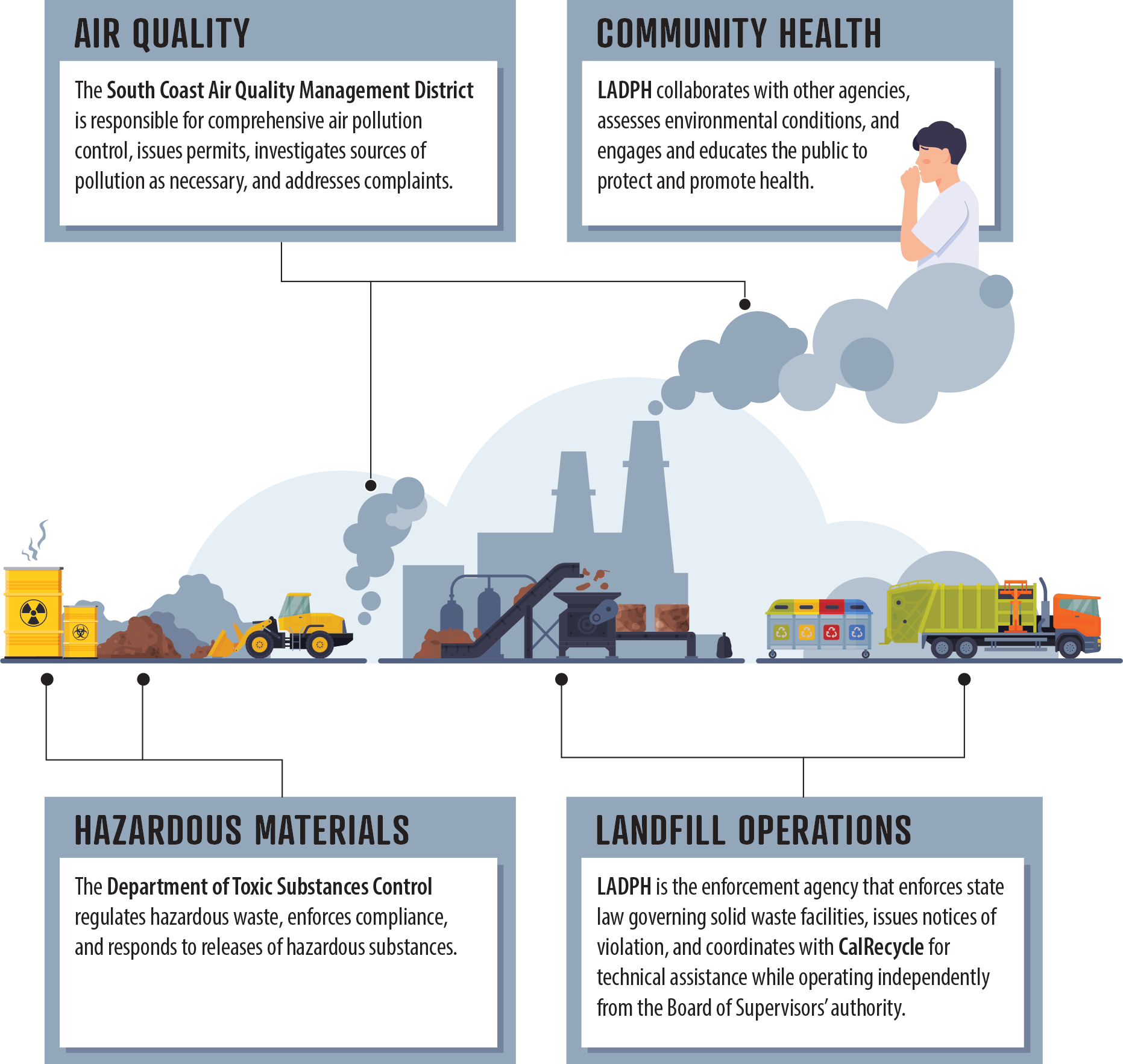
Although LADPH is the focus of this audit, several agencies are involved in addressing conditions at the landfill and the effects of the chemical reaction, as Figure 4 shows. For example, in May 2025, the South Coast Air Quality Management District reported having received more than 29,000 odor complaints from residents since January 2023 and has conducted extensive regulatory action to improve the air quality surrounding the landfill.
Figure 4
Several Agencies Are Involved in Responding to the Conditions at the Landfill
Source: State law and regulations, agency websites, and interviews with LADPH and enforcement program staff about departmental responsibilities.
Note: The agencies listed in this figure are those with responsibilities most related to this audit. For example, the California Air Resources Board and OEHHA are also involved in the landfill response less directly than those agencies the figure shows.
Figure 4. The figure shows four key elements affected by the landfill; each displayed in separate textboxes surrounding an image of a landfill. These elements are “Air Quality”, “Hazardous Materials”, “Landfill Operations”, and “Community Health”. Each textbox identifies the condition and the agency responsible for addressing it.
The first textbox, located at the top left of the figure, is labeled “Air Quality.” This condition is overseen by the South Coast Air Quality Management District, which conducts air pollution control, issues permits, investigates pollution sources, and addresses complaints.
The second textbox, located on the upper right of the figure, is labeled “Community Health.” For this condition, the Los Angeles County Department of Public Health collaborates with other agencies, assesses environmental conditions, and engages and educates the public to protect and promote health.
The third textbox, located at the lower left of the figure, is labeled “Hazardous Materials.” This condition is managed by the Department of Toxic Substances Control, which regulates hazardous waste, enforces compliance, and responds to releases of hazardous substances.
The fourth textbox, located on the lower right side of the figure, is labeled “Landfill Operations.” This condition is overseen by the Los Angeles County Department of Public Health, the local enforcement agency for solid waste facilities. The department enforces state law, oversees waste storage and transportation, issues notices of violation, and coordinates with CalRecycle for technical assistance while operating independently of the County Board of Supervisors.
The agencies shown in the figure are those most relevant to this audit; the California Air Resources Board and the Office of Environmental Health Hazard Assessment also participate in the landfill response, but to a lesser extent than the agencies highlighted in the figure.
Audit Results
LADPH Acted to Respond to Residents’ Health Symptoms but Missed Opportunities to Better Protect Community Health
Key Points
- The Los Angeles County Department of Public Health (LADPH) Solid Waste Management Program (enforcement program) has promptly taken reasonable steps to direct Chiquita Canyon Landfill, LLC (Chiquita) to implement measures intended to mitigate the impact of the high‑temperature, underground chemical reaction at the Chiquita Canyon Landfill (landfill) on the community near the landfill, such as physically covering the reaction area.
- Although LADPH stated that it monitored air quality throughout its response, we found that it often did not comment publicly when chemical levels exceeded protective thresholds, which may have contributed to confusion among residents about their safety.
- LADPH’s attempts to understand community health symptoms were limited by its poor communication about its online survey. Further, it does not have an up‑to‑date understanding of the health experience of the community around the landfill because it has not made recent efforts to proactively collect this information.
- It took LADPH nearly two years to issue a directive to Chiquita related to relocation assistance for residents near the landfill. LADPH’s relocation response was much slower than its response to the Aliso Canyon gas leak, which LADPH stated presented similar health concerns. In its Aliso Canyon response, LADPH initiated action on relocation within one month.
The Enforcement Program Has Taken Reasonable and Timely Steps to Mitigate the Effects of the Chemical Reaction
The enforcement program is one of many entities that have been taking steps to address the chemical reaction at the landfill and its effects on nearby communities. Other agencies in California and the U.S. Environmental Protection Agency (U.S. EPA) have also assessed the conditions at the landfill and required Chiquita to take corrective actions. Accordingly, the enforcement program is not the sole entity responsible for ensuring that conditions at the landfill do not threaten public health. Nevertheless, the enforcement program is responsible for ensuring that Chiquita complies with state laws governing waste management, including those that require Chiquita to maintain the landfill in a reasonable state of repair. To do so, the enforcement program generally inspects the landfill monthly to observe conditions such as the operation of the landfill gas monitoring system and whether dust and litter are adequately controlled. From calendar year 2020 through 2022, the enforcement program noted a low rate of violations and areas of concern per monthly inspection of the landfill. According to the enforcement program’s environmental health services manager, in her experience, before the chemical reaction began in 2022, Chiquita was just as cooperative during its monthly inspections as any other landfill operator.
If the enforcement program determines that a solid waste facility or disposal site, such as a solid waste landfill, has violated applicable requirements, it may issue an order establishing a timeline by which the operator must bring the site into compliance. The enforcement program may also impose a financial penalty if the operator does not comply with the ordered timeline. Further, the enforcement program may suspend or revoke a facility’s permit, or it may pursue other legal action to enforce its orders. Site operators may appeal these orders by requesting a hearing before a hearing officer or three‑person hearing panel appointed by the Los Angeles County Board of Supervisors (Board of Supervisors) or chairperson of the board, and, following such a hearing, may further appeal the decision to the California Department of Resources Recycling and Recovery (CalRecycle). As part of our audit, we determined whether the actions the enforcement program recommended or required Chiquita to take were reasonable, whether the enforcement program acted in a timely manner, and whether it took reasonable steps to use its authority to compel Chiquita to comply.
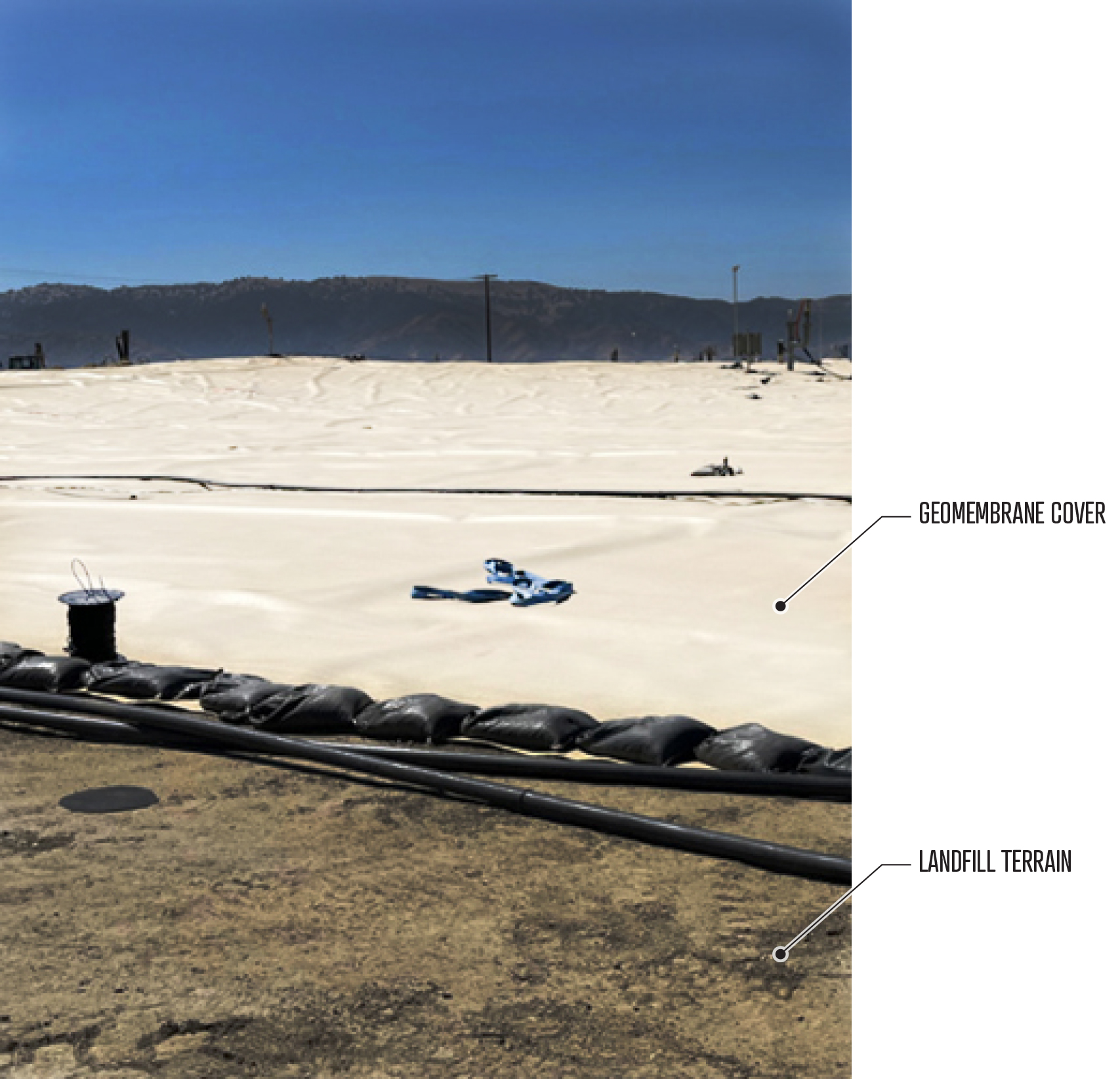
We conclude that the enforcement program has required Chiquita to pursue a reasonable course of action given the nature of the situation to which it is responding. As the Introduction describes, staff at both CalRecycle and Chiquita anticipate that the chemical reaction will continue for years. However, both the enforcement program and Chiquita believe it is possible to mitigate its effects. Therefore, the enforcement program’s efforts have focused on mitigating the effects of the chemical reaction and understanding whether it is spreading. For example, the enforcement program has ordered Chiquita to physically cover areas of the landfill, with the goal of reducing the landfill gas emissions that reach the community. Chiquita must cover the landfill with a geomembrane cover, which is specially engineered from impermeable materials and designed to keep landfill gas from escaping. Figure 5 shows a picture of the installation of the geomembrane cover.
Figure 5
The Enforcement Program Has Ordered Chiquita to Install a Geomembrane Cover Over Areas of the Landfill
Source: U.S. EPA.
Figure 5. The image depicts the off-white geomembrane cover laid over the landfill terrain. A text box labels the covered portion “Geomembrane Cover,” and another textbox labels the uncovered foreground as “landfill terrain.” Black sandbags weigh down the edge of the geomembrane cover. The background shows hills, utility poles, and the sky.
The enforcement program also took steps to address the leachate at the landfill site. According to the California Environmental Protection Agency, leachate is waste liquid that is present in landfills. It is treated as hazardous waste, and the chemical reaction is causing there to be additional quantities of this waste at the landfill. In November 2023, the enforcement program sent Chiquita a letter expressing concern about outbreaks of leachate and the stability of a slope of terrain that had become saturated with leachate. The enforcement agency required Chiquita to develop a related slope stability analysis work plan, which the enforcement agency conditionally approved in December 2023. Further, in May 2025, the enforcement program ordered Chiquita to relocate a group of leachate tanks to an area of the landfill that is unaffected by the chemical reaction because the ground under the tanks was settling. Chiquita temporarily relocated these tanks by November 2025.
In addition, the enforcement program has required Chiquita to take other actions, such as installing temperature monitoring probes (temperature probes). According to a November 2023 letter from the enforcement program to Chiquita, temperature probes are the primary method to track the chemical reaction’s progression accurately. Appendix A explains in more detail the types of corrective actions the enforcement program has directed Chiquita to take.
The enforcement program has also acted with reasonable speed. In summer 2023, enforcement program inspectors documented odor violations and complaints in their inspection reports. According to a later enforcement order, the enforcement program contacted CalRecycle in August 2023 to request its assistance. And in September 2023, the enforcement program noted violations of regulations related to methane emissions and leachate. By October 2023, it had told Chiquita to implement specific corrective actions aimed at mitigating the effects of the chemical reaction. The enforcement program then conducted an on‑site visit with other agencies in November 2023; in late 2023 and the first half of 2024, it issued a series of letters containing many required actions.
At least initially, the enforcement program and Chiquita worked together, frequently corresponding over very brief periods whenever the two entities were discussing mitigation measures and timelines for implementation. For example, in early 2024 the enforcement program and Chiquita corresponded regularly about two mitigation measures: the installation of temperature probes and a physical cover over the chemical reaction area.
However, these exchanges did not always result in Chiquita completing the corrective actions that the enforcement program wanted. For example, in early 2024, the enforcement program established an expectation that Chiquita would install a geomembrane cover over portions of the landfill, which Chiquita began to do. By May 2024, Chiquita was not covering the landfill at the rate the enforcement program expected. The enforcement program issued a compliance order in June 2024, which represented an escalation of its use of authority. That order required Chiquita, among other steps, to complete the installation of a cover over the chemical reaction area, submit a variety of reports that would assist the enforcement program in understanding the size and severity of the reaction, and submit a plan detailing how Chiquita proposed to use air and soil barriers to slow or contain the reaction.
To comply with the June 2024 order, Chiquita installed landfill gas extraction wells, laid 30 acres of geomembrane cover over the reaction area, and submitted reports that included information about the landfill’s slope stability. However, most notably, Chiquita did not propose a satisfactory plan for slowing or containing the chemical reaction through the use of air or soil barriers, despite submitting multiple plans for the enforcement program’s approval.
In response to Chiquita not submitting a satisfactory air and soil barrier plan, as well as evidence indicating that the chemical reaction was expanding, the enforcement program issued a second order in May 2025. The enforcement program did not issue its second order until nearly a year after its June 2024 order because it was not immediately clear that further orders were necessary. The June 2024 order contained 12 distinct mitigation measures the enforcement program ordered Chiquita to take by a specific date, and Chiquita fully implemented 10 of these measures either on time or within one week of the deadline the enforcement program established. For those mitigation measures Chiquita did not fully complete by their deadlines, Chiquita engaged with the enforcement program on each issue before it was evident that further action was needed to prompt Chiquita to comply.
The enforcement program’s May 2025 order directed Chiquita, among other measures, to install a specified type of cover over all areas of the landfill site that were not covered at that time and to which the chemical reaction had expanded or had the potential to expand. Chiquita appealed the order later that month, stating that it was already working with the California Department of Toxic Substances Control to create a phased expansion of the landfill cover and that the enforcement program’s deadline for submitting a plan for expansion was impossible to meet. By November 2025, Chiquita had submitted two plans for cover expansion, neither of which the enforcement program deemed acceptable. At that time, the enforcement program established a deadline of August 31, 2026, for Chiquita to cover the entire facility where waste is disposed.
In April 2026, the county’s Solid Waste Facilities Hearing Board held an appeal hearing and denied Chiquita’s appeal, meaning that the deadline for Chiquita to fully install the cover at the landfill by August 31, 2026 remained in effect. As of the conclusion of our audit’s fieldwork, Chiquita had appealed to CalRecycle to reconsider the local hearing board’s decision, and CalRecycle told us its hearing officer was actively working on reviewing this appeal. The enforcement program’s May 2025 order lists enforcement actions that may result from noncompliance with the order, including civil penalties of up to $5,000 per day for each violation, suspension or revocation of the permit to operate the landfill, or action in superior court to enforce the order. According to the enforcement program’s environmental health services manager, the enforcement program would consult with legal counsel before taking any enforcement action.
Chiquita has been directed to take similar action by two other regulating agencies: the State Department of Toxic Substances Control and the U.S. EPA, both of which have ordered Chiquita to cover the areas of the landfill where the reaction may spread. In a July 2026 letter to the Chiquita Canyon Landfill Community Advisory Committee (CAC), Chiquita reported that it expected to complete the deployment of the additional 100 acres of geomembrane cover required by the U.S. EPA by December 1, 2026. The enforcement program’s environmental health services manager conveyed to us that covering these 100 acres would leave uncovered about 66 acres of the landfill site that the enforcement program’s May 2025 order directed Chiquita to cover.
LADPH Did Not Proactively Communicate With the Community About Specific Air Quality Data
The county emphasized the importance of monitoring air quality near the landfill when it issued a conditional use permit to Chiquita in 2017. The permit requires Chiquita to monitor air quality at the landfill site and at areas surrounding the landfill and to implement an odor impact minimization plan, which must include measures that will control odors from extending beyond the landfill site. Chiquita must also hire an independent consultant to identify certain locations for continuous air monitoring stations within a 5‑mile radius of the landfill. The consultant must be qualified to read the monitoring results and to have those results analyzed by a laboratory. In addition, the permit requires Chiquita to present the results to LADPH and the South Coast Air Quality Management District (air quality district) quarterly and annually.
Chiquita submits reports for two separate air monitoring programs: the community air monitoring program, which it operates because of its conditional use permit, and the enhanced air quality monitoring program, which it began operating in response to an August 2023 recommendation from LADPH. In practice, reports from both programs show that Chiquita is measuring the concentrations of specific chemicals in the air and comparing those concentrations against applicable thresholds. For example, Chiquita measures the concentration or level of hydrogen sulfide in the air and compares it to the acute reference exposure level (REL) for that chemical. As Figure 3 in the Introduction shows, the REL for a chemical is a key metric for assessing risk to health. Acute RELs describe thresholds for particular chemicals under which humans are not expected to experience noncancerous adverse health effects when exposed intermittently to a chemical for one‑hour periods. Measurements of a chemical’s presence that rise above a REL are known as exceedances. When we discuss exceedances throughout this section, we refer only to exceedances of acute RELs.
The permit also takes into consideration that LADPH may have recommendations for the protection of public health in light of Chiquita’s air quality monitoring. Specifically, the permit states: “Evaluation of air quality monitoring results shall include recommendations by the [LA]DPH regarding health and safety impacts on nearby residents, schools, and centers of employment.” In fact, in a September 2023 statement on the landfill incident, LADPH said that its role was to review air monitoring reports for potential health impacts. In this statement, LADPH also stated that it reviews continuous landfill air monitoring data and follows up with Chiquita.
As the Introduction describes, community members have reported negative health symptoms related to the increase in landfill gas emissions and resulting odors. Because these health concerns are linked to the presence of chemicals in the air, and an increase in the presence of these chemicals in the air could threaten community health, we expected that LADPH would examine air quality data to evaluate health risks and then communicate effectively with the public about its evaluation.
LADPH’s Review of General Air Quality Information
LADPH’s chief science officer explained that, as part of its effort to understand air quality in the communities near the landfill, LADPH reviewed the odor complaints that residents submitted to the air quality district, the notices of violation that the district issued to Chiquita, and information community members reported to LADPH.2 These activities would all assist the department in understanding the overall quality of the air because, even though they do not specify the level of certain chemicals in the air, they demonstrate the experience that community members have about air quality. This is because the human body can detect some chemicals that cause odors at concentrations lower than the acute REL. Also, people can experience health symptoms when odors are at these lower levels. Therefore, LADPH can assess certain aspects of air quality based on reports of odors from the community and without precise measurements of the levels of chemicals in the air.
Early in its response to the effects of the chemical reaction, LADPH communicated with community members about the health effects associated with the odors from the landfill. It did so through flyers that it published and verbal updates that it gave to the community at CAC meetings. The department also provided advice about how individuals could protect themselves from these effects, generally through avoiding exposure and using air filtration devices. We mention later in this report that some community members believed this advice was insufficient. Nonetheless, LADPH’s review of complaints and notices of violations likely assisted it in responding in a broad manner to the conditions created by the chemical reaction. These information sources are a reasonable basis for maintaining a general understanding of the air quality conditions in the communities near the landfill and whether they have improved or worsened.
LADPH’s Review of Specific Air Quality Data
A more specific review of the presence of chemicals is also important for assessing the risk to a community. In fact, LADPH’s communications to the community indicated that this type of monitoring, including comparing chemicals to health thresholds such as the acute REL, was part of its response activities and risk assessment. We note that LADPH engaged in three primary activities related to measuring levels of specific chemicals in the air: an initial effort to collect information, an in‑depth one‑time review, and an ongoing review of Chiquita’s data. Although it sometimes shared its assessment of health risks related to these data, we believe that LADPH should have done more to inform the public about its review of these data and the health risks associated with them.
In the initial two months of its response, LADPH collected air quality information through direct measurement and observation. In July and August 2023, LADPH staff made a total of 11 visits to the communities near the landfill to investigate the odors and conduct air quality testing. According to internal correspondence about these visits, staff members periodically exited their vehicles and measured air quality using handheld gas detectors.3 Staff reported detecting odors during three of the visits and detected chemicals with their handheld gas detectors during two of the visits. LADPH’s deputy director of health protection stated that the department did not share the results of this effort with the community but used the results to understand residents’ experiences and inform LADPH’s early response efforts.
Following these efforts, the county contracted with an environmental consulting firm to perform an independent health risk evaluation to assess the health risks associated with exposure to increased emissions resulting from the incident at the landfill. Beginning in October 2023 and concluding in December 2023, the contractor conducted independent air sampling and evaluation in the communities surrounding the landfill. The contractor collected air samples to investigate outdoor air quality and evaluate potential health risks associated with odors from the landfill, and it measured volatile organic compounds and sulfur compounds to assess the health risks associated with exposure to landfill emissions.
The contractor’s evaluation showed that, according to its sampling, the communities near the landfill did not experience exceedances of acute RELs of sulfur compounds. The contractor also sampled background air quality levels to establish the baseline conditions in the communities near the landfill, but outside of the area where odor complaints were documented. The contractor’s data suggested that emissions from the landfill may contribute to concentrations of one specific volatile organic compound—benzene—rising above background levels on some days. Nevertheless, the study also found that the average levels of benzene in the air near the landfill were similar to or lower than average benzene levels elsewhere in the region. The evaluation concluded that any health risks presented by air quality in the community were primarily the result of larger‑scale air quality issues in Los Angeles County. LADPH shared the results of this evaluation with the public beginning in February 2024 by publishing the report on its website, holding a dedicated community meeting to discuss its results, and reiterating those results at CAC meetings.
Although the contractor’s evaluation provided a detailed analysis, both this study and LADPH’s earlier effort to gather information through gas detectors were limited because they assessed specified levels of chemicals only for comparatively short, discrete periods of time. LADPH’s third means of reviewing air quality information—data that Chiquita provided to LADPH on an ongoing basis—gave LADPH the opportunity to continuously review information about specific chemical levels and provide information to the community about potential health and safety impacts. Chiquita has provided this information to LADPH at least quarterly for the duration of LADPH’s efforts to respond to the chemical reaction. Notwithstanding the potential value of reviewing these data and communicating with the public about them, we found that LADPH could not always demonstrate that it completed reviews of the data, and the department did not communicate with the public about specific exceedances.
No Documentation of Review of Air Quality Reports
The deputy director of health protection asserted that LADPH reviewed these air quality data regularly, but we could not verify how often LADPH completed its reviews. Records that LADPH provided to us did not demonstrate that someone at LADPH had always reviewed the air quality reports that the department received or show the department’s assessment of the air quality data. Most of the air quality monitoring reports that LADPH showed us that it had received were lacking a corresponding assessment or report that would demonstrate that LADPH had reviewed the air quality data. We expected that LADPH would be able to demonstrate that it was conducting such reviews. For example, in October 2025, the primary analyst responsible for reviewing the air quality reports sent an email to the chief science officer confirming that he had reviewed a recent air quality report and found nothing of concern. However, LADPH did not provide that type of internal correspondence for most of the other air quality monitoring reports it received.
Additionally, we found reason to question the depth of LADPH’s review of the air quality data. The analyst primarily responsible for reviewing these data and elevating concerns to leadership told us he was unaware of specific, and particularly high, exceedances that we asked about. He also explained that the purpose of LADPH’s initial air quality monitoring was to determine whether there were unusual, particularly dangerous chemicals in the air and not to identify exceedances. This approach is concerning given that exceedances can be, under specific circumstances, threats to health.
Limited Communication With the Public About Exceedances
Chiquita reported frequent exceedances of the acute REL for hydrogen sulfide in late 2023 and the first quarter of 2024, and occasional exceedances of the acute REL for hydrogen sulfide during the second and third quarter of 2024. Chiquita also reported rare exceedances of the acute REL for benzene between 2023 and 2025. To keep the community informed of its assessment of health risks, LADPH could have provided written comments to quarterly air quality reports or otherwise published its health assessment, even when it did not believe there would be any potential health and safety impacts. In fact, LADPH’s comments on the third‑quarter report in 2022 conveyed that particular condition: a confirmation that it had reviewed the data and did not expect that there would be health and safety impacts to nearby residents, schools, and centers of employment. Comments such as these could help reassure the community that experts are monitoring current conditions and that despite specific air quality conditions, impacts to their health and safety are not expected.
We found that LADPH issued few written communications of any kind regarding its assessment of specific levels of chemicals in the air, despite frequent questions and comments from the community about air quality and risk to health. LADPH’s deputy director of health protection stated that LADPH generally communicates when an initial public health assessment is completed, when a credible hazard is identified, or when new information materially changes the understanding of risk or recommended protective measures, and it does not issue recurring communications when its previous assessment remains unchanged. Additionally, the deputy director of health protection explained that an exceedance by itself does not determine the potential level of health risk. She explained that interpreting an exceedance to determine the potential health risk depends on factors such as magnitude, duration, monitoring conditions, and other relevant context.
Because LADPH stated that exceedances require interpretation and, given that there was a period during which continuous air quality monitoring data suggested that hydrogen sulfide had exceeded the RELs, we asked LADPH whether it had followed up on any of the hydrogen sulfide exceedances to explain related health risks to the public. In response, the deputy director of health protection did not identify any specific communications that the department had issued to the public. Instead, she described general activities, such as discussions that she said the department had with other agencies and attendance at community meetings where exceedances were discussed. In our review of available records, we did not identify any evidence of LADPH explaining to the public the health risks of the hydrogen sulfide exceedances when they were most prevalent.
LADPH’s chief science officer further explained that LADPH contributed to the health‑related messaging and materials made available through a website managed by a multiagency collaborative and provided examples that corroborated her statement. We reviewed this website and found that it includes some limited information about exceedances from the period of September 2023 through April 2024. However, the number of exceedances the website describes is far fewer than the number found in Chiquita’s quarterly air monitoring reports from this period. Additionally, the website and its information were not available to the community until summer 2024, several months after the exceedances occurred.
LADPH’s chief science officer stated that the department did not routinely focus its community messaging on the technical details of RELs or individual exceedance values because those measures require context to interpret and by themselves do not establish the magnitude of health risk. We believe that the lack of communication from LADPH about specific exceedances resulted in residents not receiving timely and important information about their health and safety implications. Given that LADPH shared with us that it believes that it does not need to issue notices to the public when its previous assessments of air quality have not changed, we believe that the Board of Supervisors should take action to ensure that LADPH regularly provides updates to the communities near the landfill about the health implications of the air quality in their area.
LADPH Has Not Clearly Communicated Its Efforts to Assess Community Health Symptoms and Lacks Data Showing Whether Those Symptoms Persist
Investigating and understanding health symptoms that are occurring at the population level are significant elements of public health practice. One of the essential health services of the Public Health Accreditation Board (PHAB) is to investigate, diagnose, and address health problems and hazards, and its accreditation standards set the expectation that public health agencies will use surveillance—the continuous, systematic collection, management, and analysis and interpretation of health‑related data—to plan and implement public health practices. Among other purposes, the data may be used to evaluate the success of mitigation efforts and add to the understanding of health effects.
LADPH indicated that there are multiple pieces of information it considers important when responding to events like those at the landfill. It shared that measurable data such as notices of violation issued by the air quality district, identification of the source of the odors, and air quality data are all primary evidence of whether conditions are changing. LADPH shared its perspective that community‑reported symptoms provide supporting information but are not a primary indicator because individual symptoms are subjective and variable. We acknowledge that no one source of information is likely sufficient to provide complete insight into conditions near the landfill. However, without complete, accurate, and up‑to‑date community symptom information, the department would lack important insights into the extent and type of symptoms in the community. Therefore, we believe it was important for LADPH to have effectively collected this information.
Our review found that LADPH has not effectively assessed the community’s health condition to understand the potential effects of the chemical reaction for the duration of its response efforts. LADPH has primarily used two methods to monitor health symptoms. Specifically, it operates a phone hotline and email address to which residents can report their health concerns, and it conducted an online odor and health effects survey. However, it does not have up‑to‑date information about the symptoms that individuals are experiencing because it has stopped receiving a significant number of symptom reports from the community and has not taken steps to proactively collect that information.
Phone Hotline
As a part of LADPH’s initial attempt to understand and document the health symptoms that residents were experiencing, it assigned an LADPH public health nurse the responsibility to take reports from residents who called, emailed, or texted LADPH. This reporting option predated the chemical reaction at the landfill and can be used by county residents to report health concerns from any source. From July 2023 through January 2025, the nurse recorded residents’ concerns, symptoms, and other information. During that time, about 65 individuals called LADPH, collectively totaling more than 650 calls but representing only a small percentage of households LADPH included in its later outreach efforts when monitoring symptoms.
Online Survey
Toward the end of 2024, LADPH developed a second approach to collecting health information from residents. In late October of that year, LADPH launched an online survey that it intended to use to collect information about the impacts that the chemical reaction was having on community members. Although the hotline continued to be available, the public health nurse who had been taking reports from the public explained that after LADPH began its survey, he and the department directed residents to use the survey to report their symptoms. Consequently, LADPH received fewer calls to the hotline in the months following the launch of the survey, and by December 2024, the survey had essentially replaced the hotline as the department’s data collection method. LADPH’s chief science officer told us that the online survey was designed to capture standardized information about odors and their associated health impacts. In December 2024, LADPH began posting monthly updates to its website that informed website visitors of survey results to date.
LADPH promoted the survey by announcing it at a community meeting, creating a targeted social media campaign, and conducting an in‑person, door‑to‑door effort targeting about 1,400 addresses in Val Verde, Hasley Canyon, and Castaic. These survey promotion efforts occurred in November and December 2024. LADPH’s survey website stated that the county was conducting the survey to evaluate the effectiveness of landfill odor mitigation efforts and that community feedback could help the county and its state and federal partners improve monitoring and response efforts, identify patterns, and enhance their understanding of environmental conditions related to the chemical reaction. LADPH intended for the survey to be used repeatedly by residents to report odors each day they experienced them.
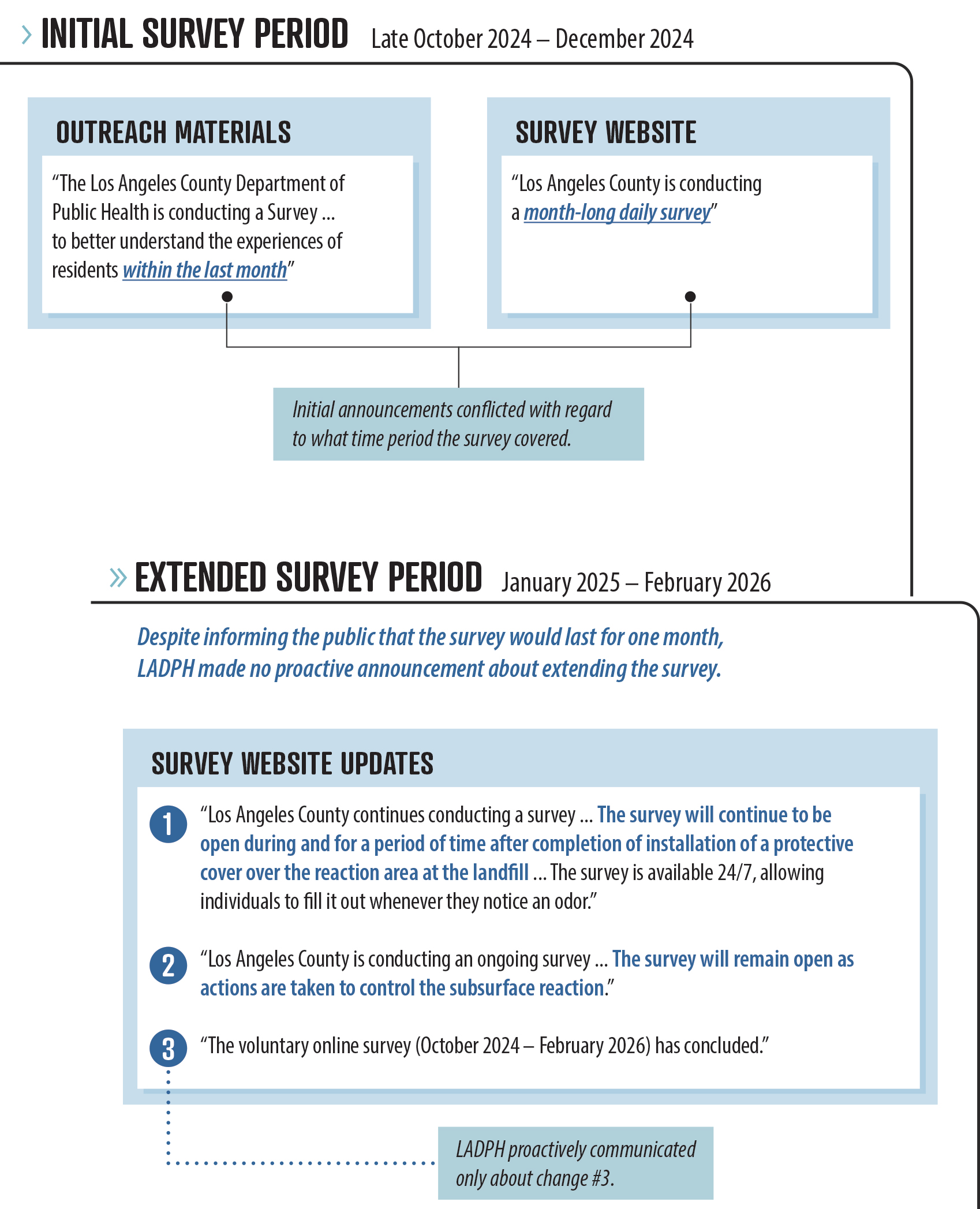
However, LADPH did not consistently communicate clear information to the community about the survey, which likely diminished its effectiveness in achieving the goals it set for the survey. Figure 6 shows the wording that LADPH used in its written communication about the survey. As the Figure shows, the written communications were not uniform in their messaging about the survey. The promotional materials that LADPH developed to leave at residents’ homes during its neighborhood canvassing effort conveyed that the survey would be retrospective, whereas the survey website described it as ongoing and meant to reflect community members’ present‑day experiences. The written promotional materials that LADPH used when going door‑to‑door to notify community members of the survey were particularly important because they were so frequently the means for individuals to learn about the survey. The records LADPH kept about its door‑to‑door promotion show that at more than 90 percent of the locations that LADPH staff visited, they left promotional materials at the doorstep because they did not encounter a person to speak with.
Figure 6
LADPH Issued Inconsistent and Changing Messages About Its Online Odor and Health Effects Survey
Source: LADPH survey website, LADPH survey planning documentation, and statements LADPH made at community meetings.
Figure 6. The figure divides LADPH’s online odor and health effects survey into two sections representing two different time periods. The top half of the figure is labeled “Initial Survey Period – Late October 2024 to December 2024.” The bottom half is labeled “Extended Survey Period – January 2025 to February 2026.”
In the top section, LADPH’s initial survey period is shown as occurring from late October 2024 through December 2024. A text box highlights that initial announcements conflicted regarding what time period the survey covered. For example, early outreach materials stated, “The Los Angeles County Department of Public Health is conducting a Survey…to better understand the experiences of residents within the last month”, while later information on the survey website stated, “Los Angeles County is conducting a month-long daily survey.”
In the lower second section of the figure labeled “Extended Survey Period – January 2025 – February 2026” the graphic states, “Despite conveying the survey would last for one month, LADPH made no proactive announcement about extending the survey.”
Below this, the figure shows a numbered list of three updates to the survey website.
The first website update stated, “Los Angeles County continues conducting a survey…The survey will continue to be open during and for a period of time after completion of installation of a protective cover over the reaction area at the landfill…The survey is available 24/7, allowing individuals to fill it out whenever they notice an odor.”
The second website update stated, “Los Angeles County is conducting an ongoing survey…The survey will remain open as actions are taken to control the subsurface reaction.”
The third website update stated, “The voluntary online survey (Oct 2024 – February 2026) has concluded.”
At the bottom of the figure, a final text box branching from the three numbered points states that LADPH only proactively communicated about the third survey website update when the survey concluded.
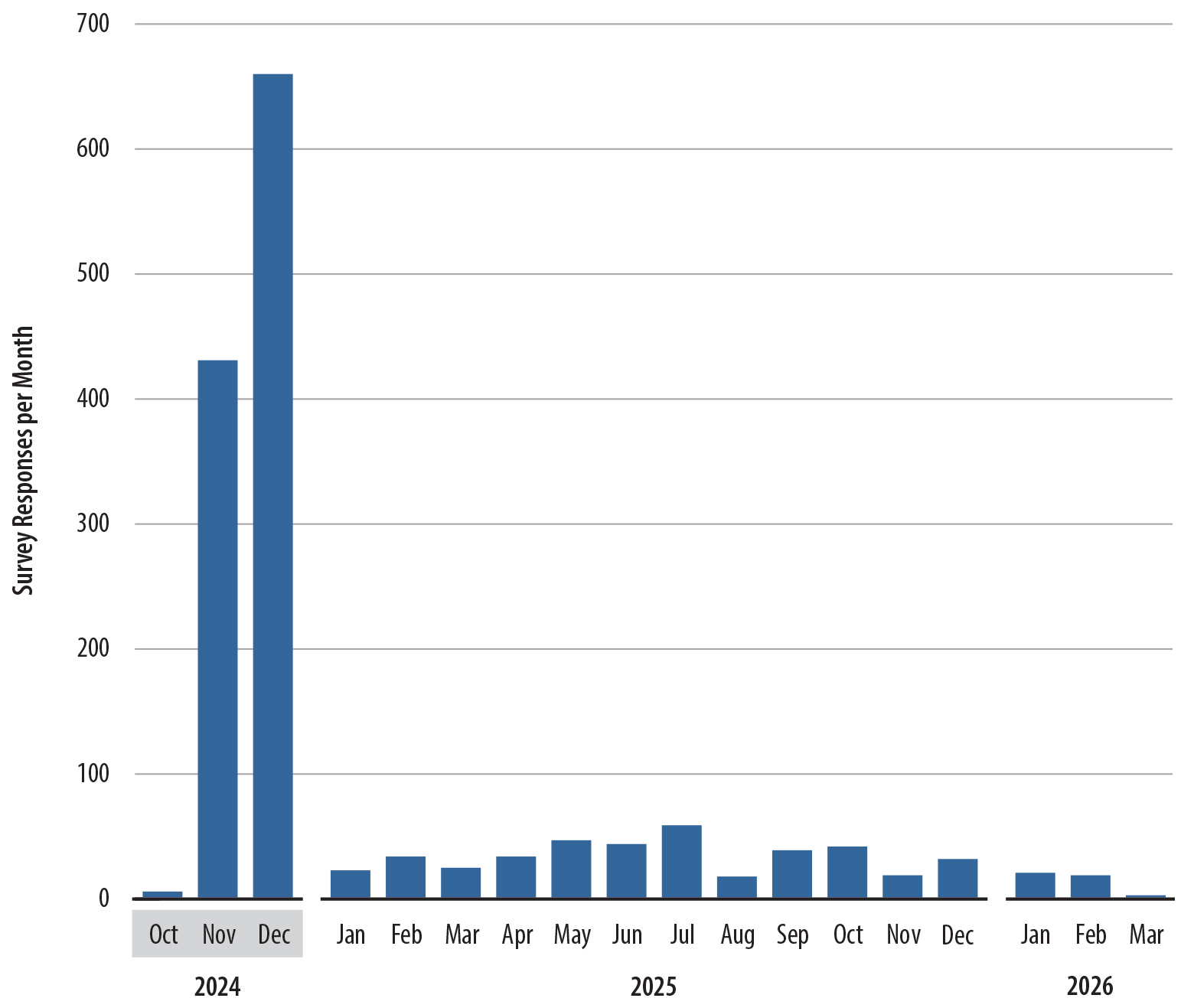
The most significant communication problem that we identified occurred in late 2024 and early 2025 when LADPH determined that it would keep the survey open for longer than it originally planned but did not perform outreach to proactively communicate that change to residents. Although the messages that LADPH originally communicated about the survey’s duration were not completely uniform, they generally conveyed the idea that the survey would either last for or concern itself with the experiences people had over a one‑month period. The survey responses that LADPH received and statements made by community members indicate that members of the community generally understood that the survey was to last only for a limited time. As Figure 7 shows, the department received most of its survey responses—about 70 percent—during the initial survey period of late October through December 2024. At the conclusion of this period, LADPH determined that it would leave the survey open, allowing residents to continue to report information. However, the department did not communicate this change by proactively providing notice to the community at the time it happened or soon thereafter. The only message to the community about this change that we could identify at the time the change occurred was a change to the description of the survey on its website, as Figure 6 shows. Simply revising the website’s language is a passive approach to communicating the change, because it relies on residents to access the website later on their own, despite previously being told of the survey’s limited duration.
Figure 7
LADPH Received the Majority of Its Survey Responses in the Initial Survey Period
Source: LADPH’s survey data.
Figure 7. The figure shows a bar chart illustrating how many survey responses LADPH received each month while the online survey was active. The Y‑axis displays the number of responses in increments of 100, ranging from 0 to 700. The X‑axis lists the months from October 2024 through March 2026.
In October 2024, the survey received very few responses. In November 2024, the survey received over 400 responses, and in December 2024, the survey received over 600 additional responses. By January 2025, monthly survey responses remained well below 100, and each month thereafter until the survey closure in March 2026 also had fewer than 100 responses per month.
LADPH acknowledged the community’s confusion about the survey at a February 2026 meeting of the CAC where it announced that it would be ending the survey. The deputy director of health protection attended that meeting to present the results of the survey and twice acknowledged during the meeting that LADPH had heard from community members that they did not know the survey was still available to them.
The survey did not provide LADPH with adequate data to achieve its goal: to assess the effectiveness of mitigation activities at the landfill. In fact, LADPH does not believe it can reliably quantify how many individuals responded to the survey. At the February 2026 CAC meeting, the deputy director of health protection stated that the department did not know how many people had taken the survey, as the text box shows. We reviewed the survey data and agree that one cannot use the data to determine how many individuals took the survey or how often a single individual did so. This differs from survey information that LADPH presented to the Board of Supervisors following the Aliso Canyon event, in which it knew the number of households it had surveyed. Nonetheless, with an average of 33 survey responses per month during the expanded survey period, the survey had an overall low response rate during the majority of its duration. The low response rate from an unknown number of respondents means that LADPH’s survey data are insufficient to draw conclusions about whether the community’s health and symptoms worsened, improved, or otherwise changed during that time. Since LADPH closed the survey in February 2026, it has used its phone hotline to attempt to collect information about and monitor the community’s health concerns. As of June 2026, the public health nurse reported to us that he had received very few contacts—calls or emails—from residents reporting symptoms.
February 2026 CAC Meeting Statements by LADPH
“It’s not a scientific survey that has controls, it’s really to get a sense of the community’s experience. And so it may have, it could be 1,500, the same person responding 1,500 times. It could be 1,500 individual people. It could be 700 people responding twice. I don’t know and I don’t think we captured it. We don’t know how many times an individual responded.”
Source: LADPH’s deputy director of health protection, February 2026 CAC meeting recording.
When we asked how else LADPH knows about the health condition of the communities near the landfill, LADPH’s chief science officer explained that the department reviews notices of violation that the air quality district issues, monitors air quality data to determine whether there are any changes in landfill emissions, and discusses those findings with partner agencies. However, the steps the chief science officer described are not adequate to understand the community’s health. Notices of violation issued by the air quality district do not include specific health information but instead simply remark that the landfill has discharged air contaminants that could cause injury, detriment, or nuisance to people. Air quality data can help inform LADPH about the levels of symptom‑causing chemicals in the environment, but the data do not provide specific details about the health condition of the community.
Proactively soliciting new information from residents would better enable LADPH to tailor its response activities to the conditions that residents are currently facing and learn whether they have changed. As of the conclusion of our audit, LADPH did not have up‑to‑date information about the prevalence of symptoms in the communities near the landfill, which is critical to knowing whether the department needs to change its approach to protecting the public. Furthermore, we observed during this audit that LADPH did not see the value in proactively collecting additional information, nor does it intend to do so. Therefore, we believe that the department would benefit from clear direction from the Board of Supervisors, directing it to routinely collect health symptom information and publish the results for the community to review.
Attempts to Document Symptoms and Protect Public Health
The Legislature also asked us to evaluate the steps that LADPH has taken to document symptoms and act to protect the public’s health in instances when the science and research on exposure to hazardous chemicals does not adequately reflect the symptoms, impact, and experiences of the community. LADPH took the same steps to document symptoms regardless of whether the reported symptoms were expected or unexpected when compared to scientific research. When communicating with the public about health, LADPH focused its comments on the most frequently reported symptoms—such as headaches and nausea—which it stated are consistent with exposure to odors such as those from the landfill. When advising residents about their symptoms, including less common symptoms that may have a less established connection to exposure to odors, LADPH has recommended to individuals that they should consult with their personal physicians to address their reported health problems.4 Although it is reasonable for LADPH to have directed individuals to their personal physicians to address specific health concerns, the department could have better assessed health in the community and potentially better understood the prevalence of symptoms. If it had, it would have been able to develop a more informed response. LADPH also took other steps to protect public health, such as commissioning a health risk evaluation and advocating for relocation. We describe our evaluation of these steps elsewhere in this report.
LADPH Lacked Urgency When Advocating for Resident Relocation
Throughout its response to the chemical reaction at the landfill, LADPH has indicated that community members will experience relief from the symptoms caused by exposure to landfill gases if their exposure to those gases stops. For example, in a September 2023 flyer, LADPH stated that symptoms from short‑term exposure to landfill gas odors usually resolve when exposure to the gases stops. Similarly, the department’s chief science officer told residents at an October 2024 CAC meeting that exposure to landfill gases and odorants can cause physical symptoms that were likely to go away when that exposure stopped. LADPH has recommended that community members reduce their exposure by spending time away from the odor, spending less time outdoors when odors are present, taking steps to prevent odors from entering indoor air, and taking various steps to filter or purify the air in their homes.
At CAC meetings, residents have expressed concern with these recommended solutions. Some have indicated that home hardening efforts, including the use of air filters, have been insufficient to grant them relief and prevent odors from entering their homes. With evident frustration, community members have derided the idea that they should obtain relief by reducing their exposure, expressing the futility of the advice given that they live in homes that are near the landfill.
Despite the link between exposure and symptoms and the fact that residents were exposed simply because of where they lived, LADPH did not act swiftly to advocate for relocation assistance for residents. Specifically, LADPH did not act regarding relocation until May 2025—nearly two years into its response—when it directed Chiquita to offer temporary relocation assistance to impacted residents until the chemical reaction at the landfill was fully controlled and odors no longer existed in the community. In its directive, LADPH stated that there was no other meaningful and rapid way to lessen the adverse health impacts residents have experienced.
However, the conditions on which the May 2025 directive is based are almost entirely the same as those that existed at the beginning of the response to the chemical reaction, suggesting that LADPH could have issued its directive when the conditions first appeared. Specifically, the directive notes that conditions at the landfill have generated “noxious odors” and that residents are experiencing adverse physical health symptoms. These conditions existed in 2023 when LADPH began to respond to the chemical reaction, and the directive notes how concerns about conditions in the surrounding community persisted during 2024. The directive also states that there were hundreds of complaints to the air quality district in April 2025, a condition that was also true throughout many months in 2023 and 2024.
The singular worsening condition that the directive notes is CalRecycle’s assessment that the chemical reaction is growing and that regulatory agencies have determined that Chiquita must take additional steps to mitigate the effects of the reaction. Although these specific conditions were not known to LADPH during the early stages of its response, the general condition that the chemical reaction has the potential to cause harm to area residents and that Chiquita’s mitigating measures would take time to implement has remained consistent throughout the response period.
Chiquita offered a financial assistance program for affected residents, but that program was markedly different from a program specifically designed to offer relocation assistance. According to its relief program website, Chiquita offered a relief payment program from March 2024 through February 2025, allowing residents in communities near the landfill to request funding to assist with expenses such as temporary relocation, home hardening, or increased utility bills. In August 2024, Chiquita stated that its program’s payments were not intended to serve as reimbursement for full relocation, nor as full compensation for every alleged harm reported by community members. Chiquita determined the amount of assistance that residents received. As of August 2024, Chiquita claimed that the minimum monthly relief payment was $375 per household and the maximum was $4,500. However, during the period that Chiquita was operating its assistance program, residents complained about the minimal assistance they received and the lack of transparency in the process through which Chiquita decided how much assistance to provide to each household.
When we asked LADPH why it had not issued its relocation directive sooner, the deputy director of health protection cited Chiquita’s financial assistance program as the reason. We find this rationale insufficient. LADPH’s May 2025 directive specifically notes that Chiquita would need to “reinstate and enhance relief by offering funding for… temporary relocation assistance.” By noting that the relief Chiquita offered would need to be enhanced to provide relocation assistance, LADPH acknowledged what Chiquita had stated during the program’s life: that it was not meant to provide full relocation assistance. Therefore, it was not an adequate reason to have waited to direct Chiquita to provide such assistance. LADPH’s rationale also does not address the fact that Chiquita’s financial assistance program did not exist until March 2024, several months into the response to the chemical reaction. Accordingly, LADPH’s rationale does not reasonably support why it did not act to direct Chiquita to provide relocation assistance in the earlier months of its response.
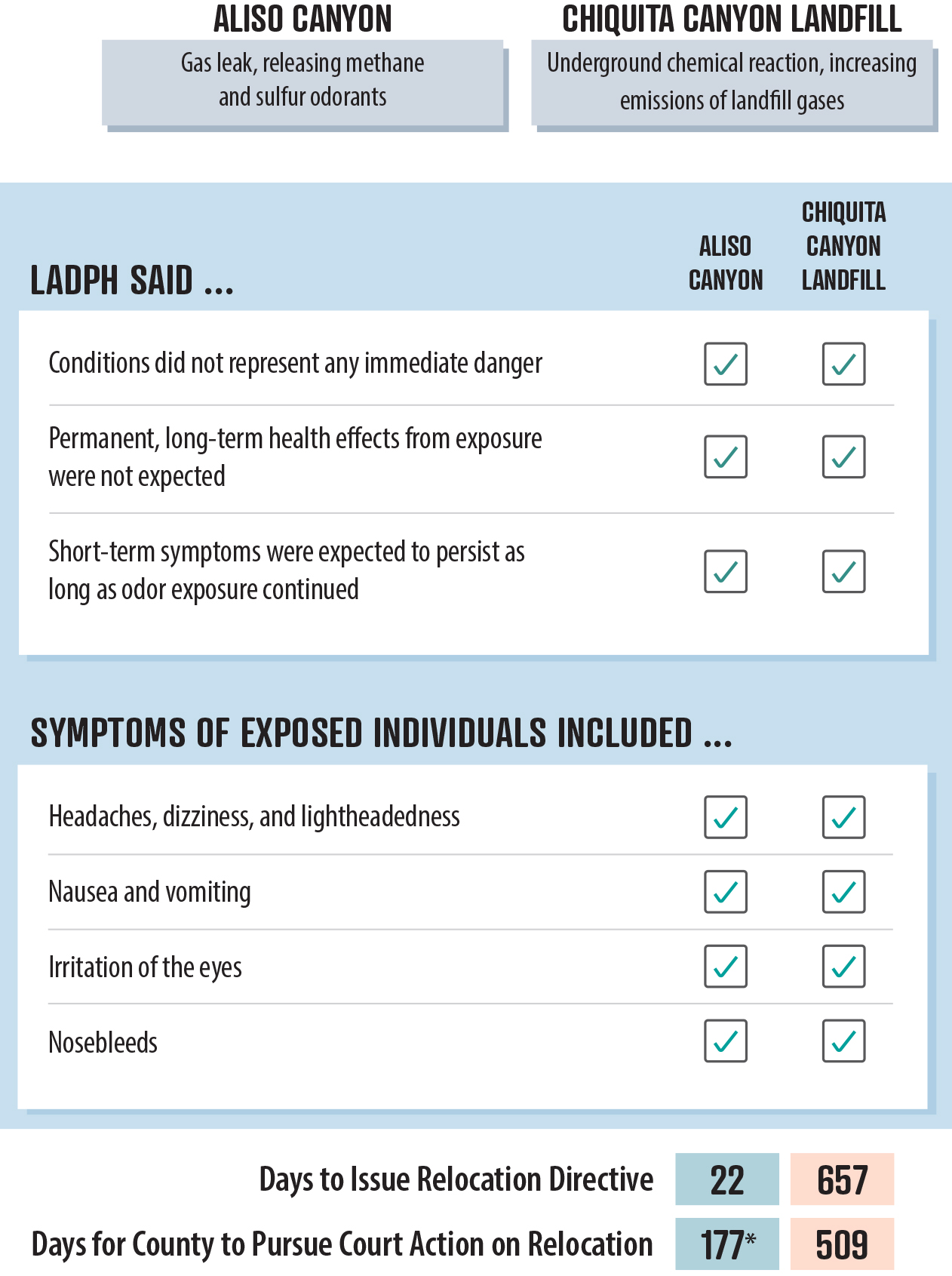
LADPH’s lack of swift action to recommend relocation is especially evident when compared to its response to another health hazard event, the Aliso Canyon gas leak. As Figure 8 shows, according to LADPH documents produced during the Aliso Canyon response, the health risks related to the two incidents were similar.
Figure 8
Despite Similar Conditions to Aliso Canyon, LADPH Did Not Act as Quickly to Address Relocation for Residents Who Live Near the Landfill
Source: Auditor review of LADPH’s communications and directives related to its Aliso Canyon and landfill responses as well as court filings for both events.
* The City of Los Angeles initiated legal action against Southern California Gas Company at an earlier point in time. Los Angeles County later joined the city in its legal action. The number of days shown here are determined by the first court action the county took related to relocation, which occurred in April 2016.
Figure 8. The figure compares LADPH’s statements and actions during the Aliso Canyon incident and the Chiquita Canyon Landfill incident. The graphic includes four main areas of comparison: what LADPH said about each event, the symptoms reported by exposed individuals, the amount of time it took LADPH to issue a relocation directive, and the amount of time it took Los Angeles County to pursue court action related to relocation.
The figure shows that LADPH made similar statements for both incidents. LADPH said that conditions did not represent any immediate danger for Aliso Canyon or the Chiquita Canyon Landfill. LADPH also stated that permanent, long‑term health effects from the exposures were not expected for either incident. In both cases, LADPH said that short‑term symptoms would be expected to persist as long as exposure continued.
The table also notes that exposed residents in both Aliso Canyon and the communities near the Chiquita Canyon Landfill reported similar symptoms. These included headaches, dizziness, lightheadedness, nausea, vomiting, irritation of the eyes, and nosebleeds.
At the bottom of the figure, the number of days LADPH took to issue a relocation directive is compared for both incidents. LADPH took 22 days to issue a relocation directive for Aliso Canyon. In contrast, LADPH took 657 days to issue a relocation directive for the Chiquita Canyon Landfill.
Below that, the figure compares the number of days it took Los Angeles County to pursue court action related to relocation. The County pursued court action 177 days after the Aliso Canyon incident and 509 days after the Chiquita Canyon Landfill incident. A note in the figure explains that the City of Los Angeles initiated legal action against Southern California Gas Company earlier in the Aliso Canyon response, and the County later joined that action. The number of days shown reflects the date of the County’s first court action related to relocation for Aliso Canyon, which occurred in April 2016.
LADPH was unable to adequately explain why it requested relocation for residents near Aliso Canyon much more quickly than it first requested relocation for residents near the landfill. LADPH’s current leaders do not have firsthand knowledge of the department’s response to Aliso Canyon and therefore can only speculate as to why their predecessors made certain decisions. The leaders at LADPH with whom we spoke about this discrepancy included the Los Angeles County health officer (county health officer) and the deputy director of health protection. These individuals maintained that the Aliso Canyon event was entirely different from the chemical reaction because of the speed with which it occurred and the potential for it to rapidly worsen. However, the directives that LADPH issued related to Aliso Canyon do not note any concerns about either of these two conditions.
In addition to the relocation‑related actions that LADPH has taken directly, the county has pursued relocation relief in court. In December 2024 the county filed a complaint against Chiquita in federal court seeking, in part, to have Chiquita subsidize the relocation of citizens living in proximity to the landfill who were affected by the chemical reaction. However, this action is also misaligned in its timing when compared to the county’s similar action as part of the Aliso Canyon event response. As Figure 8 shows, the county’s court action to pursue relocation relief for residents near Aliso Canyon was also more rapid than its action in response to the chemical reaction at the landfill.
We found no evidence that Chiquita has complied with LADPH’s May 2025 directive, and the county’s federal court lawsuit remains ongoing. Nonetheless, the lack of urgency with which LADPH pursued relocation has been inconsistent with the conditions to which it was responding and the harm that it sought to prevent to residents, which were consistent throughout the response period. Had LADPH acted sooner, it is possible that the county and residents would have greater clarity about the types of relocation assistance that were available to those affected by the chemical reaction.
Recommendations
Enforcement Program
If CalRecycle upholds the enforcement program’s order, in whole or in part, the enforcement program should take appropriate enforcement actions available under state law, such as imposing penalties for any noncompliance or delayed compliance with its order as soon as it is reasonable to do so.
Board of Supervisors
To ensure that the public is informed about the health risks of the air in the communities near the landfill, the Board of Supervisors should by November 2026 direct LADPH to update its public website monthly and make available at monthly CAC meetings LADPH’s assessment of the health risks associated with any exceedances of RELs that LADPH identifies through its review of air quality monitoring data published by Chiquita or other sources. These assessments should, at a minimum, include an identification of the chemicals that exceeded RELs, as well as LADPH’s rationale for its health risk assessment.
To ensure that LADPH and the county have adequate and current information about the health effects of the chemical reaction, the Board of Supervisors should, by November 2026, direct LADPH to periodically collect information about health symptoms and other relevant information from residents and community members and publish the results in a format accessible to the community. The Board of Supervisors should require that LADPH’s information collection efforts include proactive attempts to contact and collect information from residents and community members directly, as opposed to relying on passive collection methods.
Residents Experienced Limited Communication and Community Engagement From LADPH
Key Points
- During its response, LADPH communicated with residents verbally and in writing, but its communications were not comprehensive in the information they included, nor did they always include information that was valuable to residents. At one point, LADPH did not issue a substantive written communication to the community for a year, during which time it could have provided periodic updates, such as information about air quality safety.
- When it engaged with the community near the landfill, LADPH adhered to the basic elements of best practices, such as interacting with community stakeholders. However, it did not address limitations in its engagement activities. For example, LADPH participated in CAC meetings but did not hold additional community meetings to overcome one of the limits of the CAC meeting format: reduced opportunity to directly engage with residents. Additionally, LADPH’s response to community concerns was sometimes delayed or ineffective.
LADPH’s Communication With Residents Has Been Limited, and It Has Not Consistently Issued Valuable Written Communications
A key element of successful public health administration is effective communication with the public. According to PHAB, communication includes using the correct channels to reach the intended population, communicating with accuracy and speed, and making sure that communications are culturally and linguistically appropriate. The text box shows the ways in which LADPH has communicated with the community near the landfill. However, its communication approach has had key weaknesses: LADPH shared only limited information about the actions it was taking to protect public health via verbal updates and written communication, and it did not translate a key written document for non‑English speakers.
LADPH’s Communication Methods
- Participating in community meetings
- Distributing flyers
- Canvassing neighborhoods to promote an online survey
- Posting information on its website
Source: LADPH documents about its communications and interviews with LADPH.
Verbal Communication
LADPH’s primary means of communication was its involvement in CAC meetings. As we explain in the Introduction, the CAC serves as an advisory body to the Board of Supervisors, and its existence predates the chemical reaction. Since LADPH’s initial response to conditions at the landfill, the CAC has generally met monthly. LADPH routinely participated in the CAC’s meetings in 2023 and 2024 to share information with the community near the landfill, speaking at 17 of the 19 meetings the committee held from July 2023 through December 2024. However, its participation dropped significantly in 2025 and 2026. From January 2025 through June 2026, LADPH spoke to share information at only six of the 16 meetings—fewer than half—that the CAC held. As a result, residents may not have been sufficiently informed about LADPH’s continuous and more recent efforts to protect the public’s health, such as the department’s extended health survey and its updates to medical providers, contributing to confusion in the community.
We observed that LADPH did not provide the community with comprehensive updates during CAC meetings about its ongoing activities to protect public health. Throughout 2024, LADPH consistently used its time during the meetings to reiterate the results of its contractor’s health risk evaluation or refer residents back to its results. Although it is reasonable for LADPH to have explained these results to the public many times, the February 2024 health risk evaluation represented only a portion of LADPH’s response activities. Throughout that year, LADPH only infrequently discussed its other activities, such as efforts to track and monitor residents’ health symptoms or to collaborate with other agencies. For example, in October 2024 LADPH submitted, in conjunction with a county supervisor, a request that the Los Angeles County Cancer Surveillance Program investigate possible cancer clusters. Despite residents expressing concerns at CAC meetings about cancer risks, LADPH did not inform the community about this request at the time it was made, although we note that this county supervisor announced this request to the public through a press release.
Written Communication
Similarly, LADPH did not share comprehensive information in written form during a significant portion of its response efforts. In the early portion of its response, between July 2023 and February 2024, LADPH distributed various informational documents to the community. These included flyers about the reaction and expected health impacts, which LADPH made available on its website and distributed at some CAC meetings. Figure 9 shows that LADPH distributed distinct pieces of written information about the chemical reaction in four of the 33 months from July 2023 through March 2026, and it posted monthly updates to its website to share information about its survey results for more than a year.
Figure 9
LADPH Did Not Consistently Provide the Community With Valuable Written Communication
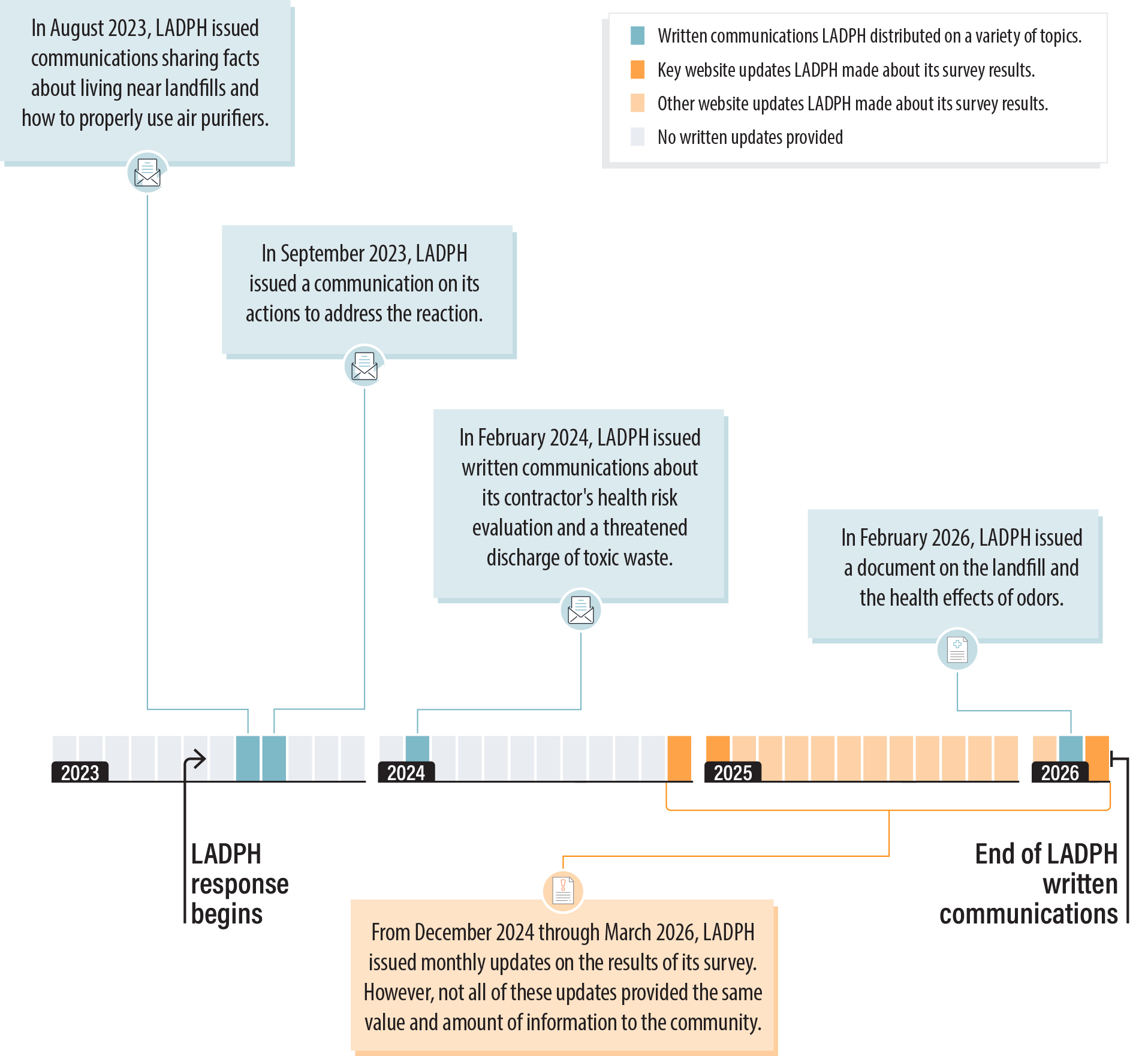
Source: LADPH’s written communications to the public about the landfill.
Note: We determined that LADPH’s first and last updates were significant because they showed an overview of the community’s health symptoms when the survey began and the culmination of LADPH’s results at the end of the survey effort. We reviewed each of the survey updates posted in the interim and found that only the January 2025 update provided a significant amount of new information due to the quantity of responses LADPH received. Other survey updates included only minor changes.
Figure 9. The figure presents a timeline of communication dates moving from left to right, starting in July 2023 and ending in March 2026.
The timeline shows the years of 2023, 2024, 2025, and 2026. Near July 2023 an arrow shows that LADPH’s response began in that month. At the far right of the timeline, the end of LADPH communications is marked in March 2026.
Points on the timeline color coded in blue or orange describe LADPH’s communications over time and their publication dates. Blue blocks represent written communications distributed by LADPH on a variety of topics. Orange blocks represent key website updates LADPH made about its survey results. Light orange blocks represent other, non-significant website updates LADPH made about its survey results.
The first point at the left of the timeline is blue. It states “In August 2023, LADPH issued communications sharing facts about living near landfills and guidance on properly using air purifiers.”
The second point, placed immediately to the right of the first, is also blue. It states, “In September 2023, LADPH issued a communication describing its actions to address the reaction.”
A third point in February 2024 states that “LADPH issues written communications about its contractor’s health risk evaluation and a threatened discharge of toxic waste.”
After the 2024 year marker, a third point states, “In February 2024, LADPH issued written communications about its contractor’s health risk evaluation and a threatened discharge of toxic waste.”
A large gap of nine months follows. Then, two orange points marking December 2024 and January 2025, indicate key survey website updates. Another point in March of 2026 shows the final survey update. These updates bookend a series of approximately 12 monthly light‑orange blocks representing other website updates LADPH made about its survey results. A bracketed arrow covering this period points to a text box that states, “Between December 2024 and March 2026, LADPH issued monthly updates on the results of its survey. However, the value and amount of information provided in these updates varied.”
One blue point, indicating other written communication LADPH issues, appears among the survey updates in February 2026. This point states, “In February 2026, LADPH issued a document on the landfill and the health effects of odors.” At the bottom of the page, a note reads: “We determined that LADPH’s first and last updates were significant because they showed an overview of the community’s health symptoms when the survey began and the culmination of LADPH’s results at the end of the survey effort. We reviewed each interim survey update and found that only the January 2025 update provided a significant amount of new information due to the quantity of responses LADPH received. Other survey updates included only minor changes.”
Although Figure 9 shows that LADPH continued to distribute written communications to residents throughout its response efforts, not all of these communications provided the community with beneficial information or added to the community’s understanding of the chemical reaction and potential health implications. As we show earlier in Figure 7, LADPH received the vast majority of its survey responses in November and December 2024. LADPH’s initial updates to the community about those results, in December 2024 and January 2025, provided the community with a substantive amount of new and valuable information about the health symptoms their neighbors were experiencing. However, the monthly rate of survey responses dropped significantly after this point, and LADPH’s monthly updates indicated only marginal changes to the findings it had previously shared. The monthly updates the department posted provided little new information, with the total change in the number of survey responses from one month to the next ranging from a single additional survey response to about 60 new responses, out of more than 1,000 total responses. Therefore, LADPH’s written communications regarding the landfill’s chemical reaction included two extensive gaps between substantive communications: the first lasting nine months from March through November 2024 and the second lasting for nearly the entirety of 2025 and January 2026. As we note above, 2025 was also a year during which LADPH decreased its verbal communication at CAC meetings.
We identified various items that LADPH could have shared with residents during this period of reduced communication. For example, LADPH’s February 2026 fact sheet about landfill odors and health concerns discusses how the community received alerts in the summer of 2025 about potential air quality problems pertaining to specific chemicals. The flyer states that these alerts were related to temporary issues with air quality sensors. However, we did not find any evidence that LADPH communicated with residents about these alerts at the time they occurred. Additionally, during this gap in communication, LADPH did not publish any written material about the concept of RELs, despite questions from residents about these health‑protective thresholds. As we describe in Figure 3, RELs are chemical concentrations at or below which individuals are not expected to experience noncancerous adverse health effects. If LADPH had distributed written materials explaining this key information, residents would have been better able to understand experts’ assessments of air quality and how it affects their safety. Instead, questions persisted in the community that could have been resolved had LADPH communicated more frequently or comprehensively.
When responding to other health events, LADPH consistently distributed written communications that added value and answered residents’ questions. LADPH directly addressed residents’ questions when communicating with residents in the City of Paramount about their exposure to a metal used in industrial processes found in high levels in their community. LADPH produced five “frequently asked questions” documents, in addition to other monitoring reports, over the course of its approximately three‑year response. Similarly, when responding to the Aliso Canyon event and the January 2025 wildfires, LADPH provided the community with frequent updates about its activities and written communication targeting relevant health information throughout its response periods.
In contrast, after it published the results of its health risk evaluation in February 2024, LADPH did not publish another comprehensive piece of written communication about odors and health concerns related to the landfill until February 2026, two years later. Key elements of the February 2026 publication included information that LADPH could have communicated in writing considerably earlier in its response period. Specifically, LADPH shared basic information about RELs and odor thresholds, as well as how residents can stay informed about air quality levels. LADPH had not shared much of this information in writing previously, although the information was known to LADPH, relevant to residents, and potentially would have been more useful to them had LADPH shared it earlier in its response.
Translation of Health‑Related Information
Finally, LADPH did not make materials related to its contractor’s health risk evaluation available in languages other than English. According to U.S. Census data, in the communities nearest to the landfill, 17 percent to 60 percent of individuals speak a language other than English at home, depending on the community. LADPH recognized the community’s language needs when, in August 2023, it provided its Facts About Landfills flyer to the community in both English and Spanish. However, it did not treat the information resulting from its contractor’s evaluation in the same manner, even though the results of this evaluation have been foundational to LADPH’s understanding of the risks the community faces and have influenced the department’s response. Accordingly, the results of this health risk evaluation are critical for the community to understand. Nonetheless, LADPH did not provide the community with a translated version of the report or summary of its conclusions, likely making it more difficult for some members of the community to understand the information and its relevance to their health.
The chief science officer told us that the technical nature of the contractor’s report and the presentation slides that LADPH used at a community meeting where it discussed the report’s key findings prevented the translation of these materials. However, this position is not consistent with how LADPH acted in the past. The same contractor that performed the health risk evaluation related to the landfill also investigated soil gas, indoor air, and ambient/outdoor air for a portion of the City Terrace community in East Los Angeles and published the results of its investigation in June 2023. LADPH translated the executive summary of that report into Spanish, thereby ensuring that the key messages of the report were available to those who would benefit from a Spanish‑language version of those results. Had LADPH taken a similar approach to translating its contractor’s health risk evaluation, this key information would have been more accessible to residents near the landfill whose primary language is not English.
LADPH’s Approach to Community Engagement Had Shortcomings
Community engagement, which LADPH defines as the process of working collaboratively with a group of people to address issues that affect their well‑being, is a central component of public health service. According to the public health guidance we reviewed, community engagement is a way that health agencies can ensure that they respond to the actual needs and concerns of a community. LADPH recognized the value of community engagement by adopting a community engagement policy in April 2024, although the deputy director of health protection told us that the policy was not meant to be applied to the department’s response to health hazard events such as the situation at the landfill. The policy is written to apply to programs that the department operates and not to short‑term event responses. Nonetheless, we found that the policy reinforced public health best practices; therefore, we concluded that the general principles of the policy apply to health hazard responses.
Broadly, our review of LADPH’s community engagement practices considered the activities the department used to engage the community and its responses to community needs. LADPH took steps to engage with the community in a variety of ways, which the text box lists. Although these steps align with the principles from its community engagement policy and best practices at a basic level, we identified shortcomings in LADPH’s execution of its approach to community engagement, which resulted in less interaction with community members and delayed responses to the needs they expressed.
LADPH’s Engagement Activities
Repeated Activities
1. Attending CAC meetings (July 2023 to present)
2. Attending Castaic Town Council meetings (August 2023 to present)
3. Receiving health complaints via a public health nurse hotline (July 2023 to present)
4. Promoting its online survey by going door‑to‑door (November and December 2024)
One‑time Activities
5. Meeting with local school districts (September 2023)
6. Presenting health risk evaluation results (February 2024)
7. Attending a U.S. EPA town hall meeting (March 2024)
Source: Publicly available meeting documentation and LADPH records.
LADPH’s Alignment With Community Engagement Best Practices
In essence, the activities that LADPH used to engage the community align with the guidance it has issued to its staff and the best practices literature that we reviewed. For example, guidance that LADPH distributed as part of its policy on community engagement notes the importance of understanding the community context. This process includes identifying existing stakeholders, such as affected residents, involved agencies, and advisory committees. PHAB similarly suggests that health departments should engage in coalitions comprised of various partners and community members working together to address issues that affect health.
LADPH’s most consistent community engagement effort has been its attendance at CAC meetings. LADPH participated in CAC meetings alongside residents who were attending or serving on the committee, as well as multiple other entities—such as Chiquita, state and federal agencies, and the air quality district. By joining residents virtually or in person at recurring meetings hosted in their community, LADPH was able to engage with residents and stakeholders on an ongoing basis and align its activities with the recommendations in its own guidance.
The importance of bidirectional communication is another element that LADPH’s engagement policy and public health best practices emphasize. According to the federal Agency for Toxic Substances and Disease Registry and LADPH’s engagement policy, community engagement should include two‑way exchanges with the public, which could result in connections for both receiving and sharing information. At times, LADPH has participated in activities that allowed for such exchanges. In September 2023, for example, LADPH held a meeting with local school district staff to address concerns and discuss how schools could manage air quality issues. LADPH also facilitated a community meeting in February 2024 to share the findings of its consultant’s health risk evaluation and, according to a press report, spent time responding to questions. Through these activities, LADPH further connected with the communities near the landfill and had opportunities to engage in bidirectional communication.
Limitations of LADPH’s Engagement Approach
Notwithstanding the general way in which LADPH’s engagement activities align with the core principles of community engagement, LADPH’s approach was limited in ways that likely hindered the effectiveness of its community engagement, as Table 2 shows. For example, the format of CAC meetings, which LADPH does not control, has offered limited opportunities for LADPH to engage in dialogue with community members. The CAC exists as a conduit for the community to communicate with the Board of Supervisors and regulators regarding issues with landfill operations. The many entities who attend also provide updates and answer questions. Although the deputy director of health protection told us that LADPH believes the CAC meeting format allowed ample time for providing updates and sharing information, we observed that LADPH’s time to speak to the public during these meetings is inherently limited, and the meetings provide only a limited opportunity for LADPH to engage with the community. When LADPH shared information with the community in CAC meetings, these updates lasted less than 10 minutes on average, during meetings that generally encompassed two to three hours. Furthermore, despite residents asking questions and sharing concerns during the public comment portion of the meeting, the CAC did not always provide LADPH with the opportunity to respond.
To address these gaps and create opportunities for more extensive engagement, LADPH could have strategically supplemented its core activities with other intermittent but focused activities, such as facilitating question‑and‑answer sessions or regularly updating and distributing more written materials to address frequent concerns and questions voiced by residents. LADPH’s guidance on community engagement includes these activities as examples, and they can help demonstrate a public health entity’s commitment to understanding a community’s concerns and allow it to transparently explain its actions. LADPH has used such focused activities and written follow‑up communications as part of its community engagement efforts when responding to other health hazard events. For example, following the January 2025 wildfires, LADPH hosted nine virtual town hall meetings to share information and address the community’s questions. As part of its response to the circumstances at City Terrace, LADPH supplemented community meeting participation by co‑creating a newsletter to provide updates about its actions and added a “frequently asked questions” section to its website to address questions related to health evaluation findings. Despite marked differences in these events’ scope and magnitude, these examples illustrate that LADPH has previously used more focused activities as part of its engagement efforts.
LADPH’s Responsiveness to Community Concerns
We also considered LADPH’s responsiveness to key community concerns when assessing its engagement with the community. As early as May 2024, the CAC requested that LADPH share the results of its health monitoring efforts, specifically suggesting a list or chart of common symptoms, so the community could understand which symptoms were most common. LADPH subsequently shared information in August 2024 that summarized the symptom reports it had received through its hotline. Later, in December 2024, LADPH began proactively sharing the results of the online survey it conducted and updating those results monthly. Through these actions, LADPH demonstrated that it received the community’s input and responded to it, even though its actions were months later than the community’s request. We noted a similar pattern in the way LADPH responded to the community’s desire for it to coordinate with local health care providers.
A notable element of community engagement, as indicated by the best practice documents we reviewed, is that engagement with the community does not mean that the public health entity will do everything the community suggests or desires. This was the case for a key community request of LADPH. Specifically, the community has expressed its desire for LADPH to conduct a comprehensive health study of the communities near the landfill that would include in‑person interactions with residents. In August 2024, LADPH’s chief science officer responded clearly to this request by stating at a CAC meeting that the county was not planning to conduct an additional health study or survey at that time and provided reasons why LADPH believed that such a study would not be a prudent use of resources. Notwithstanding the critique we present earlier about the quality of LADPH’s effort to understand the community’s health condition, we acknowledge that LADPH is not required to take an action simply because the community wants it to and that, at least initially, LADPH provided a clear response to this community request.
However, the community’s interest in a health study continued after August 2024, and LADPH did not continue responding to this community request. Comments that community members made at subsequent CAC meetings demonstrate that the community believed that a study was important. However, we identified no clear communication from LADPH during this time in response to the community’s concern. This situation represented an opportunity for LADPH to reiterate its previous response, elaborate on its rationale for its position on the issue, or investigate the community’s concern to ensure that it fully understood what residents wanted it to do. The department could have continued to respond to the community—for example, through written communication to which it could refer in future conversations with residents—even if its position on the value of a study did not change.
Another community concern to which LADPH did not adequately respond involved residents’ mental health. Residents have raised mental health concerns at CAC meetings, and mental health symptoms were among those most commonly reported to LADPH. These included symptoms such as anxiety and depression, difficulty sleeping, fatigue, and stress. LADPH has acknowledged in public statements and written communications the stress and mental health impacts that residents near the landfill experienced but has otherwise done little to address them. The community began voicing a need for mental health services as early as September 2023. In October 2023, the county Department of Mental Health was included on a list of resources available to community members. In an update to the Castaic Town Council in February 2024, LADPH highlighted this contact information for residents. However, LADPH has not otherwise involved the Department of Mental Health or shared other mental health resources with the communities near the landfill.
When we asked why LADPH did not provide mental health resources or information to the community, its chief science officer indicated that the department had not done so because it was not in its purview but rather was the responsibility of the Department of Mental Health. We acknowledge the subject‑matter expertise that the Department of Mental Health could contribute to the response to the chemical reaction. However, another department’s specialized expertise does not relieve LADPH of its responsibility to assist the communities near the landfill, and LADPH could have contacted the Department of Mental Health to help connect residents to relevant resources. Two of PHAB’s essential public health services encompass the mobilization of partnerships to improve health and creating or championing plans that impact health. As part of the second of these services, PHAB specifically notes that the service includes working with partners and the community to develop and implement health improvement strategies and plans. Therefore, we believe it was within LADPH’s purview to work toward addressing the community mental health needs about which it was aware, such as by inviting the Department of Mental Health to present at a CAC meeting or by dedicating a portion of its response website to mental health resources.
Had LADPH planned its engagement approach for landfill‑area residents deliberately, it may have better served affected residents. Although we acknowledge that LADPH’s community engagement policy does not directly apply to the department’s response to health hazard events, one of the requirements of the policy—a formal engagement plan—could still have served as a best practice for LADPH’s response. The community engagement policy requires department divisions to have engagement plans, and it provides guidance to staff on how to develop them. It would likely have benefited LADPH to have drafted a community engagement plan for its response to the conditions created by the chemical reaction. Unlike a response to a short‑term event, for which the effort to develop a community engagement plan may not be worth the costs of doing so, LADPH’s response to the conditions created by the chemical reaction has now lasted multiple years, indicating that the department could have benefited from more strategically planning its efforts to engage with community members.
While we were performing this audit, LADPH did not indicate to us that it saw any reason to alter its approach to community engagement. Because the response to the chemical reaction is ongoing, if the Board of Supervisors were to direct LADPH to create a plan for community engagement, it would likely benefit the communities near the landfill.
Recommendation
To ensure that LADPH’s engagement with the community near the landfill is sufficient, the Board of Supervisors should, by November 2026, direct LADPH to develop a community engagement plan that would apply to its response to the conditions at the landfill. LADPH should create this plan with direct input from the community near the landfill, and the plan should specify the ways in which LADPH will ensure that it maintains two‑way communication with community members and promptly addresses the concerns that the community expresses.
Establishing Safeguards Would Improve LADPH’s Ability to Respond Consistently to Health Hazard Events
Key Point
- LADPH does not have policies or procedures for how it will respond to health hazard events, which has contributed to the inconsistency in its responses. We observed that the key determinant for how LADPH responds to health hazard events was the expertise of leadership at the time of the event. Although we encountered no reason to question the credibility of LADPH’s staff and leadership as qualified public health professionals, the department could better promote consistent responses to health hazard events by adopting relevant policies and procedures.
LADPH Lacks Policies and Procedures to Help Ensure That It Consistently Meets Its Goals When Responding to Health Hazard Events
As we discuss throughout this report, we reviewed LADPH’s response to conditions near the landfill as well as other health hazard event responses in the county. We observed that LADPH’s response efforts were not always consistent, and, even after discussing these observations with LADPH’s leadership, we were not always able to discern the reasons for these inconsistencies. In particular, LADPH told us we should expect to see differences between event responses, and that the department tailors its responses to the risks associated with each event. As multiple LADPH staff explained to us, the department does not rely on established policies or procedures to conduct its responses to health hazard events. Instead of pointing back to how it had followed a formal process, when explaining its responses to the events we reviewed, LADPH staff generally relied on undocumented explanations of why it took certain actions, frequently directing us to public‑facing documents that did not describe its rationale.
We observed that the predominant factor guiding LADPH’s response approaches was the expertise of the individuals who were involved at the time the events occurred. Although we encountered no reason to question the credibility of LADPH’s staff and leadership as qualified public health professionals, we found that the department’s reliance on staff expertise did not adequately ensure that its response activities were consistent across time and different health hazard events.
As we explain in the Introduction, the county health officer told us that LADPH generally undertakes four types of actions, although the department has not formally documented them in a policy. Figure 10 lists these types of actions. According to the county health officer, all event responses that LADPH is involved in contain elements of these four categories of actions. LADPH generally took action in each of the four categories in response to the events we reviewed. However, we observed inconsistencies in its actions pertaining to each category, which Figure 10 also shows.
Figure 10
LADPH Did Not Consistently Respond to Health Hazard Events
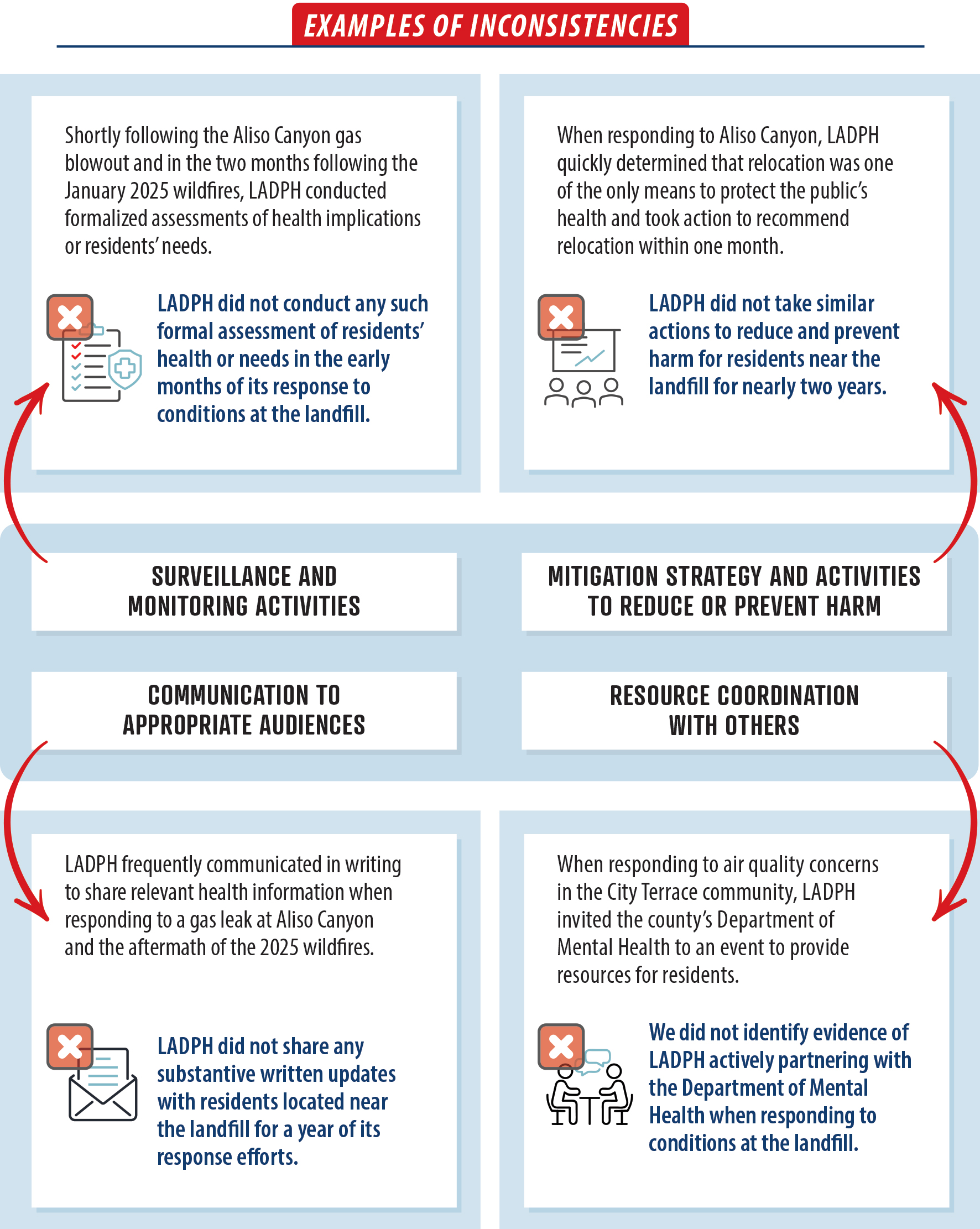
Source: LADPH health and needs assessments, public health directives, communications with the public, and interagency communications.
Figure 10. At the center of the figure are four text boxes describing the actions that LADPH reported that it undertakes when responding to health hazard events. These are: surveillance and monitoring activities; mitigation strategies and activities to reduce or prevent harm; communication to appropriate audiences; and resource coordination with others. Each text box has an arrow pointing to another text box that provides an example of inconsistency related to that action.
The first text box, located at the upper left, is labeled “Surveillance and monitoring activities.” An arrow points from this box to another placed above it. The example of inconsistency states: “Shortly following the Aliso Canyon gas blowout and in the two months following the 2025 wildfires, LADPH’s initial surveillance activities included formalized assessments of health implications or residents’ needs. LADPH did not conduct any such formal assessment of residents’ health or needs in the early months of its response to conditions at the landfill.”
The second text box, located at the upper right, is labeled “Mitigation strategy and activities to reduce or prevent harm.” An arrow leads from this box to another above it. The example of inconsistency states: “When responding to Aliso Canyon, LADPH quickly determined that relocation was one of the only means to protect the public’s health and took action to recommend relocation within one month. LADPH did not take similar actions to reduce and prevent harm for landfill residents for nearly two years.”
The third text box, located at the lower left, is labeled “Communication to appropriate audiences.” An arrow from this box points to another placed below it. The example of inconsistency reads: “LADPH communicated in writing to share new information and target residents’ questions more consistently when responding to hexavalent chromium emissions in the City of Paramount, a gas leak at Aliso Canyon, and the aftermath of the 2025 wildfires. LADPH did not share any substantive new written updates with residents near the landfill for a year or its response efforts.”
The fourth text box, located at the lower right, is labeled “Resource coordination with others.” An arrow from this box points to another below it. The example of inconsistency states: “When responding to air quality concerns in the City Terrace community, LADPH invited the county’s Department of Mental Health to an event to provide resources for residents. We did not identify evidence of LADPH actively partnering with the Department of Mental Health when responding to conditions at the landfill.”
We recognize that event characteristics differ and that a uniform response to all events would not be appropriate, but we do not believe that variance to be a sufficient reason not to have policies and procedures guiding event response. LADPH could create guidelines for its staff to apply that would not result in uniform responses. For example, we discuss earlier in this report how the value of LADPH’s written communication during the response to the chemical reaction was different than that of its written communication during some other event responses. A clear set of procedures for assessing what information the department should communicate and how often communications are necessary, as well as defining how the department will monitor its adherence to its own expectations would assist LADPH in making sure that it is approaching written communications in a consistent manner. Having clear policies that guide its event responses would also allow LADPH to understand why staff took specific actions in the past, thereby providing a basis of institutional knowledge to inform future responses.
Policies and procedures can promote consistency and help a department to achieve its goals. The U.S. Government Accountability Office’s Standards for Internal Control in the Federal Government (Green Book) outlines a framework for government entities to design and implement systems of internal control, or processes that help entities gain assurance that they can achieve their objectives. According to the Green Book, designing and implementing policies and procedures are core parts of a control system. By documenting expectations in policies and specifying actions to be taken in procedures, an entity’s management can mitigate risks that threaten its ability to achieve its goals and objectives, such as the selected objectives the text box shows.
Selected Objectives Related to Health Hazard Event Responses
- To take action to protect everyone in the county from public health risks created by toxic exposures.
- To work in partnership with affected communities and prioritize inclusive engagement.
- To be transparent and accountable to the public.
Source: LADPH’s Office of Environmental Justice and Climate Health 2024–2029 Strategic Plan.
Another practice that would assist LADPH in consistently responding to health hazard events would be for the department to document and self‑assess its responses to events when they conclude. By determining what went well in an event response and identifying room for growth, LADPH could continually improve how it operates. In fact, the Green Book recommends management reviews of actual performance—consisting of comparing an entity’s actions to its plans, goals, and objectives—as a common type of control activity. LADPH told us that it conducts this type of review, but it could not provide evidence of ever having done so. By recording these reviews and clearly outlining takeaways, LADPH could develop the type of documentation the Green Book recommends for evaluating an organization’s effectiveness.
In the absence of a structured approach, LADPH increases its risk of responding to health hazard events in ways that are not aligned with its values or do not meet the needs of county residents, as well as its susceptibility to criticism from the communities that it is intending to help. Our audit of LADPH’s response to conditions surrounding the landfill found multiple areas in which LADPH could improve. By implementing controls to achieve its objectives, LADPH could better serve residents throughout the county who may be affected by health hazard events.
Recommendations
To ensure that it approaches all responses to health hazard events in a consistent manner, LADPH should, by January 2027, adopt policies and procedures that define its four areas of response activity, establish the key information that staff and leadership must consider when determining the responsive actions that are necessary, guide staff in making those determinations, and establish how staff and leadership should document their decisions.
To ensure that it monitors its responses to health hazard events and adjusts its approach based on any opportunities for improvement it observes, LADPH should, by January 2027, adopt and implement a policy to regularly review its responses to health hazard events for the purpose of noting what went well and was aligned with its policies and procedures, as well as the areas in which its response did not meet its expectations or led to negative feedback from the community. LADPH should also document its reviews for future reference.
We conducted this performance audit in accordance with generally accepted government auditing standards and under the authority vested in the California State Auditor by Government Code section 8543 et seq. Those standards require that we plan and perform the audit to obtain sufficient, appropriate evidence to provide a reasonable basis for our findings and conclusions based on the audit objectives. We believe that the evidence obtained provides a reasonable basis for our findings and conclusions based on our audit objectives.
Respectfully submitted,
GRANT PARKS
California State Auditor
September 29, 2026
Staff:
Bob Harris, Audit Principal
Daniella Jacobs, Senior Auditor
Nathan Drake
Nicole Menas
Nereida Estrella Navalesca, MIMS
Brandy Roberts
Emily Willburn
Legal Counsel:
David King
Appendices
Appendix A
Types of Corrective Actions the Enforcement Program Required Chiquita to Implement
We reviewed corrective actions the enforcement program requested and ordered Chiquita to take from October 2023 through May 2025, which is the date of the enforcement program’s most recent order. Below, we group the corrective actions into four categories and provide summary information about each category. In addition to the corrective actions summarized in these categories, the enforcement program has issued numerous other corrective action requests and requirements, including specific directions about landfill equipment repairs, requirements about landfill gas extraction, and the relocation of leachate tanks on the landfill site.
Covering the Landfill
As part of its initial recommended mitigation measures, the enforcement program recommended that Chiquita place soil in and around the settlement area for the chemical reaction and other areas where there was evidence of higher‑than‑normal temperatures. Additionally, the enforcement program recommended that Chiquita install a temporary cover over the chemical reaction settlement area. Chiquita did not believe that a soil cover was an optimal choice because, among other reasons, it would require extended time to accomplish that action. After further correspondence, the enforcement program conditionally approved Chiquita’s plan to install a geomembrane cover over the chemical reaction settlement area. In June 2024, the enforcement program incorporated that installation requirement into its first compliance order. After delays and deadline extensions, Chiquita completed the installation in December 2024.
In May 2025, the enforcement program issued its second compliance order to require Chiquita to install a geomembrane cover over the areas of the landfill that were not yet covered and to which the reaction area had expanded or had the potential to expand. In November 2025 the enforcement program amended this order to include a deadline of August 31, 2026 and to specify that Chiquita must apply the cover to the entire facility where waste is disposed. We describe Chiquita’s appeal of this order earlier in our report.
Temperature Monitoring Probes
As a part of initial mitigation measures, the enforcement program recommended that Chiquita install temperature probes around the chemical reaction settlement area. Although Chiquita and the enforcement program initially coordinated on the timeline for the installation, Chiquita experienced delays and submitted requests to extend the timeline, which the enforcement program reviewed and approved. In May 2024, Chiquita submitted a completion report to the enforcement program, showing that it had completed the installation of the probes in March 2024.
The enforcement program’s June 2024 and May 2025 compliance orders each requested that Chiquita install additional temperature probes. However, Chiquita disagreed with the necessity and placement of the temperature probes that the enforcement program ordered in June 2024 and submitted an alternative proposal to install additional probes, which the enforcement program approved. As of August 2026, Chiquita had installed all temperature probes that the enforcement program had directed it to include.
Data Analysis and Reporting
The enforcement program’s initial mitigation measures included recommendations to Chiquita for data collection, sampling, and analysis, such as sampling the leachate for benzene and other volatile organic compounds, using drones to monitor the surface of the chemical reaction settlement area, and submitting monthly data of carbon monoxide levels and temperature readings. The enforcement program recommended several additional data‑related mitigation measures after its November 2023 site visit to the landfill. These measures mostly focused on Chiquita’s collection of temperature readings, gas readings, and weekly and monthly reporting for analysis. Chiquita requested additional clarification and feedback from the enforcement program as needed and has implemented most of these measures.
Barrier Plan
After its November 2023 site visit, the enforcement program recommended that Chiquita develop a soil reaction barrier plan and that Chiquita propose the criteria that would require the installation of that soil reaction barrier between the chemical reaction and operational areas of the landfill. A soil reaction barrier is a physical barrier that the enforcement program believed would stop the spread of the chemical reaction. Eventually, the enforcement program began referring to this plan as a soil reaction break/barrier plan (SRBBP). Chiquita agreed to create a SRBBP but disagreed that such a plan was necessary. Although Chiquita submitted three proposed plans, the enforcement program has found problems with them all. In particular, the enforcement program commented that the third plan did not actually contain a proposal for a physical barrier and instead focused on gas and leachate removal for control and containment of the chemical reaction. The enforcement program superseded its previous orders related to the SRBBP with its May 2025 order, which instead directed Chiquita to take more specific actions, such as stopping the expansion of the reaction and installing additional temperature probes.
Appendix B
Scope and Methodology
The Joint Legislative Audit Committee (Audit Committee) directed the California State Auditor to conduct an audit of LADPH’s oversight and response to the conditions at the landfill. Specifically, the Audit Committee asked us to evaluate LADPH’s policies and procedures for protecting public health and safety and the sufficiency of its actions in response to the chemical reaction at the landfill. Table B lists the objectives that the Audit Committee approved and the methods we used to address them. In addition to these methods, we visited the exterior of the landfill site and the nearby communities. Unless otherwise stated in the table or elsewhere in the report, statements and conclusions about items selected for review should not be projected to the population.
Response
Los Angeles County and the Los Angeles County Department of Public Health
September 3, 2026
Mr. Grant Parks
California State Auditor
621 Capitol Mall, Suite 1200
Sacramento, CA 92814
Dear Mr. Parks:
I am writing on behalf of the County of Los Angeles and the Department of Public Health to transmit the County’s response to the State Auditor Report 2025-128, “Los Angeles County Department of Public Health: Its Actions in Response to Conditions Near the Chiquita Canyon Landfill Have Been Incomplete.” It is the County’s expectation that its response document will appear with the final audit report on the Auditor’s webpage.
If you have any questions or require additional information, please contact Azar Kattan at akattan@ph.lacounty.gov.
Sincerely,
Barbara Ferrer, Ph.D., M.P.H., M.Ed.
Director
Los Angeles County Department of Public Health
Attachment
c: Los Angeles County Board of Supervisors
Dawyn Harrison, Los Angeles County Counsel
THE COUNTY OF LOS ANGELES AND THE COUNTY DEPARTMENT OF PUBLIC HEALTH
RESPONSE TO STATE AUDIT REPORT 2025-128
September 3, 2026
The California State Auditor (Auditor) was directed to review the Los Angeles County Department of Public Health’s (LADPH) “oversight and response to the conditions at Chiquita Canyon Landfill (CCL).” To facilitate the audit process, LADPH staff met with the Auditor on multiple occasions, produced records, answered questions, explained the governing public health considerations, and reviewed and commented on the Auditor’s meeting summaries and initial draft report. The County of Los Angeles (County) and LADPH have reviewed the final draft Audit Report 2025-128, dated September 24, 2026 (Audit Report), ① but provided to the County for review on August 28, 2026. ② The County and LADPH, by regulation, are provided five business days to respond in writing to the Audit Report, and the Auditor shall include this written response in the published report. Given the compressed response time, the County and LADPH are providing summary comments regarding the Audit Report, the Auditor’s process in writing the report, and responding to each of the recommendations contained within the report.
SUMMARY COMMENTS ON REPORT 2025-128
Although the focus of the audit was on LADPH’s oversight and response to the conditions at CCL, the report largely evaluates LADPH actions in isolation and not as part of a response structure created by federal, state, and local agencies. ③ As such, the report does not adequately account for the multi-agency coordinated response and the distinct technical, regulatory, enforcement, and communication roles of the involved County, regional, state, and federal agencies. This integrated response structure operates through the Multi-Agency Critical Action Team (MCAT) and includes representatives from the US Environmental Protection Agency (US EPA); the CA Environmental Protection Agency (Cal EPA), which includes CalRecyle, the CA Air Resources Board (CARB), and the Office of Environmental Health Hazard Assessment (OEHHA); the Department of Toxic Substance Control (DTSC); the CA State Water Resources Board; the CA Department of Public Health (CDPH); the South Coast Air Quality Management District (AQMD); and Los Angeles County agencies, including the Departments of Public Works, Public Health, and Regional Planning, as well as the Fire Department’s Health Hazardous Materials Division. In addition, the Los Angeles County Department of Public Health’s Solid Waste Management Program participates in its role as the CalRecycle-certified Local Enforcement Agency (LEA). There are a number of subunits that report up to the MCAT, including the Public Health Advisory Unit (PHAU), whose members include US EPA, CalEPA, OEHHA, DTSC, CA State Water Resources Board, CDPH, LADPH, and AQMD. ③ Accordingly, the report lacks context as to LADPH’s role within the larger multi-agency team structure that has provided a coordinated response since the outset to the environmental and community health concerns caused by the Subsurface Elevated Temperature (SET) event.
LADPH has been proactive in addressing the health concerns of the community. In response to the significant increase in odor complaints near CCL, LADPH reviewed and commented on CCL’s air monitoring efforts and evaluation by CCL’s expert consultant, The Center for Toxicology and Environmental Health (CTEH). LADPH considered the CCL consultant’s conclusions about potential health impacts to residents to be premature. To more appropriately determine both potential health impacts to the community and evaluate community air quality surrounding CCL, the County and LADPH retained Roux Associates, a nationally known environmental consultant, to conduct extensive community air sampling to evaluate potential human health risks associated with the conditions at CCL, and make recommendations to improve community air monitoring efforts to better evaluate potential air quality impacts to the community. The purpose was to quickly assess the risks that emissions from CCL could have on community health. The results of this effort informed the AQMD’s Air Monitoring Order to CCL, as well as the basis for LADPH’s health protective messaging.
LADPH has always validated residents’ reports of headaches, respiratory and gastrointestinal symptoms, stress, and serious quality-of-life impacts associated with the persistent odors. LADPH recognized that hydrogen sulfide and other odorous compounds can cause short term symptoms at levels below health-based screening values and consistently communicated that information to the community. LADPH used monitoring results as one component of its ongoing assessment while continuing to evaluate episodic exposures, document odor impacts and associated health effects, and the need for continued investigation, mitigation, and enforcement.
LADPH’s response was iterative and evidence based. It maintains established resident telephone and email reporting channels; conducted site visits and direct observations and measurements; and reviewed complaints, agency notices of violation, and monitoring reports. Additionally, as noted above, LADPH commissioned an early independent community air sampling and health risk screening evaluation to supplement the information then available. Roux Associates conducted sampling from October 31 through December 16, 2023, and LADPH publicly released and presented the evaluation in February 2024. LADPH then continued monitoring, public guidance, community meetings and outreach, a community health survey, enforcement activity, evaluation of relocation and other protective measures, and participation in the coordinated multi-agency response.
The Audit Report’s Appendix B describes interviews, record review, and review of selected websites and prior incidents. ④ That approach does not fully capture activities conducted through technical workgroups, partner-agency records, oral briefings, public meetings, and coordinated decisions. ⑤ The report also compares incidents with different sources, contaminants, emergency conditions, monitoring designs, authorities, and remedies. The responses below focus on the specific additional facts necessary to place each recommendation in context.
OVERVIEW
⑤ The Auditor compared this slow-onset, prolonged landfill SET event with the 2015 Aliso Canyon natural-gas well blowout (the largest uncontrolled release from an underground, pressurized gas storage facility in the history of the United States), the 2019 City Terrace soil-benzene findings (an incidental environmental finding), the 2016 City of Paramount hexavalent-chromium emissions (related to Proposition 65), and, initially, the 2025 Pacific Palisades and Eaton wildfires. Those incidents involved different release sources, patterns, and contaminants. Some involved emergency conditions and required different monitoring designs, authorities, and available remedies. Each environmental event was vastly different in scope and required an appropriately tailored response. Each is significantly different from the SET event at CCL. ⑤ The Audit Report does not establish that the selected incidents are valid comparators or account for those differences.
③ Because several elements of the draft Audit report provided to the County on August 28, 2026, lacked context or reflected only part of the coordinated multi‑agency response, LADPH prepared its response based on the draft provided and organized its comments by major themes to provide the broader context necessary for understanding its response to the conditions at CCL.
The SET event at CCL produced a gradual and prolonged increase in landfill gases and sustained odor impacts. ⑥ Intermittent elevated measurements of benzene, hydrogen sulfide, and other volatile organic compounds, together with prolonged odors and community reported effects, required continuing investigation, mitigation efforts, and public communication by the involved agencies, while remaining below levels associated with health‑based exposure limits. Air monitoring provides validated trend data and regulatory information, but fixed monitors cannot capture every odor episode. LADPH therefore evaluated both the measured data and residents’ lived experience, including reports from those impacted, responses to LADPH’s community survey, and AQMD’s Notices of Violation associated with community odor complaints. ③ It also worked through the MCAT’s PHAU, described above, to support coordinated health communication. The Audit Report does not fully account for this division of responsibility or the coordinated response and public communication actions undertaken by multiple agencies.
④ The audit’s records-based methodology does not fully reflect how LADPH’s work occurred through technical workgroups, partner agency records, oral briefings, public presentations, and jointly coordinated decisions. ⑦ In several places, the report interprets the absence of a stand-alone LADPH memorandum as evidence that review or communication did not occur, even though the report acknowledges related staff review and public activity.
⑧ A similar distinction applies to enforcement. Operator delays, appeals, or instances of noncompliance are not evidence that LADPH or the Local Enforcement Agency (LEA) failed to act; rather, they reflect why escalating orders, administrative processes, coordinated regulatory actions, and litigation were necessary.
Resident symptom reports were important and actionable evidence of community impacts. LADPH used those reports to validate residents’ experiences, identify concerns, shape protective guidance and mitigation, and determine whether additional investigation or outreach was appropriate. LADPH considered symptom and quality-of-life impact information together with source conditions, odor observations, air monitoring trends, complaint patterns, AQMD notices of violation, and other available health and surveillance information. The use of complementary sources strengthens the public health assessment and does not diminish the significance of any resident’s reported health impacts or the need to address persistent community impacts.
The County and LADPH used the symptom and quality-of-life impact information, community odor observations, AQMD complaint patterns and Notices of Violation as part of the evidence in the County’s lawsuit against CCL. The County and LADPH were initially successful in obtaining a favorable ruling on a preliminary injunction against CCL (i.e., the Court found that it was likely that the County would prevail in the lawsuit against CCL). Unfortunately, CCL appealed, delaying resolution of the County’s request for relief to the community. Although the County prevailed on appeal, the Court ultimately found that the County and LADPH’s proposed remedy of temporary relocation for 938 homes near CCL was overbroad. The County remains committed to pursuing relief and will be working with its experts and the community to present additional evidence and analyses to show that the requested relief for the impacted community is warranted.
STATE AUDITOR REPORT RECOMMENDATIONS
Recommendation
If CalRecycle upholds the enforcement program’s order, in whole or in part, the enforcement program should take appropriate enforcement actions available under state law, such as imposing penalties for any noncompliance or delayed compliance with its order as soon as it is reasonable to do so.
⑨ RESPONSE: The County’s Local Enforcement Agency (LEA) for Solid Waste concurs with this recommendation. On August 28, 2026, CalRecycle’s Administrative Hearing Officer upheld the LEA’s order to CCL to install a geomembrane cover over the entire main canyon of the landfill by August 31, 2026. The LEA will continue to use its enforcement authority available under state law, including appropriate penalties when legally supported and reasonable.
Recommendation
To ensure the public is informed about the health risks of the air in the communities near the landfill, the Board of Supervisors should by November 2026 direct LADPH to update its public website monthly and make available at monthly CAC meetings LADPH’s assessment of the health risks associated with any exceedances of RELs that LADPH identifies through its review of air quality monitoring data published by Chiquita or other sources. These assessments should, at a minimum, include an identification of the chemicals that exceeded RELs, as well as LADPH’s rationale for its health risk assessment.
RESPONSE: While the County and LADPH concur with the objective of providing timely and coherent information to the public regarding the potential health significance of monitoring results, ⑩ they do not concur with the Auditor’s recommendation of a prescribed monthly reporting mechanism or the premise that each Reference Exposure Level (REL) exceedance constitutes a discrete health-risk finding requiring a separate LADPH assessment.
⑪ Actions already taken. In July and August 2023, LADPH staff made 11 site visits and documented odors on nine of those visits. LADPH also reviewed community complaints, AQMD notices of violation, landfill and community monitoring, and quarterly reports. To obtain an additional independent public-health assessment, LADPH commissioned Roux Associates to conduct community air sampling and a health-risk screening evaluation from October 31 through December 16, 2023.
LADPH publicly released the Roux evaluation on February 7, 2024, posted the report, issued public information, and presented the findings in detail at a community meeting and to the CCL Community Advisory Committee (CAC), the community advisory body and conduit for communication between community members, CCL, and regulatory agencies regarding operations of the Landfill. The evaluation did not identify acute REL exceedances for sulfur compounds; it explained that hydrogen sulfide could contribute to odors and short-term symptoms even below health-based levels and it found measured benzene to be generally similar to or below background levels existing in the Los Angeles Basin. LADPH also noted that the six-week sampling window was a preliminary, limited duration screening. It informed the response but was not designed to rule out episodic exposures, fully characterize longer term conditions, or explain every reported symptom. Therefore, LADPH’s assessment and response continued.
⑫ The Auditor’s conclusion that LADPH should have examined the data, informed the public about the Roux review, or issued written comments even when it found no potential impact does not reflect documented actions. The audit itself acknowledges staff review of monitoring reports, an analyst’s written determination regarding a quarterly report, oral CAC updates, the public release of the Roux report, and a detailed community presentation. The absence of a separate written comment on every quarterly submission is not evidence that LADPH failed to review the data or communicate a public health conclusion.
Technical context. A REL is a health protective screening value, not an automatic finding of harm. LADPH, in partnership with response agencies, evaluates the potential public health significance of an exceedance by considering confirmation of the compound and measurement, the applicable averaging period, magnitude and duration, monitor location, meteorology, background concentrations, source attribution, and the potential for community exposure.
⑬ The coordinated response assigns distinct but complementary responsibilities. CCL and its contractors operate and maintain the air monitoring network. AQMD oversees monitoring methodology, data reporting, regulatory compliance, and post exceedance notifications, including when it has resolved, and investigations under its regulatory authority and the stipulated order of abatement. When a monitor reports a concentration above a determined threshold, CCL’s contractor must investigate the validity of the measurement and whether it may have originated from the landfill and submit its findings to AQMD. LADPH works with AQMD and other response partners to assess the public health significance of the available information and determine whether additional protective measures or health guidance are warranted.
⑬ The AQMD abatement order also requires a public notification system for specified exceedances. These alerts provide timely notice while the technical investigation proceeds. LADPH provides the related public health context including the meaning and limitations of an exceedance and practical steps residents can take to reduce exposure. This information is communicated through its website, CAC meetings, and the coordinated CCLResponse.com platform. Follow up information is provided through these coordinated channels as the measurement, source, and potential health significance are evaluated. This approach gives the community both prompt access to monitoring results and understandable public health guidance, as the noted exceedance is investigated and monitored.
⑬ The report does not adequately distinguish AQMD’s responsibility for regulatory oversight of the monitoring and exceedance investigation process from LADPH’s responsibility for assessing and communicating the public health implications.1 It also does not fully account for the coordinated communication mechanisms through which LADPH contributed health information to the broader multi-agency response.
1 And indeed, it is the State that determines these respective regulatory oversight roles and sets the REL exceedance thresholds, and only the State has the power to modify them.
Recommendation
To ensure that LADPH and the county have adequate and current information about the health effects of the chemical reaction, the Board of Supervisors should by November 2026 direct LADPH to periodically collect information about health symptoms and other relevant information from residents and community members and publish the results in a format accessible to the community. The Board of Supervisors should require that LADPH’s information collection efforts include proactive attempts to contact and collect information from residents and community members directly, as opposed to passive collection methods.
⑭ RESPONSE: While the County and LADPH concur with the general premise that current community information is important, they do not concur with the specific Auditor’s recommendation as stated. LADPH will maintain accessible channels for residents to report symptoms, periodically publish appropriately interpreted summaries, and use proactive outreach when conditions or information needs warrant. The collection method and frequency should be selected to answer the specific public health question and coordinated with monitoring, complaints, the source, quality-of-life impact information, and other health information. One method will not necessarily be appropriate for every phase of a prolonged incident.
Actions already taken. LADPH has operated a dedicated telephone line and email intake for impacted community members beginning in July 2023 and has used the reports to inform guidance and response. It then designed and promoted an online community health survey from October 2024 through February 2026, discussed it at community meetings, distributed information to approximately 8,400 addresses in Val Verde, Hasley Canyon, and Castaic, and published periodic summaries. The survey received more than 1,500 responses, while the telephone and email channels remained available. These were proactive collection and publication activities, not an absence of symptom or quality-of-life information.
⑮ Audit context and factual correction. Statements by the Auditor do not fully account for the multiple information channels that LADPH established, the proactive promotion of the survey, or the more than 1,500 responses received. LADPH agrees that current symptom and quality-of-life information is valuable and will continue to use resident reports to validate community concerns, guide protective actions, and inform enforcement and response. Methodological context will accompany published summaries, but that context should not be understood to diminish the validity or importance of residents’ experiences.
⑯ Context Regarding Relocation. The implication that LADPH and the County took no relocation related action before May 2025 omits important context. LADPH and County partners evaluated temporary relocation and other protective measures as conditions evolved. LADPH verbally communicated its assessments and recommendations regarding protective measures to County partners, which informed the County’s following actions. Specifically, at the County’s request, in August 2023 and thereafter, CCL distributed air purifiers and air filters to impacted residents. In March/April 2024, the County established a Community Utility Relief Program to assist impacted residents with increased electricity costs due to odor impacts to the residents’ homes. Furthermore, at the County’s request, CCL operated the Chiquita Community Relief Program. Through the program, residents of Val Verde, Live Oak, Hasley Hills, Hillcrest Parkway, Hasley Canyon and Stevenson Ranch were able to request funding to be used for expenses associated with odor mitigation, including temporary relocation, home hardening, and increased utility bills and to request an air filtration device or replacement air filters. The program operated from March 2024 through January 2025. The County’s December 2024 federal lawsuit and subsequent motion for preliminary injunction sought temporary relocation of the most-impacted residents, home-hardening, and related relief. Through its May 2025 directive, LADPH required CCL to immediately resume home hardening and temporary relocation support for impacted residents, formalizing a broader temporary-relocation requirement. Together, these actions demonstrate an escalating effort to secure meaningful relief as the SET event and community impacts persisted.
⑧ Audit context and factual correction. The statement that the audit found no evidence CCL had complied with the May 2025 directive concerning the operator’s conduct; this is not evidence that LADPH failed to issue, monitor, or enforce the directive. That statement is instructive as to CCL’s attitude toward directives of regulatory and health agencies to which it has not yet complied. The report itself acknowledges that the County’s federal lawsuit remains ongoing and public records document continued LADPH directives and enforcement in 2026. ⑧ The audit should distinguish between operator’s lack of compliance and the County’s actions to obtain compliance and community relief.
⑰ The Aliso Canyon comparison, likewise, does not establish that LADPH failed to act with appropriate urgency. Aliso Canyon was the largest uncontrolled release from an underground, pressurized gas storage facility in the history of the United States. It involved different release dynamics, air contaminants, emergency authorities, source control conditions, exposure information, and mechanisms for implementing relocation. The response at CCL should be evaluated based on the conditions, information, authorities, and available tools at each point in the continuing incident.
Recommendation
To ensure that LADPH’s engagement with the community near the landfill is sufficient, the Board of Supervisors should by November 2026 direct LADPH to develop a community engagement plan that would apply to its response to the conditions at the landfill. LADPH should create this plan with direct input from the community near the landfill and the plan should specify the ways in which LADPH will ensure that it maintains two-way communication with community members and promptly addresses the concerns that the community expresses.
RESPONSE: While the County and LADPH concur with the general objective of ensuring effective communication with communities during public health incidents, ⑱ they do not concur with the Auditor’s recommendation that LADPH develop a standalone community engagement plan. A single-department plan would not reflect the multiple agency structure, regulatory authorities, coordinated roles, and expertise needed in response and communicating about the conditions at CCL.
Actions already taken. LADPH participates in the formally established CAC, Castaic Town Council meetings, community meetings, and other forums; presented the Roux evaluation; answered questions; maintained telephone, email, and web channels; conducted neighborhood outreach; and helped prepare plain-language health and protective-action information for LADPH and CCLResponse.com. It coordinated this work with the County Departments of Regional Planning, Public Works, Fire Department, the Office of Supervisor Kathryn Barger, and the Multi-Agency Critical Action Team and its Public Health Assessment Unit.
⑲ Audit context and factual correction. The report’s implication that LADPH communication was inadequate because it lacked a stand‑alone LADPH plan discounts the coordinated channels residents actually used. The audit itself documents oral CAC updates, a public release and detailed presentation of the February 2024 health risk evaluation, promotion of the health survey to thousands of nearby households, and continuing public meetings.
LADPH will continue to participate in and support the existing coordinated engagement structure, adapting the frequency, format, and content of its communications to available public health information and community needs. Using these established mechanisms supports timely, consistent, and actionable communication while maintaining clear agency roles and avoiding duplicative or conflicting processes.
Recommendation
To ensure it approaches all responses to health hazard events in a consistent manner, LADPH should, by January 2027, adopt policies and procedures that define its four areas of response activity, establish the key information that staff and leadership must consider when determining what response actions are necessary, guide staff in making those determinations, and establish how staff and leadership should document their decisions.
⑳ RESPONSE: While the County and LADPH have approached all past incident responses in a consistent manner, the County and LADPH concur with the general objective of establishing written guidance; however, they do not concur with Auditor’s framing that the absence of a single consolidated policy indicates inconsistency.
By January 2027, LADPH will develop written guidance memorializing the core response functions, roles, relevant guidance information, escalation, and documentation. The guidance will help ensure continued consistency and institutional memory while preserving professional judgment and incident command flexibility for different incidents.
㉑ Audit context and factual correction. The absence of a single policy organized around the Auditor’s four categories does not mean LADPH lacked response processes or decision criteria. The report itself already describes LADPH’s consideration of magnitude, duration, monitoring information, source conditions, affected populations, potential health significance, legal authority, and partner agency roles. Consolidating those factors in written guidance is an appropriate improvement and does not alter that the processes were used in this response.
⑤ The selected incidents also involved different sources, hazards, response authorities, and available remedies. Within each, LADPH applied the following four core public health functions:
- Surveillance, to identify public health risks and the populations or areas impacted or at risk;
- Control, to assess and identify what is needed to prevent or reduce those risks or impacts;
- Communication, to inform and listen to the public, policymakers, the press, and providers, as appropriate; and,
- Resource Coordination, to work with others, as needed, to carry out surveillance, control, and communication activities during the response.
Written guidance would document these core functions so they are applied consistently across incidents, including by staff who may support future responses, while preserving the flexibility to tailor actions to the conditions and applicable authorities for each incident.
Recommendation
To ensure that it monitors its responses to health hazard events and adjusts based on any observed opportunities for improvement, LADPH should, by January 2027, adopt and implement a policy to regularly review its response to health hazard events for the purpose of noting what went well and was aligned with its policies and procedures, as well as the areas in which its response did not meet its expectations or led to negative feedback from the community. LADPH should document its reviews for future reference.
RESPONSE: While LADPH believes it has consistently reviewed its response actions during major incidents, it concurs with the general objective of documenting the lessons learned after any reviews, whether formal or informal. ㉒ LADPH does not concur with the Auditor’s implication that the absence of a stand‑alone LADPH after‑action report indicates a lack of review.
When LADPH is not the lead agency, such reviews are often led by the County Office of Emergency Management, with LADPH contributing under established County protocols and incorporating lessons learned into current work.
㉒ Audit context and factual correction. The absence of a separate LADPH after-action report does not establish the absence of review. County Office of Emergency Management-led reviews, operational debriefs, technical workgroup discussions, and adjustments made during a continuing incident all contribute to continuous improvement.
CONCLUSION
In closing, LADPH remains committed to validating and responding to the community’s experience, communicating what the evidence shows and does not show, and using all appropriate public health and enforcement tools with its regulatory partners. The record demonstrates a response that evolved as the SET event persisted and the evidence changed, including direct observation, monitoring review, an early independent community health risk screening for the incident, public presentations and guidance, symptom and quality-of-life collection, escalating orders, relocation action, and litigation. ③ ④ Evaluation of that work should account for the full multi-agency record, the limits of the available data, and the legal and technical conditions at each decision point.
To provide clarity and perspective, we are commenting on the response to our audit report from the county and LADPH. The numbers below correspond with the numbers we have placed in the margin of the response.
① As LADPH indicates, we provided it with the audit report on August 28, 2026, which at the time was scheduled to be issued on September 24, 2026. Because of the volume of LADPH’s response to the audit report and the time needed to review and comment on its statements, we published this report on September 29, 2026.
② Government Auditing Standards, published by the Comptroller General of the United States, and which state law requires the State Auditor to follow, require an audited entity’s comments to be included or summarized in the audit report. Providing audited entities with five business days to review and respond to a report prepared at the request of the Joint Legislative Audit Committee is a component of the State Auditor’s practice but is not a requirement under state law. We request entities to which we have made recommendations to provide a response to offer clarity about whether they intend to implement those recommendations.
③ Our report adequately reflects the context that multiple agencies are involved in the response to conditions at the landfill. We provide numerous examples of this coordinated response throughout the report, such as in the Introduction, here, here, and here in the first major section, and here in our section on community engagement. Figure 4 focuses exclusively on the fact that many agencies with distinct regulatory responsibilities have roles in the response efforts. We explain LADPH’s role within the broader response efforts, and our conclusions pertain to responsibilities within LADPH’s scope. Therefore, we stand by the conclusions presented in our report.
④ LADPH incorrectly asserts that our audit methodology does not fully capture the activities it conducted and implies that our review was insufficient. We disagree. Our audit’s findings and conclusions are based on sufficient and appropriate evidence that we identified using a thorough methodology. Our review included extensive interviews with LADPH’s leadership and staff, a review of all records that LADPH provided, and our independent research about the events we reviewed. When LADPH told us that it engaged in a response activity, we asked it to provide records establishing that it did so. Although the department provided related records for several of our requests, it did not have documentation in some instances. Moreover, our report provides details about the variety of activities that LADPH conducted. For example, we describe actions LADPH took as part of multiagency collaborative efforts, and we include references here, here, here, and here to the various public meetings that it attended. In addition, even though LADPH’s response suggests that records held by other agencies would be needed to identify its activities, we reasonably expected that LADPH would be able to demonstrate its activities and efforts through its own records. Accordingly, we stand by the thoroughness of our methodology and analysis in reaching our conclusions about LADPH’s significant response activities.
⑤ LADPH states that we compared responses to other health hazard events with different characteristics without establishing that the events we selected are valid comparators. We describe that the Legislature specifically asked us to compare LADPH’s response to the Aliso Canyon gas leak and the January 2025 wildfires in Los Angeles County, and that we reviewed two other responses to events we chose because they had similarities to the conditions at the landfill. Although these health hazard events each have distinct characteristics, the comparisons we draw regarding LADPH’s response activities reveal inconsistent response actions that LADPH could not adequately explain or justify. We describe examples of these inconsistencies in Figure 10. The differences to which LADPH refers to in its response do not account for the disparities we noted in its event response activities.
⑥ It is not clear which health-based exposure limit LADPH’s response indicates the landfill’s emissions remained below. Chiquita has reported exceedances of the acute REL for hydrogen sulfide and benzene. The multiagency collaborative to which LADPH contributed, and that it refers to in its response, acknowledges some of these exceedances on its website.
⑦ LADPH’s position that our report contradicts itself or uses insufficient evidence to draw its conclusions is incorrect. Our report is internally consistent, and we followed generally accepted government auditing standards when conducting this audit, which require us to rely on sufficient and appropriate evidence when supporting our conclusions and recommendations. Throughout our report, we provide sufficient context about our conclusions and describe the basis for those conclusions. We clearly differentiate between perspective LADPH offered about its activities, and the actions we could verify occurred through documentary evidence.
⑧ We do not report that operator delays, appeals, or instances of noncompliance are evidence that the enforcement program or LADPH failed to act. Similarly, we do not conclude that Chiquita’s lack of cooperation with LADPH’s May 2025 directive seeking relocation funding implies LADPH failed to issue, monitor, or enforce its directive. On the contrary, we conclude here and here that the enforcement program acted with reasonable speed and escalation of its authority.
⑨ Although LADPH’s response states that CalRecycle’s administrative hearing officer upheld the enforcement program’s order on the same day we provided LADPH with the final draft of this report, LADPH did not inform us of CalRecycle’s decision at that time. We now expect the enforcement program to proceed with appropriate enforcement actions available under state law as we recommend and as LADPH agrees is appropriate.
⑩ We question LADPH’s resistance to acknowledging the facts supporting this recommendation. Our rationale for recommending that LADPH provide a monthly analysis of air quality data is based on the monthly interval at which these data are shared by Chiquita and the monthly meeting schedule of the CAC. It therefore seems intuitive that the timing of information that LADPH would publish would align with the availability of the data and the regular gathering of the community members who are expecting to discuss issues related to the landfill. Further, the premise that REL thresholds are important for understanding health risk is one that LADPH itself has frequently presented to the community. For example, when presenting and reiterating the results of its contractor’s health risk evaluation, LADPH emphasized that its contractor did not report exceedances of the RELs. LADPH also refers in its response to its responsibility to assess and communicate the public health implications when investigating exceedances. Similarly, we report LADPH’s perspective that each exceedance requires interpretation on a multitude of factors. Therefore, we continue to believe it to be important for LADPH to provide its expert opinion on whether individual exceedances constitute a health risk to the community. We do not understand LADPH’s reluctance to share chemical exposure data with the public, as doing so can contribute to public understanding and trust with public health officials.
⑪ LADPH’s statement that its staff made 11 site visits in July and August 2023 and documented odors on nine of those visits differs from the information LADPH provided us from internal correspondence, which we report that staff reported detecting odors during three visits and detected chemicals with their handheld gas detectors during two of the visits. LADPH did not provide any documentation to corroborate its claim about the number of site visits during which staff documented odors.
⑫ LADPH mischaracterizes our conclusions. We represent LADPH’s efforts to communicate in a generalized fashion with the public about air quality, and detail more specific actions it took. We accurately portray these activities, including the fact that LADPH could not provide evidence that it had reviewed specific air quality data throughout its response efforts, and LADPH acknowledged that it did not communicate with the public about exceedances. Accordingly, we stand by our conclusions about LADPH’s limited communications about air quality.
⑬ Although LADPH describes a process in which it coordinates with the air quality district to assess exceedances, it provided no evidence that it had ever engaged in such a process, despite our repeated requests for information about its review of air quality. Chiquita has reported exceedances of chemicals above their health protective thresholds since 2023. Furthermore, nowhere in our report did we convey that LADPH has regulatory responsibilities that belong to the air quality district. Our report clearly states that LADPH’s role is to communicate about potential public health implications. We also acknowledge how LADPH contributed information to the multi-agency response website. Nevertheless, this contribution was insufficient to keep residents informed of health implications of air quality data throughout LADPH’s response. In particular, we note how the website maintained by the multi-agency collaborative included information about some, but not all, of the exceedances from September 2023 through April 2024. Further, the website was not available to residents until summer 2024, several months after the exceedances occurred. Therefore, we stand by our conclusion that LADPH did not adequately communicate about these exceedances.
⑭ Although LADPH states that it, along with the county, does not agree with our recommendation about collecting health symptom information, its objections do not contradict our recommendation. We do not indicate in our recommendation that LADPH should use only one method of collecting this information or eliminate existing reporting channels. We observed while performing the audit that LADPH did not see the value in proactively collecting any further health information. Therefore, we recommended that the Board of Supervisors direct LADPH to periodically do so. The board’s refusal to implement this recommendation indicates that it shares LADPH’s disregard for the importance of collecting up-to-date health information from residents.
⑮ LADPH incorrectly states that our report does not fully account for the multiple information channels LADPH established to collect symptom information, the proactive promotion of the survey, or the number of responses received. We describe the channels and also describe LADPH’s promotion of the survey. In addition, Figure 7 demonstrates the number of responses LADPH received. We also explain the survey’s shortcomings despite these efforts. We describe that LADPH received most of the survey responses in late 2024, nearly two years ago, and we state that LADPH did not know how many people submitted responses.
⑯ Our audit conclusions do not omit important context. In fact, we address the actions the county and LADPH each took related to relocation. Our conclusion that LADPH lacked urgency when advocating for relocation does not apply to the actions the county took. We identify in Figure 2 and here that the county filed a lawsuit in December 2024 seeking, in part, funding for relocation. Further, LADPH’s response describes actions that we already include in our report or are not relevant to relocation. In particular, we describe LADPH’s advice that residents take various steps to filter or purify the air in their homes to protect themselves against the effects of the landfill reaction. We also identify that residents reported at CAC meetings that these measures were ineffective. In addition, we describe Chiquita’s financial assistance program and how it was not a relocation program and that residents believed that the amount of assistance provided was insufficient. LADPH also mentions in its response on page 57 a utility relief program to provide assistance with increased utility bills. Nevertheless, this program is designed to assist residents with remaining in their homes but not with relocating.
⑰ We disagree with LADPH’s position that circumstances at Aliso Canyon make it an invalid comparator for LADPH’s response efforts to conditions near the landfill. As we depict in Figure 8, the documentation that LADPH created at the time the Aliso Canyon event was occurring does not demonstrate that Aliso Canyon presented a significantly different set of health risks to the community involved when compared to conditions near Chiquita Canyon. Furthermore, LADPH’s current leaders do not have firsthand knowledge of the department’s response to the Aliso Canyon event and can only speculate as to why their predecessors made certain decisions.
⑱ LADPH’s coordination with other agencies in no way prevents it from developing a plan for engaging the community near the landfill. In fact, it would be appropriate for LADPH to include in its plan the ways in which its coordination with other agencies would shape its community engagement activities. Given that we found LADPH’s community engagement was at times limited by the approaches it took, we stand by our recommendation as a valuable step that LADPH should take.
⑲ LADPH’s characterization of our conclusions is misleading, particularly when it selectively uses examples from our report to suggest that its communication with the public was adequate. In fact, we summarize in Table 2 how the community engagement activities LADPH used had shortcomings, and we provide examples of other activities it could have used to overcome these shortcomings, including examples from its own community engagement policy and the approaches it used in response to other health hazard events. We stand by our conclusion that LADPH should form a community engagement plan to guide its response to the chemical reaction at the landfill.
⑳ We disagree with LADPH’s statement that it has approached all past incident responses in a consistent manner. Figure 10 provides several examples of inconsistencies.
㉑ Although LADPH’s response characterizes these four categories as the auditor’s, we did not define or establish these categories. The county health officer described to us the four categories of actions that LADPH undertakes when responding to health hazard events, as we note in the Introduction and in our section about LADPH’s inconsistent responses.
㉒ LADPH indicates a need for a factual correction to our audit report when it is not necessary. We do not imply that the absence of a separate LADPH after-action report indicates that LADPH has not reviewed its past activities. Instead, we state that LADPH told us it had conducted this type of review but could not provide corresponding evidence demonstrating it had done so.
Footnotes
- No evidence we reviewed during this audit authoritatively addressed the cause of the chemical reaction. The enforcement program’s environmental health services manager stated that the enforcement program has not been made aware of any root cause analysis. ↩︎
- LADPH’s chief science officer has held two positions at LADPH during the response to the chemical reaction. Since 2025, she has served as chief science officer, but before taking on that role, she served as the deputy director of health protection. To be clear about who in LADPH took certain actions or made certain statements, we refer to this individual as the chief science officer throughout this report, even when we are referring to actions she took or statements she made as the deputy director of health protection. Another individual subsequently assumed the role of deputy director of health protection. ↩︎
- The documentation of the site visits that LADPH provided to us did not clearly indicate that staff had used the gas detectors for two of the visits. ↩︎
- We also noted that LADPH’s director requested that the Los Angeles County Cancer Surveillance Program, which the University of Southern California operates, assist in providing information about concentrations of cancer in the neighborhoods near the landfill. ↩︎
The post 2025-128 Los Angeles County Department of Public Health appeared first on California State Auditor.
Legal Disclaimer:
EIN Presswire provides this news content "as is" without warranty of any kind. We do not accept any responsibility or liability for the accuracy, content, images, videos, licenses, completeness, legality, or reliability of the information contained in this article. If you have any complaints or copyright issues related to this article, kindly contact the author above.
